August 29, 2026 · 9 min read · Data study
The Work-From-Home Careers 23,000+ Career Changers Actually Match To
Every “best work-from-home jobs” list is an editor's guess. This one isn't. We looked at what 24,265 real people told our career assessment about the work environment they want - and at the 72,747 career paths our engine generated for them - and counted what people are actually matched to when remote is on the table. Three of the findings surprised us.
The five findings
- 70.6% want remote - the #1 pick of eight work environments, ahead of small teams, mission, and independence.
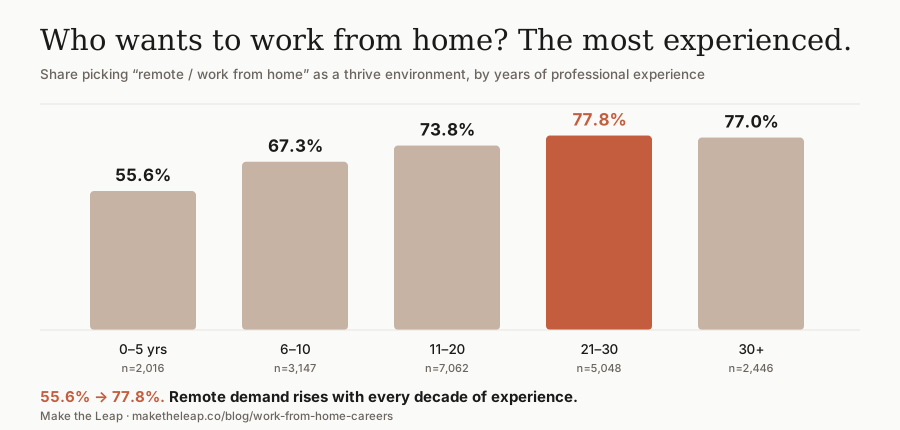
- Demand rises with experience: 55.6% at 0-5 years of experience up to 77.8% at 21-30. The “juniors want WFH” story is backwards.
- It rises with income need too: 64.5% among people needing under $40K, 76.2% among those needing $120-175K. Remote is not a low-earner preference.
- The #1 matched WFH career is operations coordinator (319 matches, $50K-$65K starting) - not customer service, not data entry.
- No pay penalty in the matches: remote-titled paths carry a median starting midpoint of $66K vs $63K across all paths.
Remote is the most-wanted work environment. Not close.
Our assessment asks “What kind of work environment do you thrive in?” with eight options and up to five picks. Across 24,265 completed assessments, 70.6% chose “remote / work from home” (95% CI [70.0, 71.2]) - more than any other option. Small team is second at 64.8%. Mission-driven work, the thing career-change advice talks about most, sits at 52.0%. Large organizations come last at 14.3%.
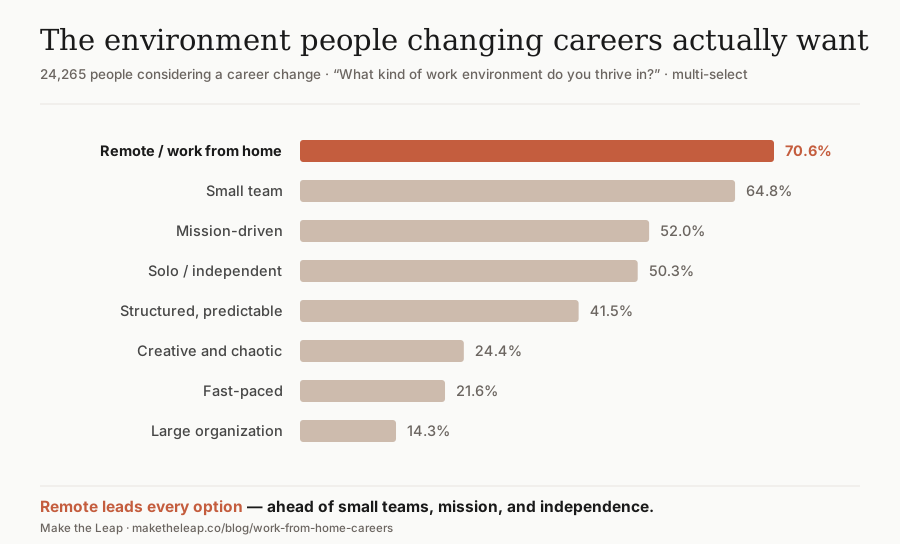
Because the question is multi-select, this isn't “remote versus everything” - it's remote alongside everything. People want a small, mission-driven team they can work with from home. But when seven in ten people considering a career change name the same environment, that environment stops being a perk and becomes a filter: careers that can't be done remotely start every conversation at a disadvantage.
The most experienced want it most
The stereotype says work-from-home is a young-employee demand that fades as people mature into leadership. Our data says the opposite, cleanly and monotonically:
| Experience | Prefer remote | Sample |
|---|---|---|
| 0-5 years | 55.6% | n=2,016 |
| 6-10 years | 67.3% | n=3,147 |
| 11-20 years | 73.8% | n=7,062 |
| 21-30 years | 77.8% | n=5,048 |
| 30+ years | 77.0% | n=2,446 |
A 22-point climb from the newest workers to the most seasoned. It makes sense once you stop assuming remote is about pajamas: someone 25 years into a career has nothing left to prove by being visible in an office, and usually has the most life built around not commuting to one - kids, parents, a place they chose on purpose. If you're over 45 and feel a little sheepish about wanting remote work, the data's answer is that you're the majority of your cohort, not the exception. (Related: what 15,811 assessments say about being “too old” to change careers.)
Remote is not a low-earner preference
The other lazy story is that remote work is what people accept instead of money. Remote preference rises with the income people say they need:
| Income needed | Prefer remote |
|---|---|
| Under $40K | 64.5% |
| $40-60K | 67.0% |
| $60-90K | 71.3% |
| $90-120K | 74.6% |
| $120-175K | 76.2% |
| $175-250K | 74.4% |
| $250K+ | 68.4% |
People who need $120-175K choose remote at 76.2% versus 64.5% among those needing under $40K. And in the matches themselves there is no remote discount: across 6,481 remote-titled paths, the median starting-range midpoint is $66K, slightly above the $63K median across all 72,747 paths. These are starting ranges shown to career changers, not market salary surveys - but the direction is the opposite of a pay cut.
The work-from-home careers people actually get matched to
This is the part no editorial list can copy. When our engine generates three career paths for a real person - built from their experience, constraints, and income floor - some paths come back explicitly remote. Counting across all 72,747 generated paths, 6,481 (8.9%) are remote-titled. Here are the careers that recur most, with the median starting range real users were shown:
| Matched WFH career | Matches | Typical starting range |
|---|---|---|
| Operations coordinator | 319× | $50K-$65K |
| Operations manager | 121× | $75K-$100K |
| Customer / client success manager* | 70× | $65K-$85K |
| Operations analyst | 64× | $70K-$90K |
| Bookkeeper | 59× | $42K-$58K |
| Content writer | 53× | $45K-$62K |
| Course creator | 51× | $15K-$45K |
| Instructional designer | 48× | $65K-$85K |
| Operations consultant | 43× | $70K-$95K |
| Executive assistant | 34× | $50K-$65K |
| Learning experience designer | 32× | $72K-$95K |
| Project coordinator | 30× | $55K-$72K |
| Data analyst | 28× | $55K-$70K |
| Technical writer | 27× | $62K-$80K |
*Customer success manager (35) and client success manager (35) merged - same role, two titles. Ranges are medians of the starting ranges shown in real matches.
Sorted by pay instead of frequency, the highest-paying matched WFH careers in the data are operations manager ($75K-$100K starting), learning experience designer ($72K-$95K), operations consultant ($70K-$95K), and operations analyst ($70K-$90K) - same table, different lens, and still the operations family on top.
Look at the top of that table: operations coordinator, operations manager, operations analyst, operations consultant. The most-matched work-from-home career family, by a wide margin, is operations - keeping work organized, processes running, and people unblocked. That's the finding that should reshape how you read every other WFH list: the stereotype careers (customer service, data entry, transcription) barely appear, because for people with real work history, the transferable skill isn't answering phones - it's running things. If your background involves coordinating anything - a store, a classroom, a caseload, a household - that is the lane the data points to first.
No bachelor's degree? The list barely changes.
Among the 6,036 people in our sample without a bachelor's - high school, some college, or trade backgrounds - the most-matched remote careers are nearly the same:
| Matched WFH career (no bachelor's) | Matches | Typical starting range |
|---|---|---|
| Operations coordinator | 144× | $50K-$65K |
| Operations manager | 37× | $72K-$95K |
| Bookkeeper | 34× | $45K-$60K |
| Executive assistant | 24× | $50K-$65K |
| Operations analyst | 17× | $70K-$90K |
| Content writer | 17× | $45K-$60K |
| Course creator | 15× | $20K-$45K |
| Operations consultant | 13× | $60K-$90K |
Operations coordinator leads here too, at the same $50K-$65K starting range. The degree changes the on-ramp story an applicant tells, not the destination the matching lands on - which is consistent with what these roles actually reward: organization, follow-through, and clear writing. If that's your background, the free assessment weighs it the same way it weighed these 6,036 - three named paths, starting ranges, about 10 minutes.
What to do with this
If remote is your filter, you're in the 70% - and the useful move isn't scrolling job boards, it's figuring out which of these careers your actual background maps to. That's a matching problem, not a browsing problem. Our free assessment reads your experience, constraints, and income floor and returns three named paths with starting ranges - the same engine every number in this article came from. And if you're weighing what you want from work more broadly, the companion study on the happiest jobs by career-fit and our career change statistics are built from the same corpus. And if your version of remote is working for yourself, the companion study on the side businesses people actually plan and match to covers the venture half of the same engine.
FAQ
What is the most common work-from-home career?
In our data, operations roles - by a wide margin. Across 72,747 career paths generated for 24,265 real people, the single most-matched remote career is operations coordinator (319 matches, typical starting range $50K-$65K), and the operations family as a whole - coordinator, manager, analyst, consultant - dominates the remote list. That runs against the stereotype that work-from-home means customer service or data entry: the careers people actually get matched to are coordination and process roles that transfer from almost any industry.
What percentage of people want to work from home?
Among people actively considering a career change, 70.6% pick 'remote / work from home' as an environment they thrive in - the highest of all eight options we offer, ahead of small teams (64.8%), mission-driven work (52.0%), and working solo (50.3%). The question is multi-select, so people choose remote alongside other preferences, not instead of them. Sample: 24,265 completed assessments through August 2026.
Do work-from-home jobs pay less?
Not in our matching data. Across 6,481 remote-titled career paths, the median starting range midpoint is $66K - slightly above the $63K median across all 72,747 paths. That reflects the kinds of careers that suit remote work (operations, writing, instructional design, analysis) rather than a remote premium, and these are starting ranges for career changers, not market-wide salary statistics. But the direction is clear: choosing remote does not mean accepting a pay cut.
Who actually wants remote work - younger or older workers?
The most experienced want it most, and it isn't close. Remote preference rises with every experience band: 55.6% at 0-5 years, 67.3% at 6-10, 73.8% at 11-20, and 77.8% at 21-30 years of experience. The popular story - that work-from-home is a junior-employee demand - is backwards in our data. People with two or three decades of experience have the least to prove in an office and the most life built around not commuting to one.
What work-from-home careers can you get without a degree?
Among the 6,036 assessment takers in our sample without a bachelor's degree, the most-matched remote careers are operations coordinator (144 matches, $50K-$65K starting), operations manager ($72K-$95K), bookkeeper ($45K-$60K), executive assistant ($50K-$65K), and content writer ($45K-$60K). These are matches our engine made against real experience - retail management, admin work, trades - not aspirational lists. The common thread: organizing work and clear communication matter more than credentials in these roles.
What are the highest-paying work-from-home careers?
In our matching data, the highest-paying frequently-matched remote careers are operations manager ($75K-$100K typical starting range), learning experience designer ($72K-$95K), operations consultant ($70K-$95K), and operations analyst ($70K-$90K). These are median starting ranges shown to real career changers in their matches - senior versions of these roles go higher. Note what isn't on the list: none of them are the gig-style roles most WFH lists lead with. The better-paying remote work is coordination, consulting, and instructional design.
How do I find which work-from-home career fits me?
A list can only show you the field - it can't weigh your experience, your income floor, or what you're running from in your current work. That's what our free assessment does: 30 questions about your actual situation, read as written, returning three named career paths with starting income ranges checked against what you said you need. The remote careers in this article all came out of that engine. We build it, so weigh the bias - but the result is free and takes about 10 minutes.
Find your three paths
30 questions about your actual situation - read as written, not scored into buckets - and you get three named career paths with starting income ranges checked against what you need. Free, about 10 minutes, and if remote matters to you, say so: the engine listens.
Take the free assessment
Written by Jon Miksis - entrepreneur, retreat facilitator, and founder of Make the Leap. Jon has facilitated 6 immersive retreat experiences, attended 18 retreats across four continents, and spent 5+ years researching why smart, capable people stay stuck. He's traveled to 73 countries and invested over $120,000 in personal development. Guides on this site are built from Make the Leap's assessment data and reviewed by Jon; the methodology and its limits are published here.