August 23, 2026 · 9 min read
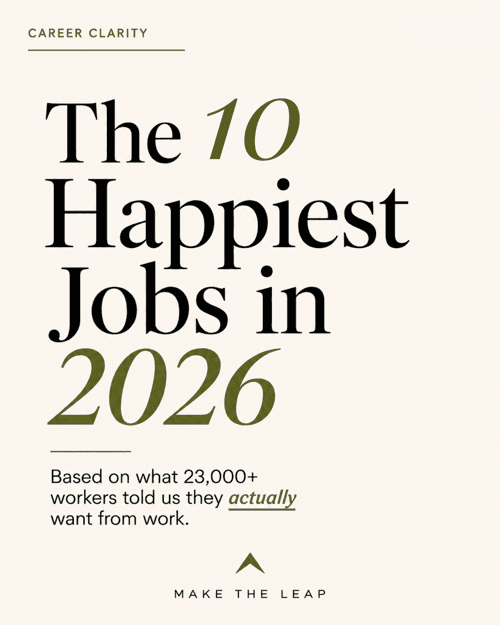
The 10 Happiest Jobs in 2026, Based on 23,000+ Career Assessments
By Jon Miksis, founder of Make the Leap
We analyzed what 23,000+ people exploring a career change consistently want more of from work, then ranked the roles that best combine those wants: autonomy, meaningful work, real use of your strengths, flexibility, growth, and solid earning potential. It is why this list looks different from the usual “best jobs” rankings - career happiness is rarely about having an easy job.
What are the happiest jobs in 2026?
Based on our analysis of more than 23,000 career assessments, the roles that best matched what people want more of from work were Leadership Development Consultant, Learning Experience Designer, Executive Coach, and Independent Operations Consultant - followed by six more below. The strongest roles combined autonomy, meaningful work, use of natural strengths, flexibility, growth, and strong earning potential. This is a career-fit ranking built from what assessment takers say they want from their next chapter - not a satisfaction survey of people currently working in these occupations.
How this ranking works: the primary evidence is what 23,000+ assessment takers say they want more of from work - autonomy, meaning, strengths use, flexibility, growth, earning potential. As a secondary signal, we looked at which career-path themes recur in the personalized results our assessment generates (consulting and fractional work appears in roughly a third of path sets) - secondary because those paths are partly a product of our own system, not independent evidence. The final ranking of ten named roles is editorial: our read of which real jobs best combine the qualities the data surfaces.
What it is not: a measured happiness score, or a satisfaction survey of people currently in these jobs. Our takers are people actively rethinking their careers - a self-selected group - and this list is where their stated wants point. Full numbers live in our research hub.
The list at a glance
- Leadership Development Consultant
- Learning Experience Designer
- Executive Coach
- Independent Operations Consultant
- Product Strategy / Innovation Manager
- Fractional CFO
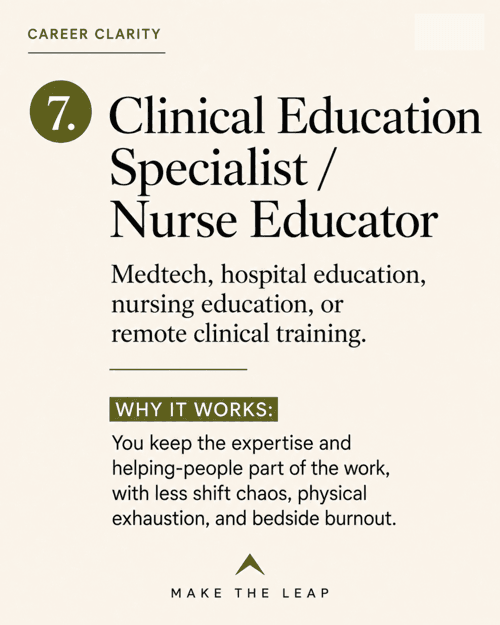
- Clinical Education Specialist / Nurse Educator
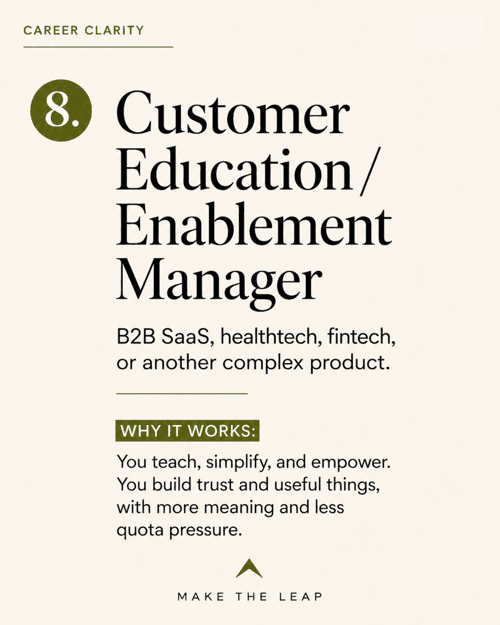
- Customer Education / Enablement Manager
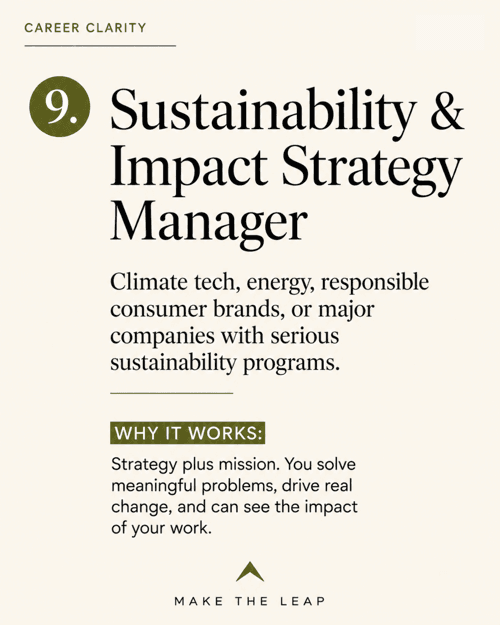
- Sustainability & Impact Strategy Manager
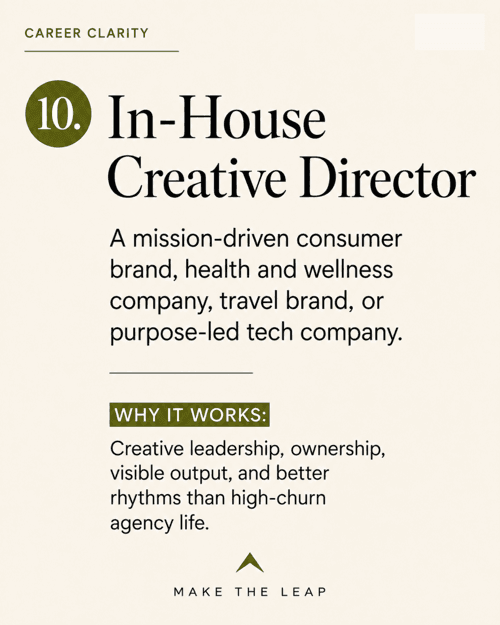
- In-House Creative Director
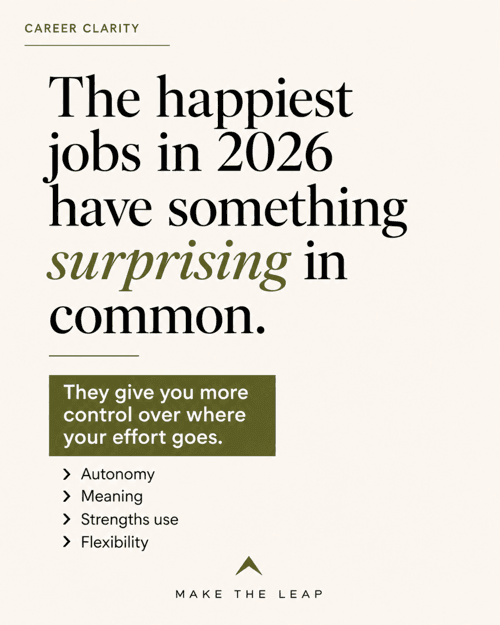
Different industries, very different day-to-day - but every one of them gives you more control over where your effort goes.
The carousel
Swipe through the full ranking (also on our TikTok):
12 slides · swipe or scroll →
Why these ten - the pattern underneath
Good pay cannot fully compensate for work that drains you, wastes your strengths, or leaves you disconnected from your own life. That is not a platitude in our data - it is the shape of it: burnout is the single most common pain pushing people toward a change, named by roughly half of everyone we assess, and it shows up at every income level. The roles below win because they move the five levers our takers keep naming: autonomy, meaning, strengths use, flexibility, and growth with real earning potential.
What independent research says about work satisfaction
Our framework lines up with what outside research keeps finding. Pew Research Center reports that only about half of U.S. workers are highly satisfied with their jobs overall - and that pay and promotion opportunities draw the lowest satisfaction of any aspect measured, while schedule flexibility draws among the highest. Pew has also found that self-employed workers report notably higher satisfaction than employees - the autonomy effect, visible at national scale. And a 2025 Gallup survey of 4,475 U.S. workers found that employees with a strong sense of purpose at work were 5.6 times as likely to be engaged, and markedly less likely to be burned out or job hunting. That outside research is a big part of why we weighted autonomy, meaning, and fit alongside earning potential - rather than ranking jobs by salary alone.
- Pew Research Center - Americans' Job Satisfaction (Dec 2024)
- Pew Research Center - How Americans View Their Jobs (2023)
- Gallup - Purposeful Work Boosts Engagement (2025)
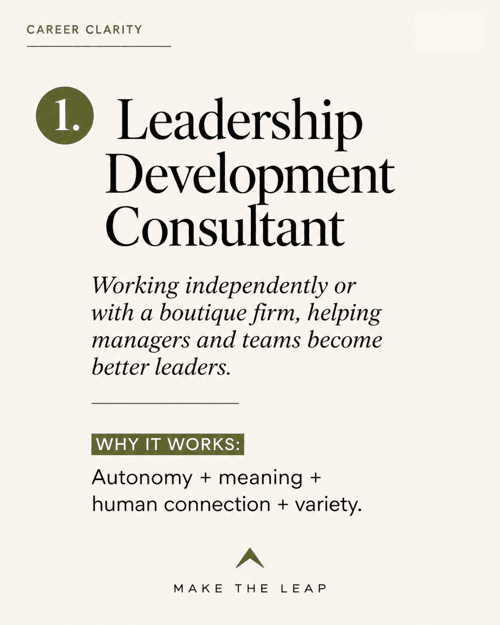
1. Leadership Development Consultant
Working independently or with a boutique firm, helping managers and teams become better leaders.
Why it works: Autonomy, meaning, human connection, and variety - the four wants our data surfaces most, in one role.
Common on-ramps: HR and L&D backgrounds, experienced people-managers, teachers and facilitators who are good in a room.
Also called: organizational development consultant, leadership consultant.
Reality check: The autonomy is real - and so is business development. Stakeholder politics and pipeline pressure can replace some of the corporate frustrations you left.
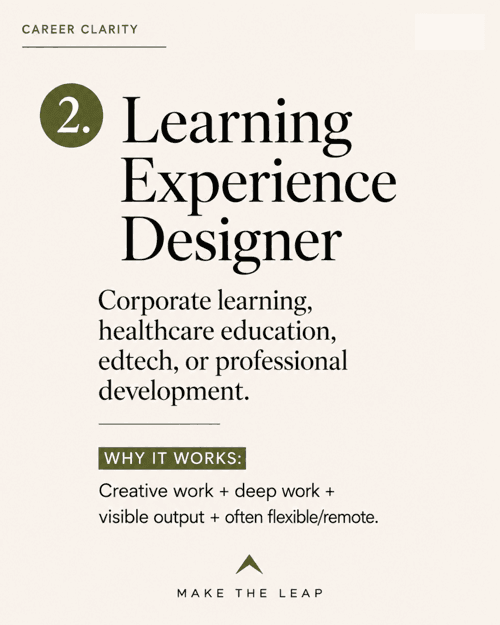
2. Learning Experience Designer
Designing corporate learning, healthcare education, edtech, or professional development.
Why it works: Creative work plus deep work, with visible output - and it is one of the most flexible, remote-friendly roles on this list.
Common on-ramps: teachers, trainers, instructional writers, and anyone who has ever made a complicated thing learnable.
Often overlaps with instructional designer and L&D roles.
Reality check: In-house roles can drift toward compliance-training volume - the creative depth depends heavily on where you land.
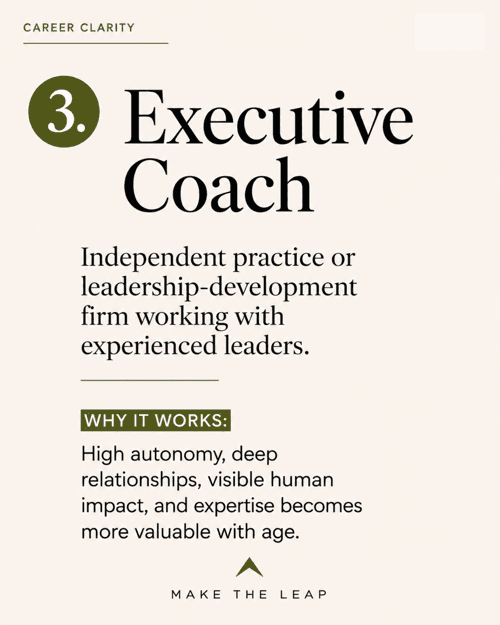
3. Executive Coach
An independent practice or a leadership-development firm, working with experienced leaders.
Why it works: High autonomy, deep relationships, visible human impact - and expertise that becomes more valuable with age, not less.
Common on-ramps: senior operators and managers who keep getting told they are the person people come to.
Reality check: Deeply meaningful work, but reputation and a consistent client pipeline take real time to build - and income is lumpy early.
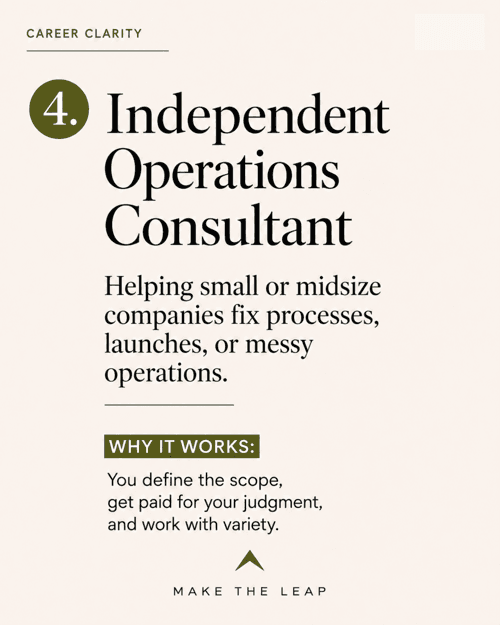
4. Independent Operations Consultant
Helping small and midsize companies fix processes, launches, or messy operations.
Why it works: You define the scope, you get paid for judgment rather than hours in a chair, and every engagement is different.
Common on-ramps: operations managers, project managers, chiefs of staff - the people who quietly run things.
Reality check: You are also the sales team. Scope creep and feast-or-famine months are the tax on the freedom.
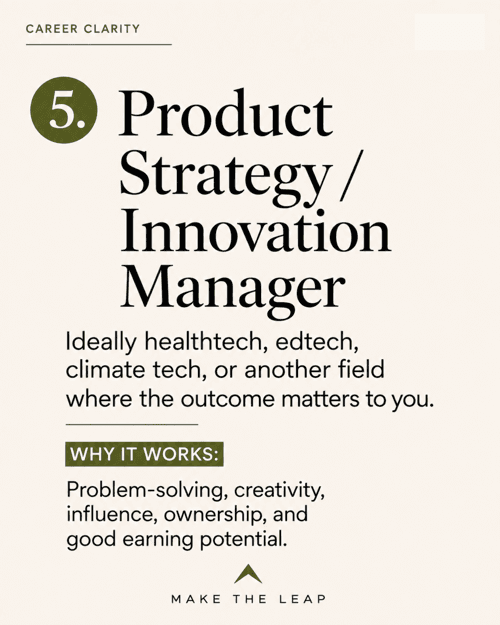
5. Product Strategy / Innovation Manager
Ideally in healthtech, edtech, climate tech, or another field where the outcome matters to you.
Why it works: Problem-solving, creativity, influence, and ownership - with some of the best earning potential on this list.
Common on-ramps: product people wanting mission, and domain experts (clinicians, educators) crossing into product.
Reality check: Ownership means accountability for outcomes you only partly control - and mission-driven sectors can pay below big tech.
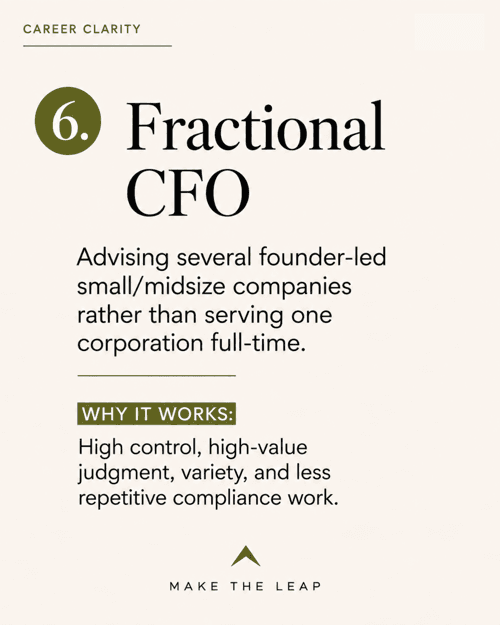
6. Fractional CFO
Advising several founder-led small and midsize companies rather than serving one corporation full-time.
Why it works: High control, high-value judgment, real variety - and far less of the repetitive compliance work that burns finance people out.
Common on-ramps: controllers, finance directors, and accountants who like the advising more than the closing.
Also called: part-time CFO, outsourced finance leader.
Reality check: Client acquisition, variable workload, and responsibility for high-stakes financial decisions across several companies at once are not for everyone.
7. Clinical Education Specialist / Nurse Educator
Medtech, hospital education, nursing education, or remote clinical training.
Why it works: You keep the expertise and the helping-people part of the work, with less shift chaos, physical exhaustion, and bedside burnout.
Common on-ramps: nurses and clinicians - this is the single most recurring exit our healthcare takers are pointed toward.
Related titles: clinical educator, clinical training specialist.
Reality check: Less bedside chaos, but you trade some patient contact for curriculum and administration - and medtech roles can travel heavily.
8. Customer Education / Enablement Manager
B2B SaaS, healthtech, fintech, or another complex product.
Why it works: You teach, simplify, and empower. You build trust and useful things - with more meaning and less quota pressure than sales.
Common on-ramps: customer success, sales engineers, support leads, and teachers moving into tech.
Related titles: customer enablement manager, customer training manager.
Reality check: Less quota pressure does not mean no metrics - adoption and renewal numbers still land on you.
9. Sustainability & Impact Strategy Manager
Climate tech, energy, responsible consumer brands, or major companies with serious sustainability programs.
Why it works: Strategy plus mission: you solve meaningful problems, drive real change, and can see the impact of your work.
Common on-ramps: strategists, analysts, and operators who want the spreadsheet to matter.
Reality check: In weaker programs the role drifts toward reporting and box-checking rather than real change - vet the mandate before you leap.
10. In-House Creative Director
A mission-driven consumer brand, health and wellness company, travel brand, or purpose-led tech company.
Why it works: Creative leadership, ownership, visible output, and better rhythms than high-churn agency life.
Common on-ramps: senior designers, brand marketers, and agency creatives ready to own one brand deeply.
Reality check: Better rhythms than agency life, but you own one brand's taste - and leadership means more meetings, less making.
Which one is yours?
Pay attention to the role that made you think, “wait, why does that sound interesting?” That reaction is usually worth following - and it is exactly what our free assessment is built to test. It reads your actual answers - your skills, constraints, and what you want more of - and returns three named paths with honest income ranges. Several of the roles on this list exist in it because the assessment kept pointing real people toward them.
Find your three paths - free.
About ten minutes. 28,000+ taken. No account needed.
Take the free assessmentJoin the conversation
This ranking started as a Make the Leap carousel on TikTok:
@maketheleapco The 10 Happiest Jobs in 2026, according to 23,000+ workers.
Frequently asked questions
What is the happiest job in 2026?
In our data-derived ranking, Leadership Development Consultant comes out strongest - it combines the four things assessment takers most consistently say they want: autonomy, meaning, human connection, and variety. But the honest answer is that the happiest job is the one that matches YOUR drivers. The pattern behind all ten roles matters more than any single title: control over where your effort goes.
How was this ranking determined?
We analyzed patterns across 23,000+ completed career assessments: what people consistently say they want more of (autonomy, meaning, use of strengths, flexibility, growth and earning potential) and which path themes their personalized results cluster into. It is not a satisfaction survey of people currently in these jobs, and it is not government data - it is what a large population actively rethinking their careers is reaching toward, scored against the drivers they name.
Do the happiest jobs pay less?
Not on this list - that is partly the point. Several of these roles (fractional CFO, product strategy, executive coaching, consulting) carry some of the strongest earning potential our path data generates. The trade-off that matters in our data is not money versus happiness; it is task-shaped work versus judgment-shaped work. Judgment work tends to pay better AND feel better.
How do I move into one of these without starting over?
Every role on this list is an experience-forward move: the common on-ramps are careers people already have - nurses into clinical education, ops managers into consulting, finance leads into fractional CFO work. The move is repositioning what you already know, not starting from zero. Our free assessment maps which of your specific strengths carry, and returns three named paths with income ranges.
What actually makes a job a 'happy' job?
Across our corpus, the recurring drivers are autonomy (control over how you work), meaning (seeing the impact), strengths use (doing what you are unusually good at), flexibility, and growth. The absence pattern is just as consistent: burnout is the single most common pain pushing people to change, named by about half of our takers - and burnout is usually an autonomy-and-meaning deficit, not a workload number.
Related: career change ideas grounded in the same data, what 23,000+ workers say about AI risk, and the four moats of AI-durable work, and the work-from-home careers people actually match to.

Written by Jon Miksis - entrepreneur, retreat facilitator, and founder of Make the Leap. Jon has facilitated 6 immersive retreat experiences, attended 18 retreats across four continents, and spent 5+ years researching why smart, capable people stay stuck. He's traveled to 73 countries and invested over $120,000 in personal development. Guides on this site are built from Make the Leap's assessment data and reviewed by Jon; the methodology and its limits are published here.