August 25, 2026 · 8 min read
71% Have Been Thinking About a Career Change for Over a Year
By Jon Miksis, founder of Make the Leap
We looked at how long 23,596 people had been considering a career change before they sat down to take a career assessment. Most had been thinking about it far longer than they expected to be - and what happens during all that waiting is the part worth sitting with.
Is it normal to think about a career change for years?
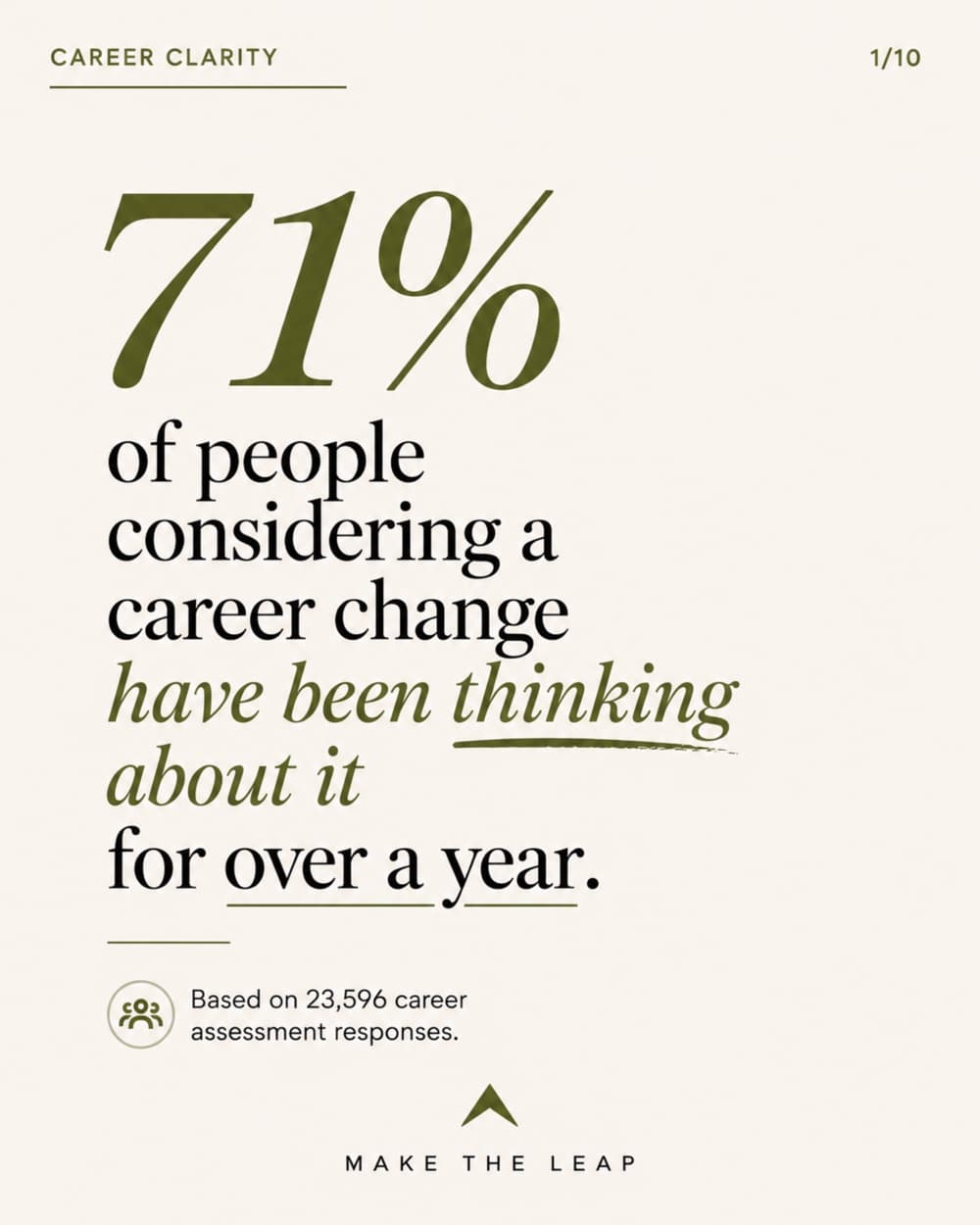
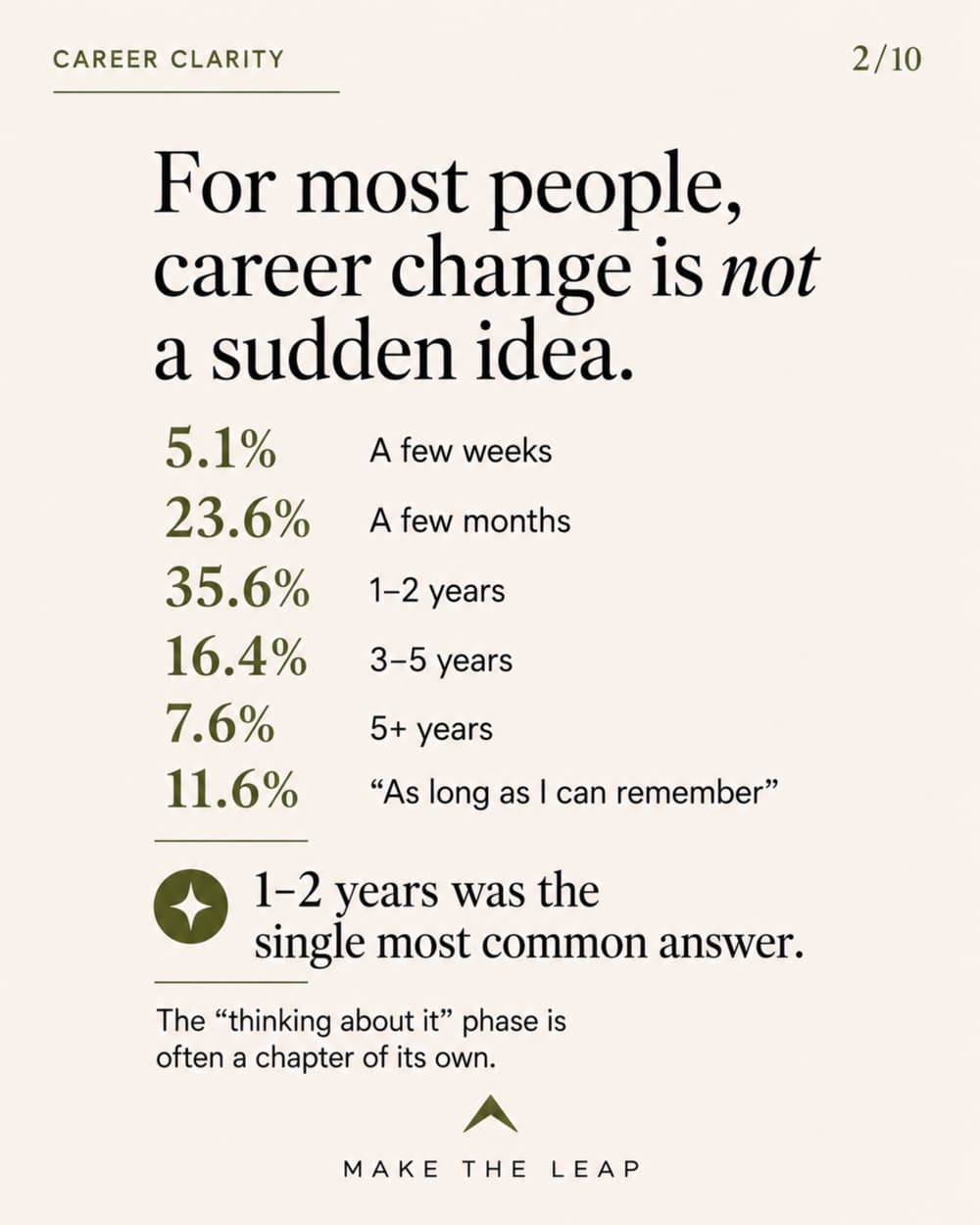
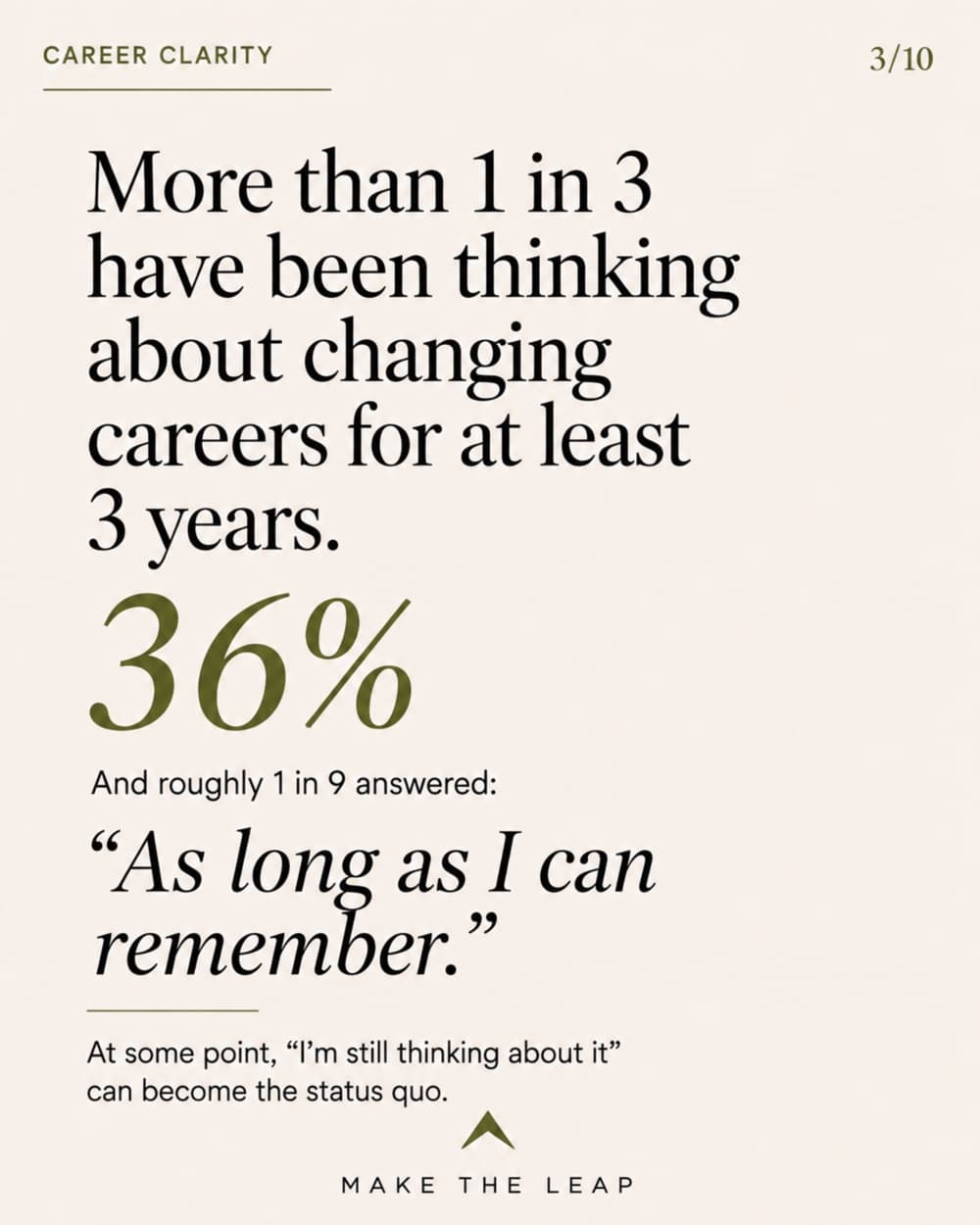
Yes - by a wide margin it is the norm, not the exception. Across 23,596 career assessment responses, 71% of people considering a career change had been thinking about it for more than a year. The most common single answer was 1–2 years (35.6%). More than a third (35.7%) had been thinking for at least three years, and 11.6% chose “as long as I can remember.” Only 5.1% were in their first few weeks. These are direct answers to one question - “How long have you been thinking about a career change?” - from people who had just decided to do something about it. If you have been circling this for years, you are in the majority of a very large room.
About this data: every figure on this page is a direct response to a multiple-choice question in the free Make the Leap career assessment - no modeling, no clustering, no editorial ranking. The population is 23,596 people who completed the assessment and answered the deliberation-length question. Where this page compares groups, “newest thinkers” means people who answered “a few weeks” (n=1,218) and “longest thinkers” means people who answered “5+ years” or “as long as I can remember” (n=4,542).
These figures come from an all-time pull. Our frozen Deliberation Study (n=22,252, published August 15, 2026) is the canonical citation for this distribution, and every bucket there sits within 0.2pp of the figures above - the shape holds across 30-day, 90-day, and all-time windows, which is what makes it a trait of this population rather than a snapshot. Cite the study for the distribution; this page adds the cross-tabs it does not cover.
What it is not: a random sample of the workforce. Everyone here is a self-selected person actively rethinking their career, which is exactly what makes the deliberation numbers meaningful and exactly why they should not be read as national statistics. All cross-tabs below are correlational. More of our first-party research lives in the research hub.
The full distribution
| How long have you been thinking about it? | Share | Respondents |
|---|---|---|
| A few weeks | 5.1% | 1,212 |
| A few months | 23.6% | 5,580 |
| 1–2 years most common answer | 35.6% | 8,391 |
| 3–5 years | 16.4% | 3,880 |
| 5+ years | 7.6% | 1,799 |
| “As long as I can remember” | 11.6% | 2,734 |
n = 23,596 valid responses. Percentages are of people who answered this question.
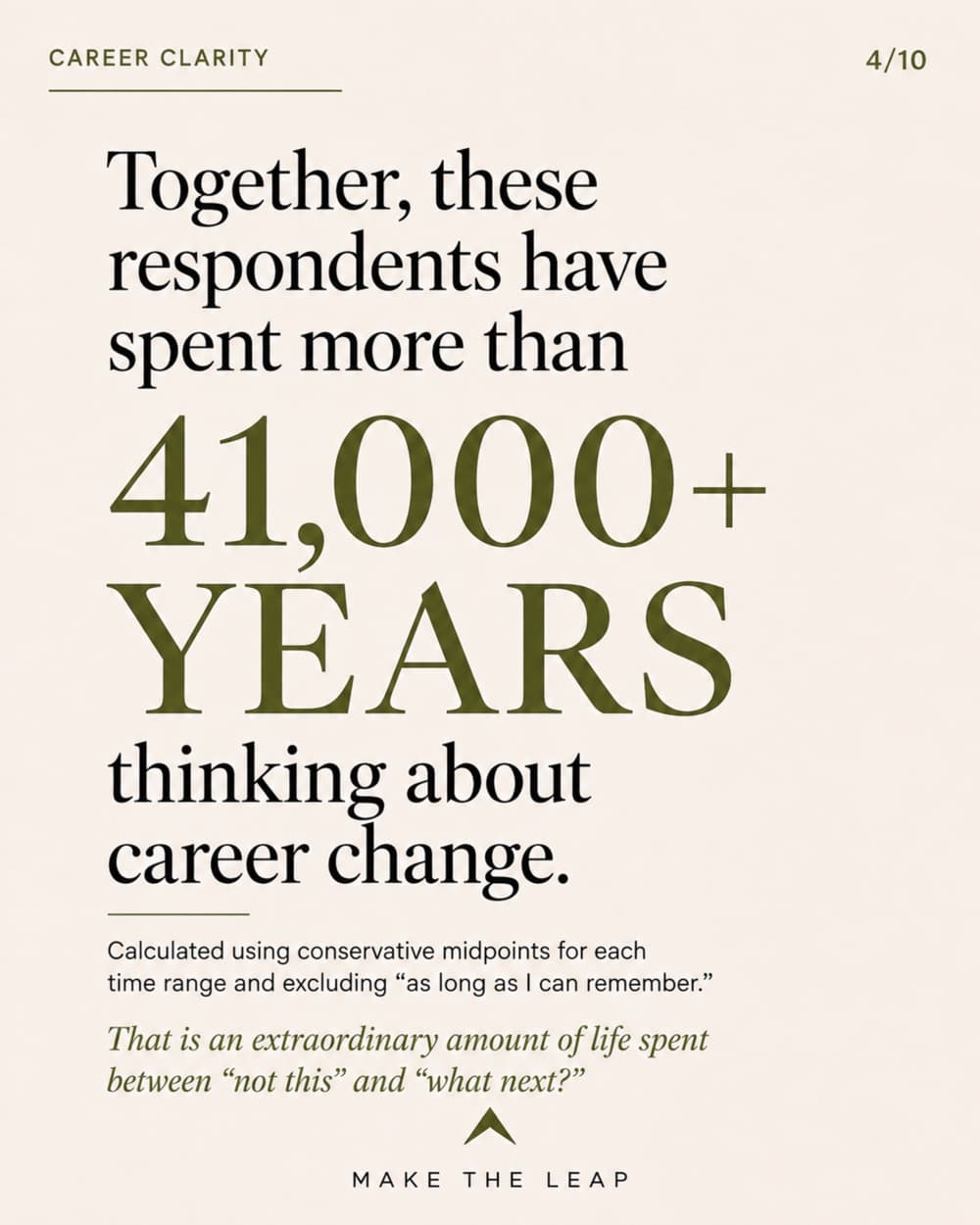
Read the table from the bottom up and the shape becomes clear: the “thinking about it” phase is not a brief prelude to a career change. For most people it is a chapter of its own, measured in years. Adding the ranges up with conservative midpoints - and excluding “as long as I can remember” entirely, because it has no defensible number - the people in this dataset have spent more than 41,000 collective years thinking about changing careers.
The carousel
The full findings, ten slides (also on our TikTok):
10 slides · swipe or scroll →
What people are doing while they wait
The duration on its own would be interesting. What makes it useful is what the same people report about their finances, their fears, and their own self-assessment. Three findings ran against what we expected.
1. The waiting is not buying much runway
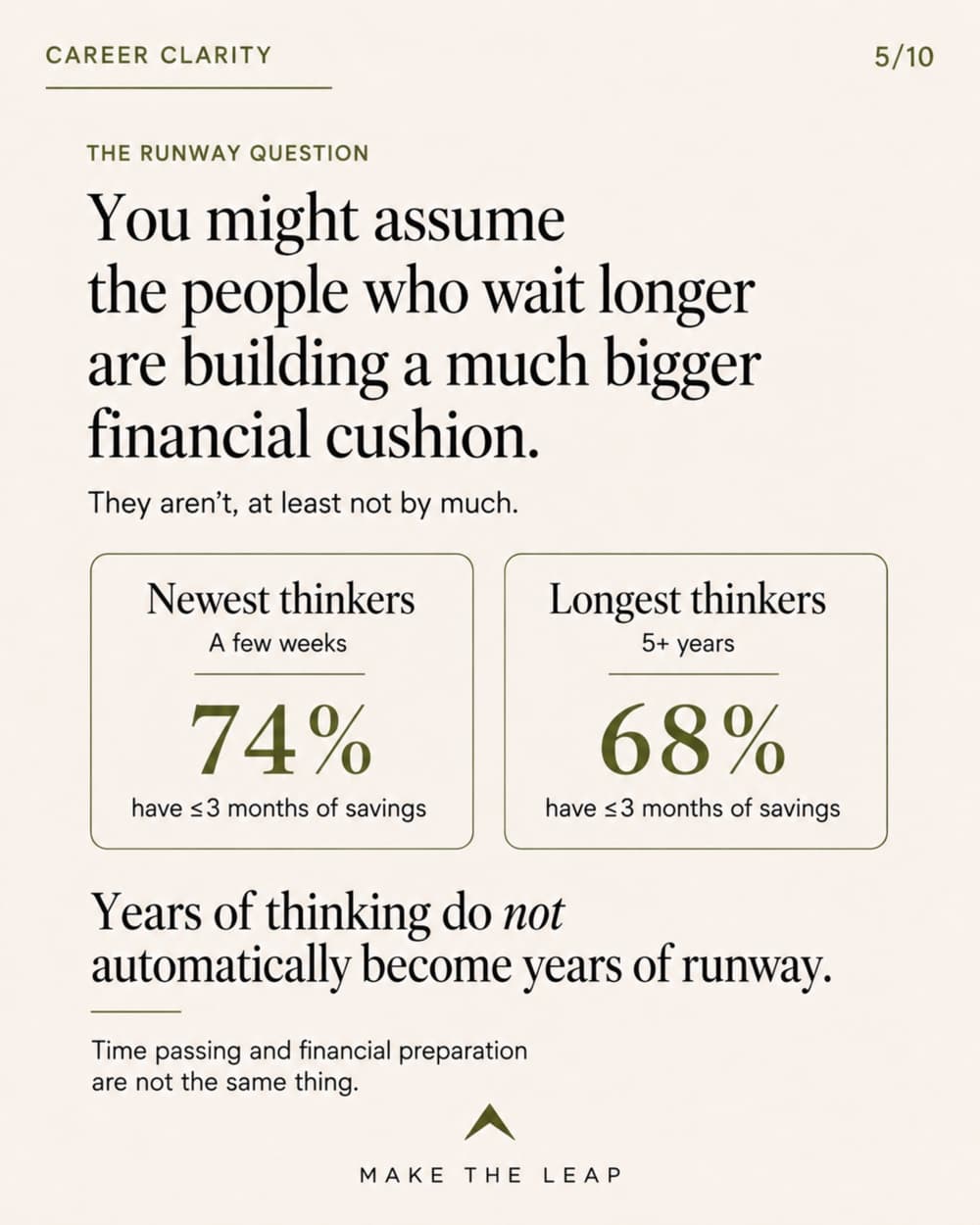
The intuitive story is that people who wait are saving - building the cushion that makes the leap survivable. The data barely supports it. Among people who had been thinking for 5+ years, 67.9% still had three months of savings or less. Among people in their first few weeks of considering it, that figure was 74.4%. A real difference, but a small one - and both groups are overwhelmingly in the same financial position.
The reasonable reading is not that saving is pointless. It is that time passing and financial preparation are two different things. A runway gets built by a plan with a number attached, not by months going by while the question stays open.
2. The doubts do not quiet down on their own
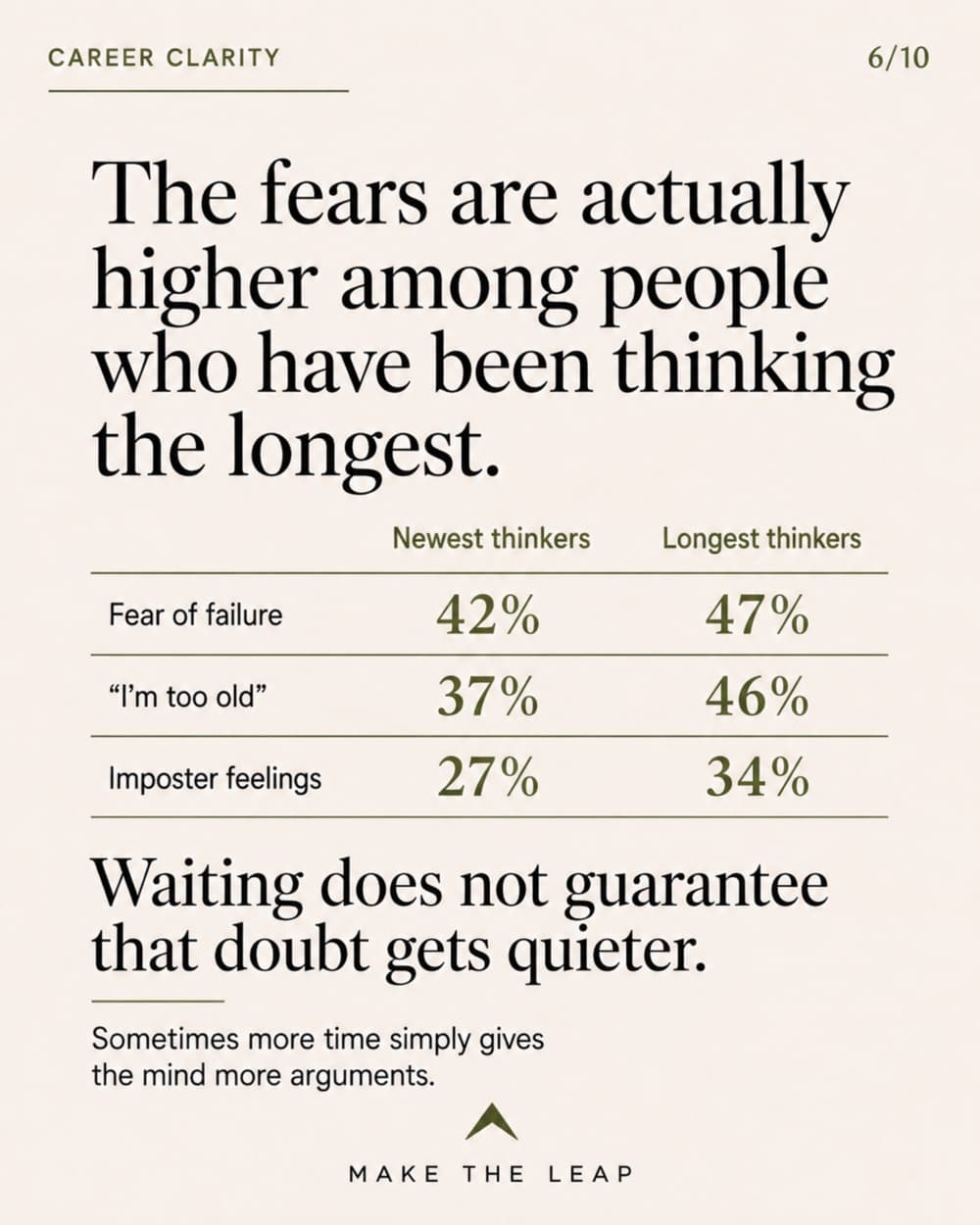
We expected the longest thinkers to be the calmest - the fear worked through, the objections retired. Every blocker we measured moved the other way.
| Named as a blocker | Newest thinkers | Longest thinkers |
|---|---|---|
| Fear of failure | 41.8% | 46.0% |
| “I’m too old to start over” | 37.2% | 44.6% |
| Imposter feelings | 27.3% | 33.9% |
| Don’t know what else to do | 42.4% | 45.4% |
Newest thinkers = “a few weeks” (n=1,218). Longest thinkers = “5+ years” or “as long as I can remember” (n=4,542). Respondents could name more than one blocker.
This is correlational and worth stating plainly: it may be that people who feel more blocked simply deliberate longer, rather than deliberation manufacturing the doubt. Either way, the practical implication holds. If the plan is to wait until the fear settles before acting, this data offers no evidence that the waiting does that work. More time can simply give the mind more arguments.
Each movement in that table is tested formally in Deliberation Without Resolution, the working-paper version of this analysis: Cochran–Armitage trend tests across all six deliberation bands, confidence intervals on every proportion, and the aggregate counts released so anyone can recompute them (DOI 10.5281/zenodo.22103969).
3. It was never a courage problem
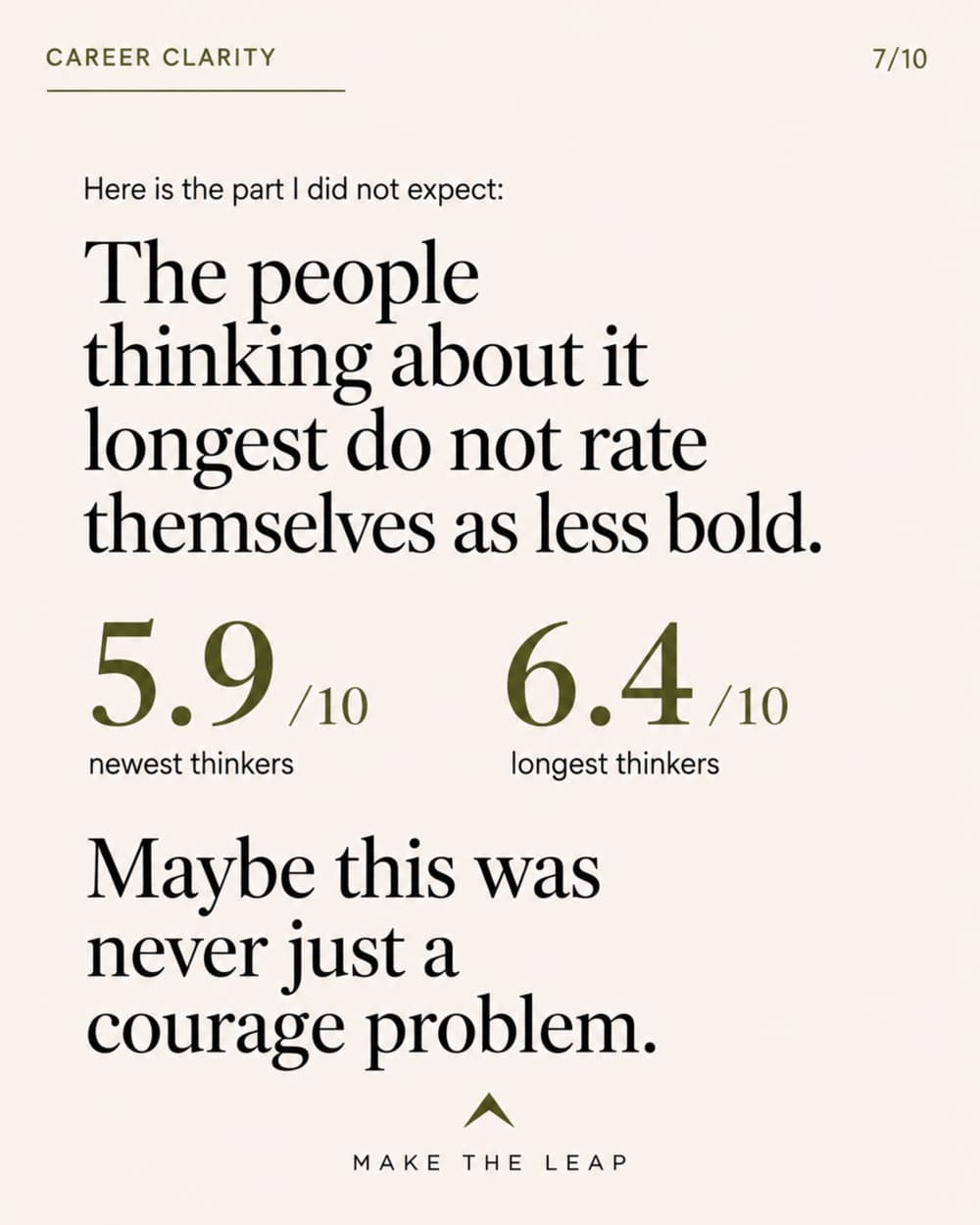
Here is the finding that reframes the rest. We ask people to rate their own boldness from 1 to 10. If long deliberation were fundamentally about timidity, the longest thinkers should score lowest. They score higher: 6.4 out of 10, versus 5.9 for the newest thinkers.
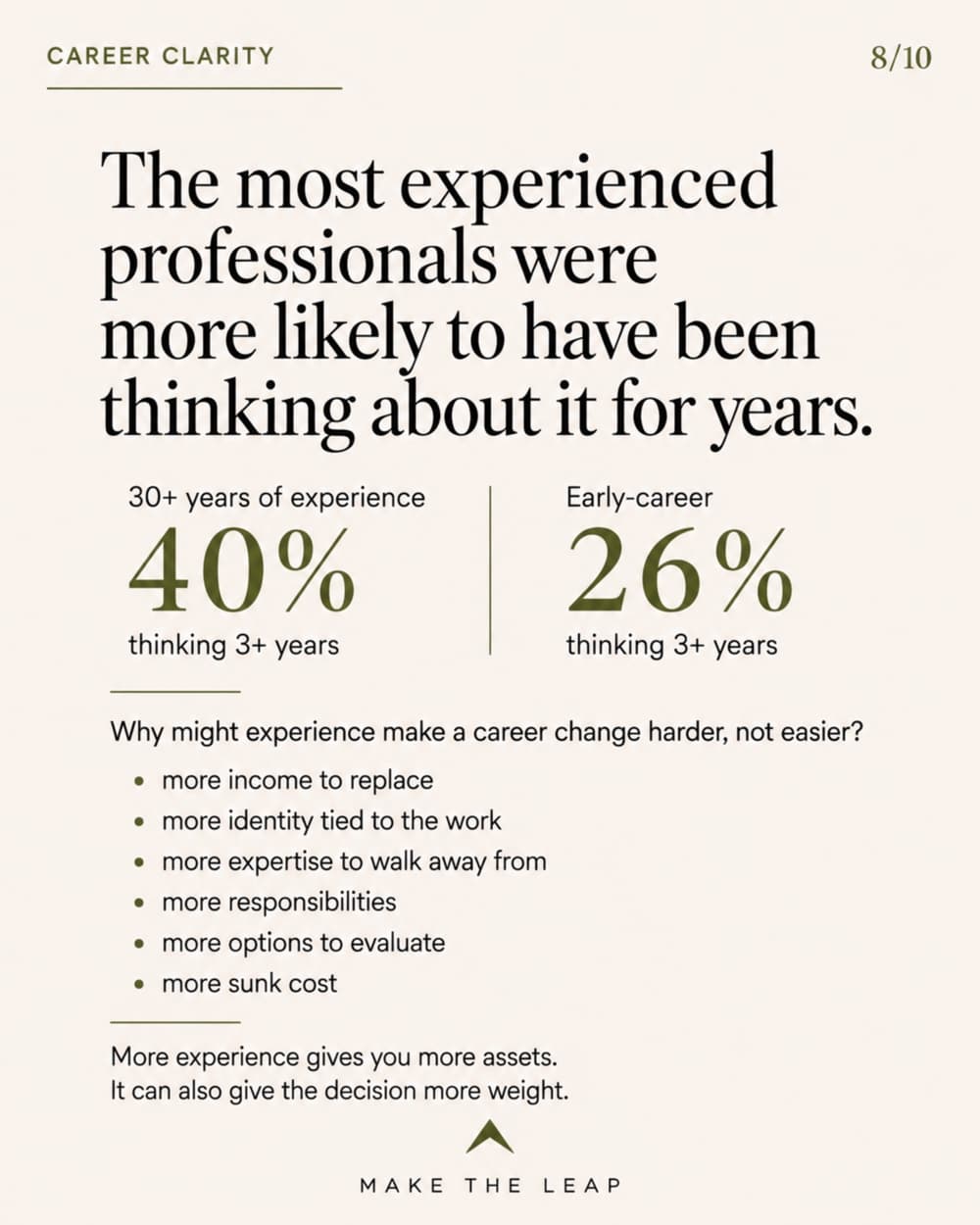
And the pattern by experience points the same direction: 40% of respondents with 30+ years of experience had been thinking for 3+ years, compared with 26% of early-career respondents. The people who wait longest are not the least capable or the least brave. They are the ones with the most at stake - income to replace, expertise built over decades, benefits, identity, dependents, reputation, and the entirely rational fear of an expensive mistake.
That reframe matters, because “be braver” is useless advice for a decision that is genuinely complex. Complexity does not yield to courage. It yields to information.
How many have actually tried
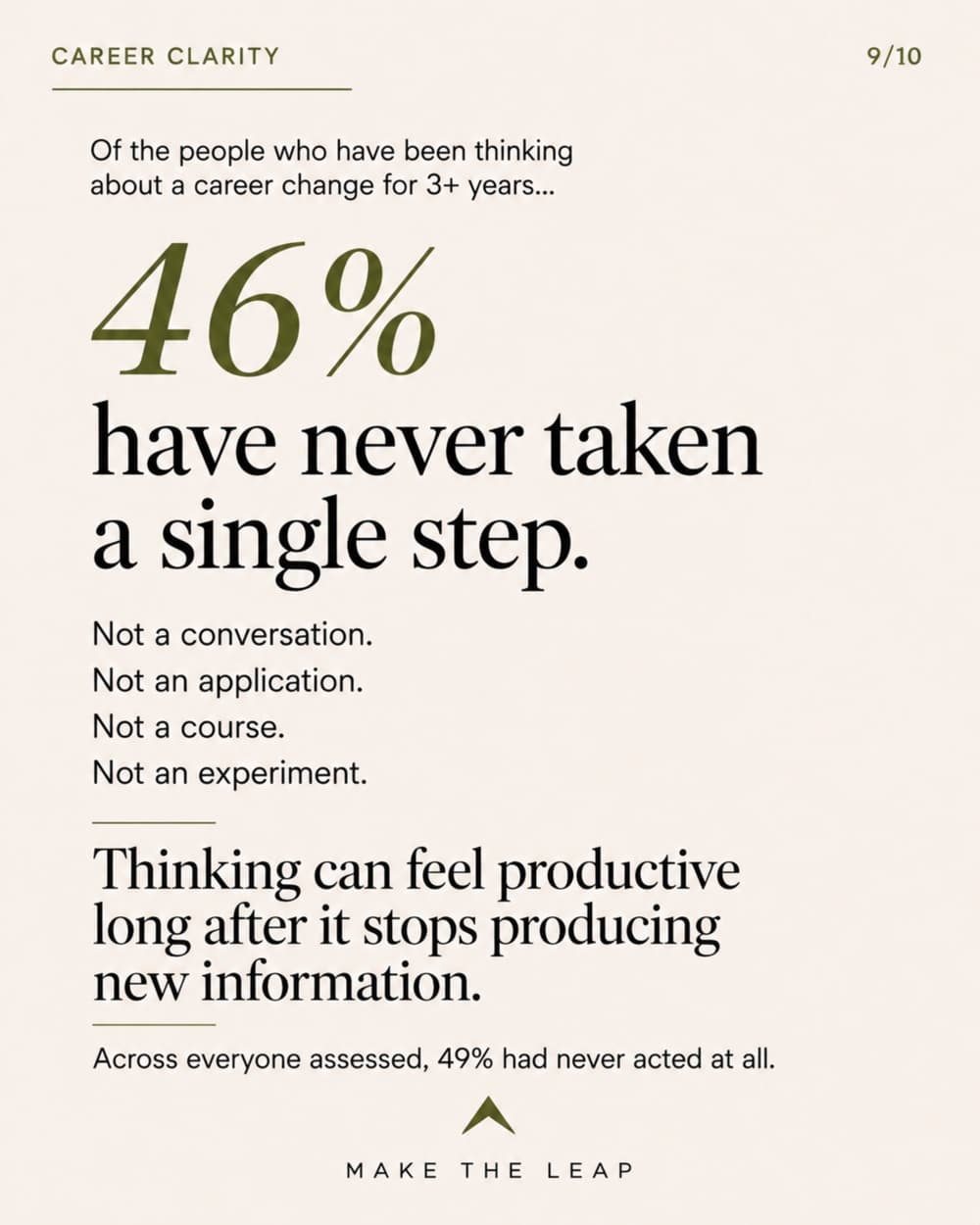
Among people who had been considering a career change for three or more years, 45.9% had never attempted a major career change. Not a previous switch, not a started-and-stopped attempt. Across everyone assessed, 48.7% had never attempted one, and 27.2% had successfully changed careers at some point.
It would be easy to read that as proof that thinking replaces doing - and we should not, because our own data does not support it. That 45.9% is lower than the 48.6% among people who had been thinking for less than a year (a small but statistically real difference). Longer deliberation is not associated with having tried less. There is also a measurement limit worth naming: this question asks whether someone has ever attempted a major career change, not whether they took steps during the deliberation we measured, so it cannot settle what happened inside those years.
What the data does show is different, and more useful: over those years the barriers do not resolve - they sharpen, and they change character. The financial barrier stays flat and complacency falls away, while the doubts about yourself climb steadily. If you have been waiting for the case against moving to weaken on its own, that is the finding to sit with.
What to do instead: a 30-day evidence sprint
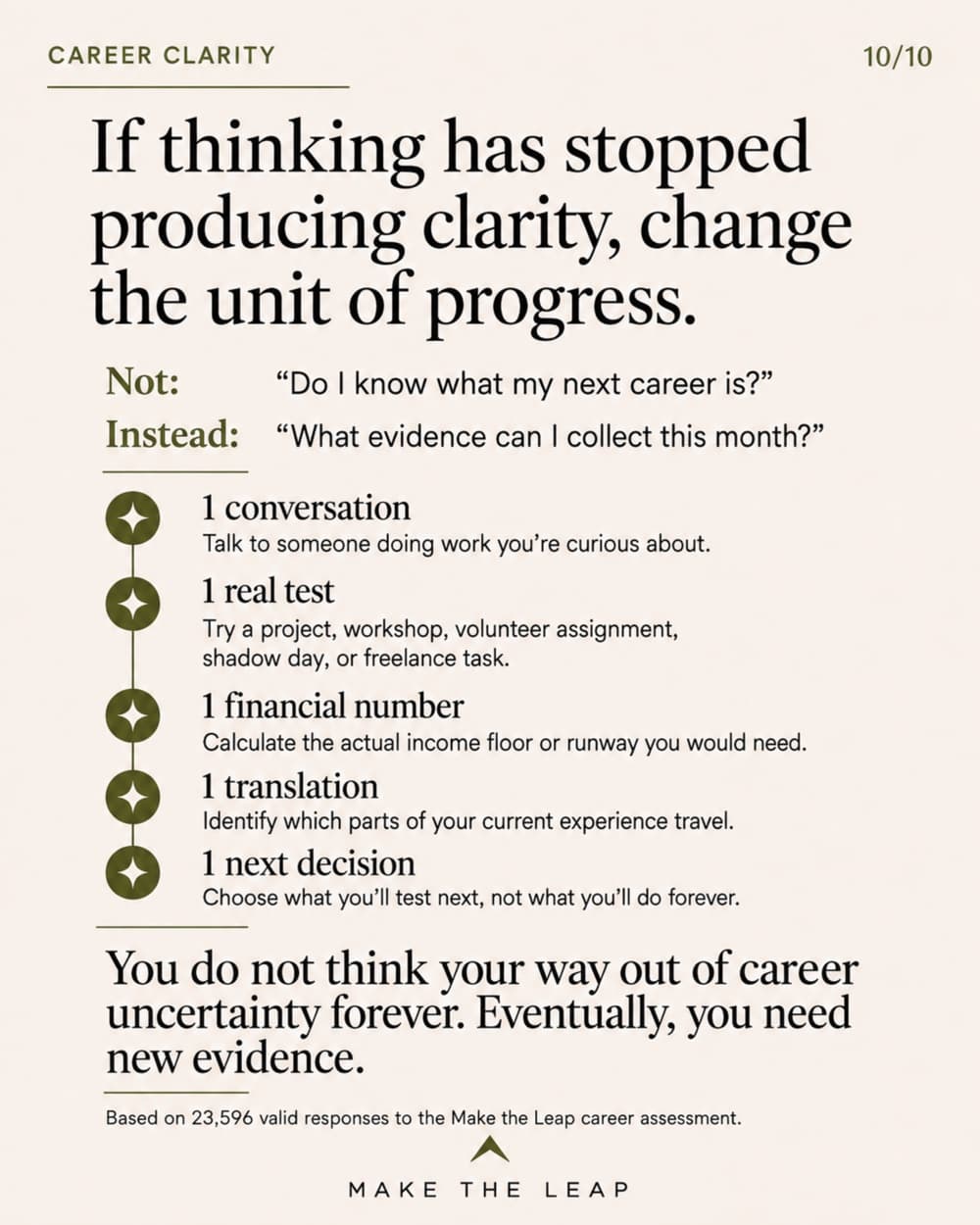
If you have been circling the same question for months or years, the useful move is not to think harder. It is to change what counts as progress. For the next 30 days, stop trying to reach certainty and start trying to collect evidence.
- 1
One conversation
Talk to one person actually doing work you are curious about. Not to ask for a job - to ask what the day is really like, what they wish they had known, and what part of it they would warn you about.
- 2
One real test
A small project, a workshop, a volunteer assignment, a shadow day, a single freelance task. Something that puts you in contact with the work itself rather than the idea of it.
- 3
One financial number
Calculate the actual income floor and runway you would need - not a vague sense that it would be tight. A real number turns an unbounded fear into a solvable constraint.
- 4
One translation
Identify which specific parts of your current experience travel to that work. Most experienced professionals carry far more transferable proof than they credit themselves for.
- 5
One next decision
Choose what you will test next - not what you will do forever. The goal of a sprint is a better next question, not a final answer.
At the end of 30 days, do not ask “do I finally know exactly what I should do?” Ask “what do I know now that I could not have learned by thinking alone?” That is a far better measure of whether a month moved you.
You do not need to manufacture certainty before you move. Often, movement is how the evidence gets created that makes the next decision clear.
Stop circling. Start with three named paths.
Our free assessment reads your actual answers - skills, constraints, what you want more of - and returns three specific career paths with honest income ranges and a first step. About ten minutes. 28,000+ taken.
Take the free assessmentIf any of this sounds like you
The blockers in the table above are not abstractions - each one has a fix that is specific to it. If the number that stopped you was the runway, start with changing careers when you cannot afford to quit. If it was the age question, the data on being “too old” is worth reading before you accept your own verdict. If it was imposter feelings, that pattern has a documented shape. And if you genuinely do not know what else you would do, that is the most common blocker of all - start with ideas grounded in the same dataset.
Join the conversation
These findings started as a Make the Leap carousel on TikTok:
@maketheleapco 71% of people considering a career change have been thinking about it for over a year.
Frequently asked questions
How long do people think about changing careers before they do it?
Across 23,596 career assessment responses, 71% of people considering a career change had been thinking about it for more than a year. The single most common answer was 1–2 years (35.6%). More than a third (35.7%) had been thinking for at least three years, and 11.6% answered “as long as I can remember.” Only 5.1% were in their first few weeks of considering it.
Is it normal to think about a career change for years?
By our data, it is the norm rather than the exception - about 7 in 10 people considering a change have been considering it for over a year, and more than 1 in 3 for three years or longer. The pattern is strongest among experienced professionals: 40% of respondents with 30+ years of experience had been thinking for 3+ years, versus 26% of early-career respondents. Long deliberation is common, and it is not by itself a sign that something is wrong with you.
Does waiting longer mean you will be more financially prepared?
Not by much, in our data. Among people who had been thinking for 5+ years, 67.9% still had three months of savings or less - compared with 74.4% of people in their first few weeks. Time passing and financial preparation are not the same thing. If saving is the plan, it works because it is an actual plan with a number attached, not because months are going by.
Does the fear get easier the longer you think about it?
Our data points the other way. Comparing the newest thinkers (a few weeks) with the longest (5+ years or “as long as I can remember”), fear of failure rose from 41.8% to 46.0%, feeling too old rose from 37.2% to 44.6%, and imposter feelings rose from 27.3% to 33.9%. This is correlational, not causal - people who feel more blocked may simply deliberate longer - but there is no sign in this data that waiting quiets the doubt on its own.
Is a long deliberation a sign you are not brave enough?
The data does not support that framing. The longest thinkers rated their own boldness slightly higher than the newest thinkers (6.4 versus 5.9 out of 10 on a self-rated scale). For experienced professionals, the decision is genuinely complex - income to replace, expertise built over decades, benefits, identity, dependents, and the real risk of an expensive mistake. That complexity, not a courage deficit, is the better explanation for a long deliberation.
Do people who think about it longer end up taking less action?
Not in our data. Among people deliberating three or more years, 45.9% had never attempted a major career change - but that is slightly lower than the 48.6% among people thinking for less than a year, not higher. What does change with deliberation length is the barriers people report: fear of failure, feeling too old, imposter feelings, and doubts about having the right skills all rise significantly, while money stays flat and feeling too comfortable falls. Deliberation is not associated with less action; it is associated with sharper self-doubt.
How do I stop thinking about a career change and actually start?
Change the unit of progress from certainty to evidence. Instead of asking “do I finally know what I should do?”, run a 30-day evidence sprint: one conversation with someone doing the work, one small real test of the work, one calculated income floor, one honest translation of what your current experience is worth elsewhere, and one decision about what you will test next. At the end of 30 days, the question is not whether you feel certain - it is what you now know that thinking alone could never have taught you.
Related reading: the full Deliberation Study, with the frozen distribution, why people stay stuck, in the same dataset, how long a career change actually takes once you start, and the 10 happiest jobs in 2026, and the side businesses people plan for years and never start.

Written by Jon Miksis - entrepreneur, retreat facilitator, and founder of Make the Leap. Jon has facilitated 6 immersive retreat experiences, attended 18 retreats across four continents, and spent 5+ years researching why smart, capable people stay stuck. He's traveled to 73 countries and invested over $120,000 in personal development. Guides on this site are built from Make the Leap's assessment data and reviewed by Jon; the methodology and its limits are published here.