September 22, 2026 · 10 min read
MyPassion.ai Review (2026): We Took the Quiz. Here's What's Free and What's $29.
We build a competing career assessment - and of every tool we have reviewed, this is the one closest to how ours works, at the same two price points. Read this knowing that. We took the free quiz end to end on the afternoon of September 22, 2026, and every screenshot is from that run.
The short version
Four minutes in, it hands you a written profile that visibly read what you typed - and then charges $29 before it will name a single career.
- How long: their own counter said “3m 59s invested” at the end. Their landing page promises “Under 10 Minutes.”
- The free result: it reads your words. The profile quoted our own typed answers back at us - the most substantive free result of any tool we have reviewed on that specific axis.
- The questions: mostly single-select radio lists where exactly one answer is possible, with some open-text boxes the result clearly used. Interstitial screens mid-quiz sell the paid tier before you have finished answering.
- The gate: your archetype and your percentile claims are shown before the email; the written profile comes after it.
- The careers: zero named for free. Three blurred rows marked “?? Fit” and “+ 17 more career matches inside the full report.”
- The price: $29 Premium Report or $79 Report + Kit, one-time, Stripe, 14-day guarantee - under a countdown reading “Your quiz-taker price ends in 02:23:57.”
- Unverified: both paid tiers. We did not buy either, so we make no claim about the 20 matches.
- The reviews: nine named people with ages, jobs and first-person quotes about their own results. Our reverse image search found no other web presence for any of them, and they appear to us to be AI-generated - which would make them fabricated reviews, not just synthetic faces.
First, the part that is genuinely good - and it is the important part
It reads what you write, and the free result proves it. That is rarer than the category makes it sound. Most “AI” career tests in this field score a fixed questionnaire and print prose that would be identical for anyone who clicked the same boxes. This one does not. The free profile we got back referenced the trail and the field, four-plus years of operational systems thinking in a Fortune 500 environment, and the specific moment we had typed about - explaining something and watching someone get it.
It also picked up the multiple-choice answer we had given about being stuck and used it against the grain, which is a harder thing to do than flattery: “You named ‘nothing I try feels like a passion’ as what's stuck - but chasing a passion as a feeling tends to keep career-switchers cycling rather than moving.”
And further down, under “Your competitive edge,” it quoted a line we had typed, verbatim, and built on it: “People come to me when they need someone to talk to” - combined with years of Fortune 500 operational fluency, this makes you one of the rare people who can structure a complex program AND hold the human in the room.
On the reads-your-words axis, this is the most substantive free result of the tools we have reviewed. That credit is exactly why the limits below matter. A product that can read you this well and still names no career without a payment has made a choice about where to draw the line, and that line is the subject of the rest of this page.
The rest of the free page is well built too: a clean section nav (Your strengths / Who you are / Career interests / Your 20 matches / Unlock full report), a six-bar Holland (RIASEC) interest chart, five scored traits, and a working-style read on four labelled axes. Whatever else is true of this product, someone thought about the page.
The landing page, and their own numbers
The header is a pill reading “Free AI Passion Quiz · Under 10 Minutes” over the H1 “What Is My Passion? Take the Free AI Quiz in Under 10 Minutes.” The first question is on the landing page itself - “Which of these sounds most like you right now?” with four options (a student or graduate with no clear direction, a career that pays well but you seek change, too many interests, stuck or unemployed). Starting with the question rather than a wall of copy is a good decision.
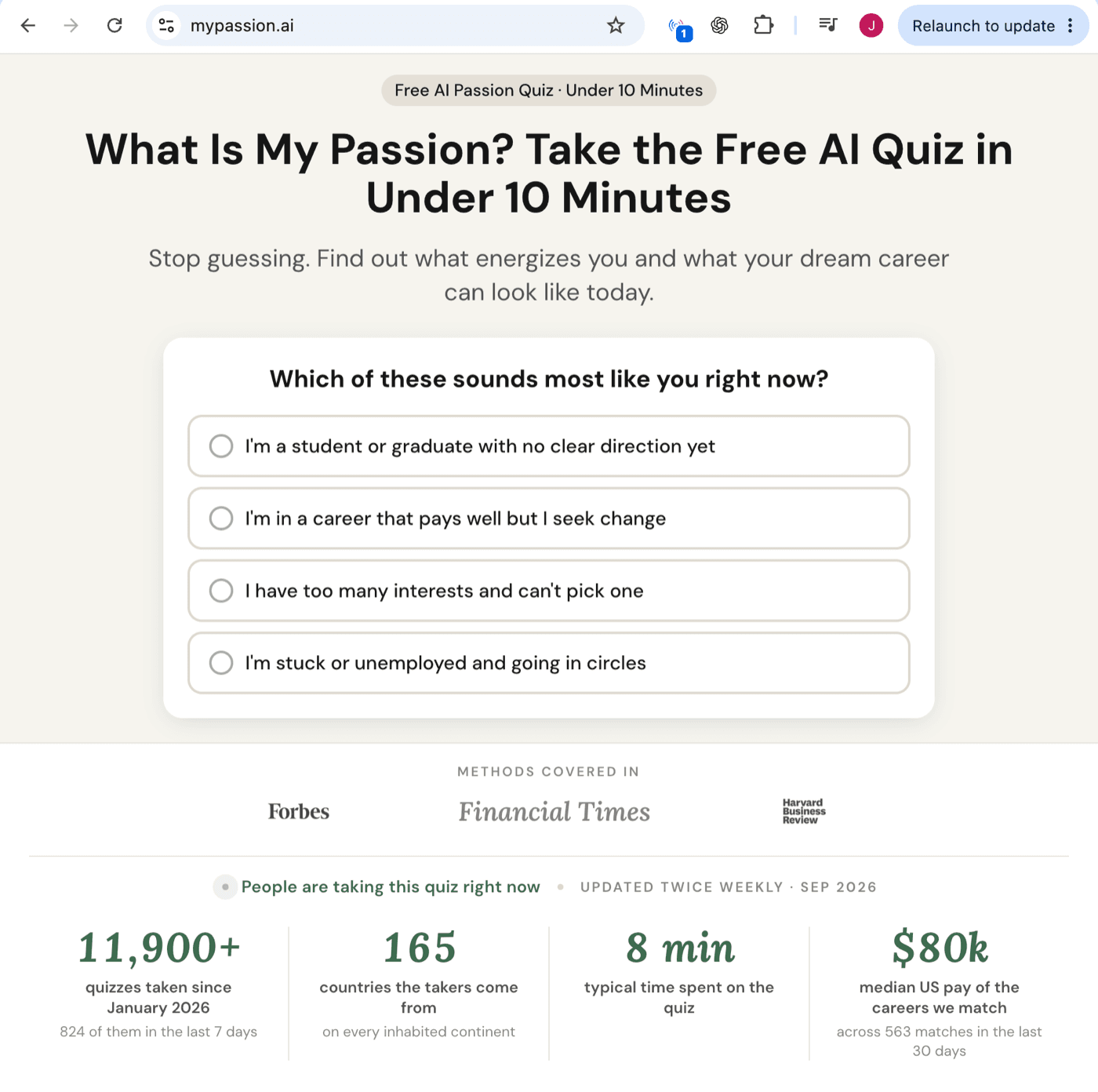
Below it sit three mastheads under the words “METHODS COVERED IN” - Forbes, Financial Times, Harvard Business Review. The same strip repeats in the footer of the results page, there reading “TRUSTED BY 11,900-PLUS CAREER-QUIZ TAKERS ACROSS 165 COUNTRIES · METHODS COVERED IN.”

Read that label carefully, because it is doing precise work: it says the methods have been covered, not the product. That is a materially different claim from the “As seen in” badge it resembles at a glance, and what a visitor sees is three publication logos sitting beside the brand. No article, author, date or link accompanies any of the three, so there is nothing on the page to check them against. A web search on September 22, 2026 turned up no coverage of MyPassion.ai in any of the three publications either - which is not proof that none exists, only that we could not find one and they do not cite one. The strip reads to us as misleading: three mastheads tied to the brand with nothing behind them a visitor can open.
Then a stat row under “People are taking this quiz right now · UPDATED TWICE WEEKLY · SEP 2026”: 11,900-plus quizzes taken since January 2026 (824 in the last 7 days), 165 countries the takers come from, 8 min typical time on the quiz, and $80k, labelled “median US pay of the careers we match, across 563 matches in the last 30 days.”
That last one is worth naming for what it is. It is not a claim about what takers earn, or what they went on to earn - it is the median US salary of the roles sitting in their own matching database over a month, presented in the same visual row as the audience figures, where it reads as a benefit. It is their number and we cannot audit it; we are only pointing out that it describes their catalogue, not your outcome.
The questions: one answer, and not many of them
The body of the quiz is single-select radio lists. A representative one, at 57%: “What's the biggest thing you're struggling with?” - no idea which direction to pick / too many interests to commit to one / can't tell what I'm actually good at / nothing I try feels like a passion / stuck or bored in what I do now. Five options, one choice.
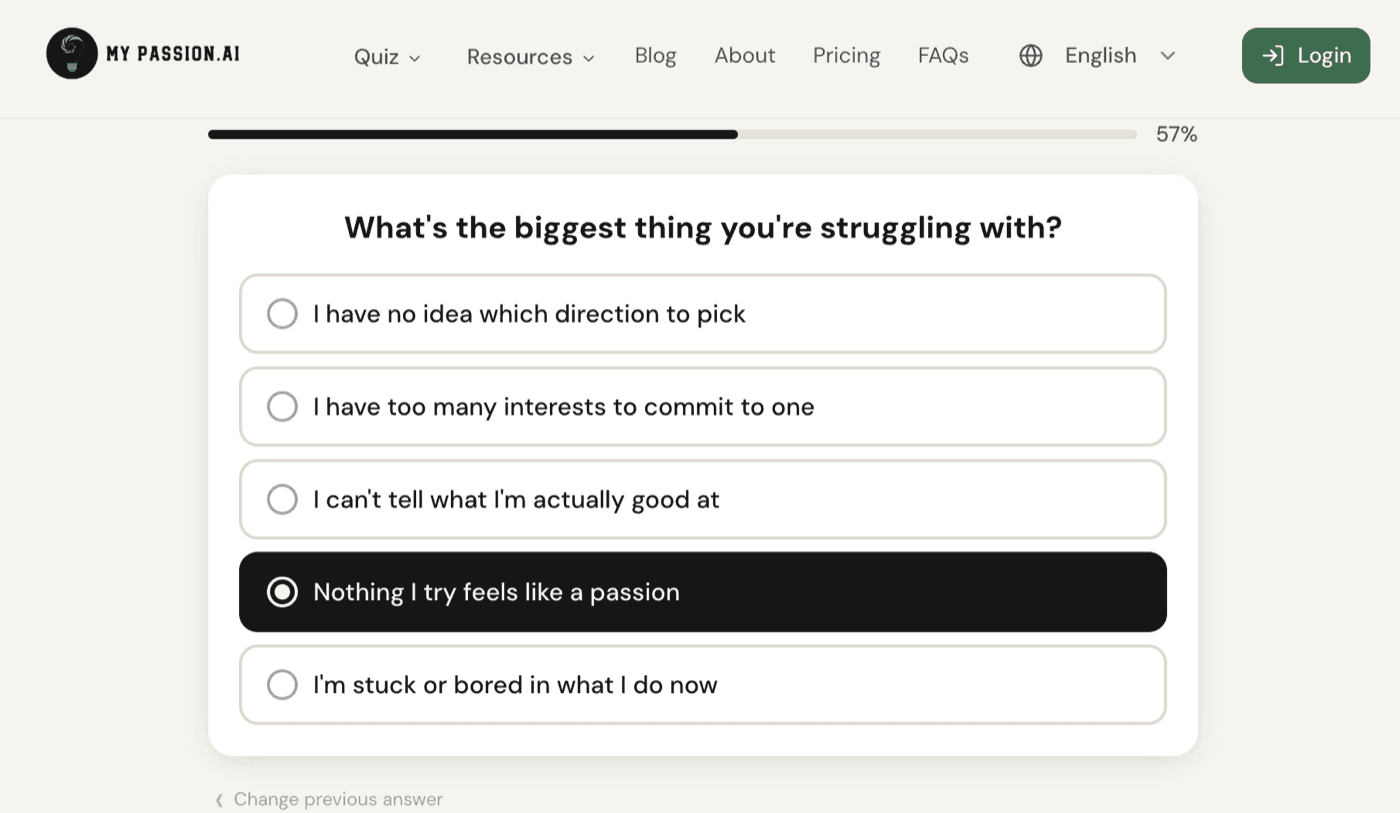
That shape costs the answer its nuance. You can pick only one option in many places where two or three would be truer - and read the five above: they are not mutually exclusive, and plenty of people arrive with three of them at once.
The quiz is not only radio buttons. The free result explicitly draws on a “free-time answer,” a “flow-state answer” and a “segment opener” - open-text boxes whose contents show up, quoted, in the profile. So the input is a mix: mostly fixed choices, with a few places where you write and are genuinely read.
The larger question is whether there is enough of it. Four minutes of mostly-fixed answers is a thin base for a career direction - too short, in our view, to gather enough input for the personalization the page promises. And nothing in our run asked what we currently earn or what we would need to earn, which is the number that decides whether a path is available to you at all.
The interstitials: selling the report before you have finished answering
At 49% through the quiz, a screen appears that is not a question. It is headed “Only 16% of professionals show this unique skill pattern.” Below it are two locked teasers - “Your Hidden Transferable Skill” (“the thing you're already good at, in the wrong context”) and “Your Financial Transition Map” (“income at 3, 6 and 12 months into your new direction”) - and a five-star testimonial from “Hannah, 32, analyst” with a headshot. Then a Next button.
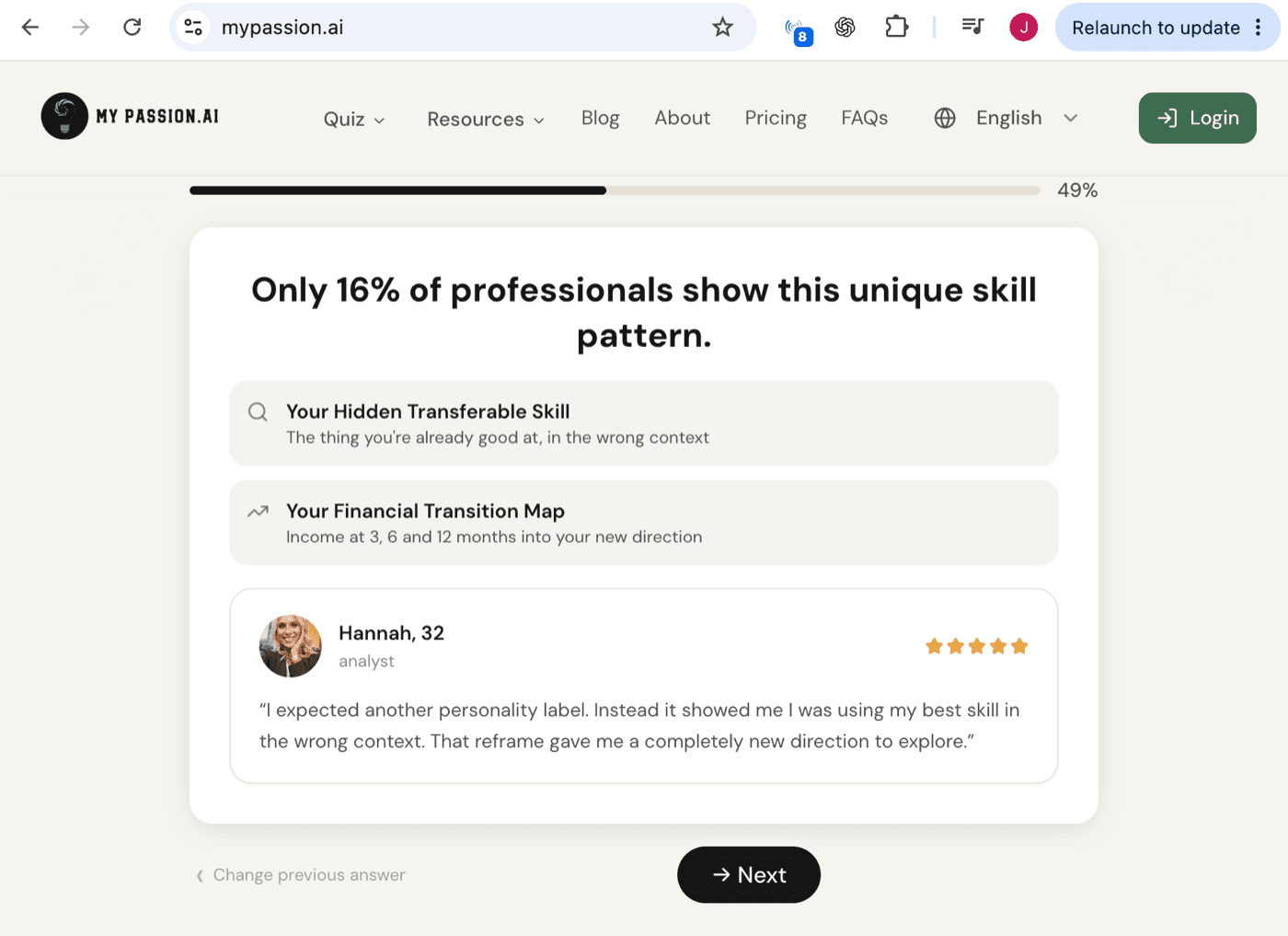
Two observable things. The 16% carries no source - no sample, no method, no definition of “this unique skill pattern,” and it arrives before the quiz has finished collecting the answers that would identify a pattern at all. And the second teaser, the one promising income at 3, 6 and 12 months, is the single most valuable-sounding thing on the screen; it is locked, and it stayed locked on the free results page.
The testimonial beside them is the format that recurs at scale later: a first name, an age, a job title and a five-star quote in the first person about what the product did for her. That headshot appears to us to be AI-generated. We come back to it below, with the evidence spelled out, because it is the claim being made by the format - a named customer reporting her own result - rather than the picture, that has to be sound.
The gate: your archetype first, your profile after the email
This is the structural choice worth understanding before you start, because it decides what you can walk away with. When the questions end you land on a screen headed “Your results are ready!” that tells you your archetype immediately - “You're The Freedom Seeker” - alongside “Your profile is more unique than 73% of participants,” “100% Completed,” “3m 59s invested” and “More focused than 79% of users.”
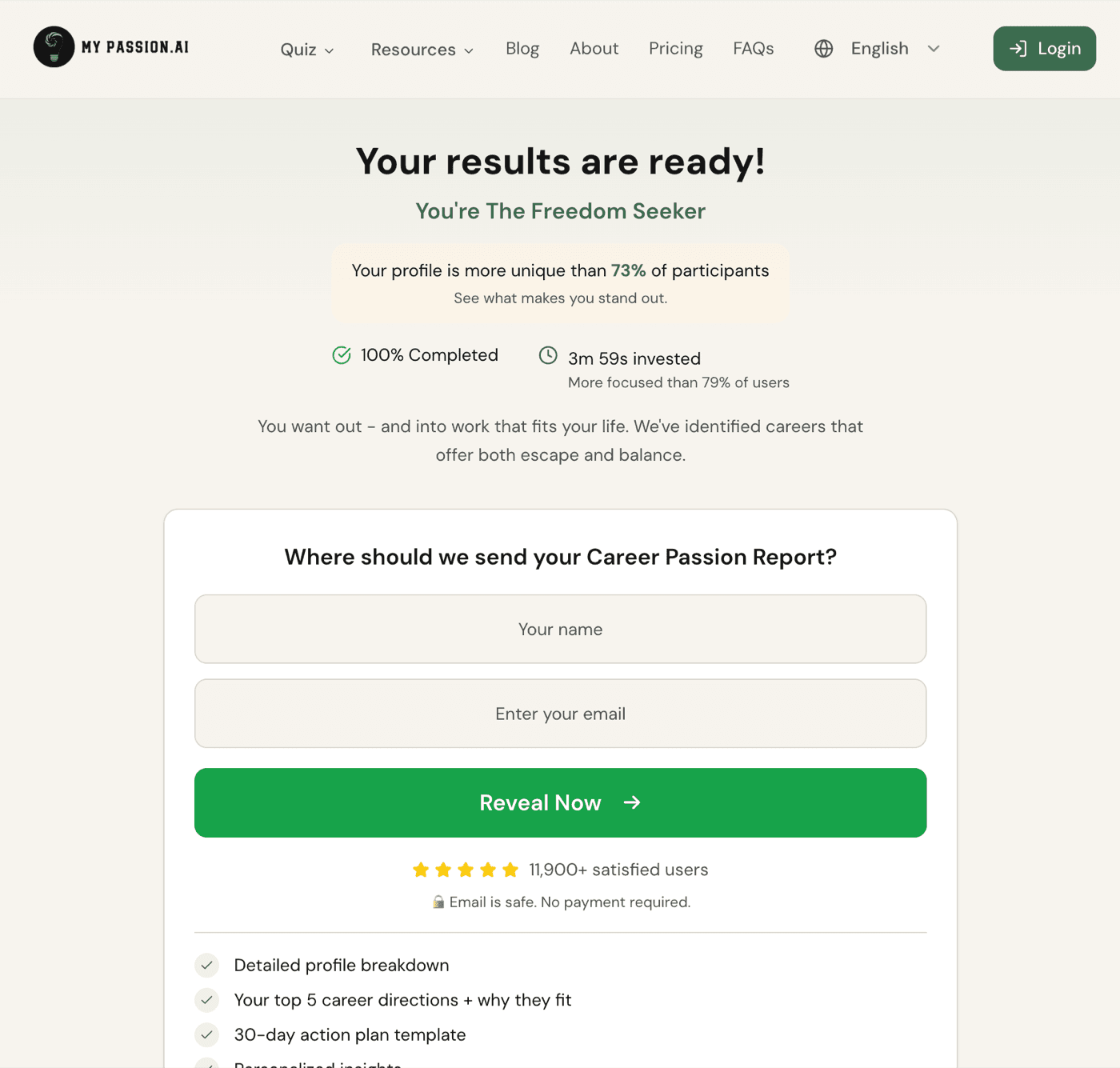
Underneath, the wall: “Where should we send your Career Passion Report?”, a name field, an email field, a Reveal Now button, “11,900-plus satisfied users” and the reassurance “Email is safe. No payment required.” That last line is true as written - nothing is charged to see the profile - and it is the only place in this category we have seen a tool volunteer it.
The sequencing is deliberate and effective: you are told who you are before you pay anything, including with an email, and told why that is unusual (73rd percentile) in the same breath. The thing you then hand your address over for is the explanation. Whether that is a fair trade is your call; it is at least a better gate than the tools that show you nothing at all and call it a result. Ours gates the same way. It shows your Work DNA type, then asks for a first name and an email to open the full results page and sends you a copy. No account and no card at either product - an email at both.
One thing on that screen we could not reconcile with what followed. The checklist under the form promises, among other items, “Your top 5 career directions + why they fit.” The page that appeared after we submitted the email named no career direction at all - the matches were locked. We are describing the results page only; we did not audit the emailed report, so we cannot tell you what arrives in the inbox.
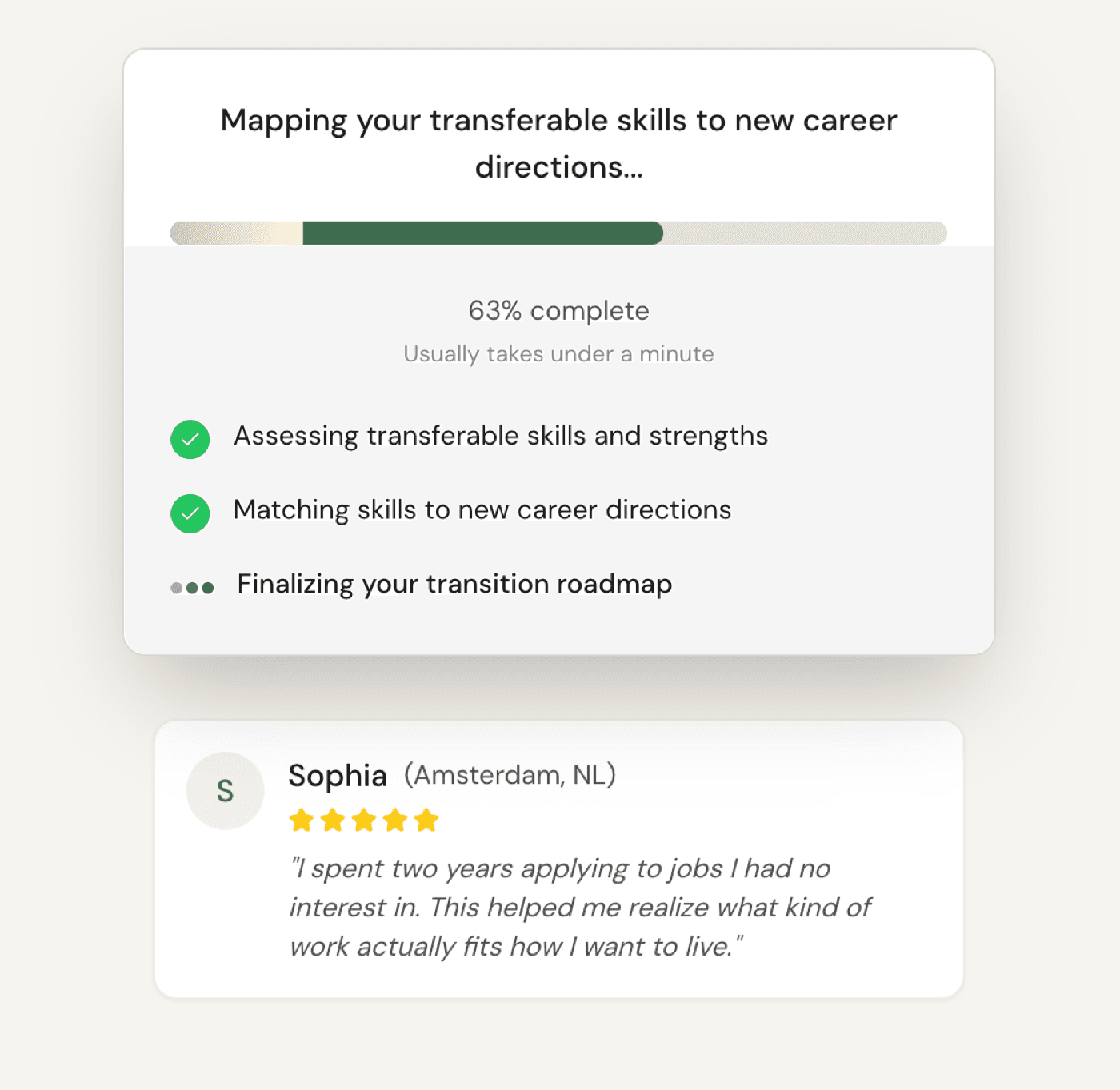
Then a loading screen: “Mapping your transferable skills to new career directions…”, 63% complete, “Usually takes under a minute,” with three ticking steps and another five-star testimonial beneath it.
What the free result actually contains
The page is headed “ROCKY'S PASSION ANALYSIS” - the name we gave at the gate - over “You are The Freedom Seeker.” What follows, in order:
- A written archetype paragraph built from our own answers, followed by three cards - YOUR ENGINE, YOUR EDGE, WATCH THIS - each of which quotes or paraphrases something we typed.
- A footnote line: “Compared to 11,900-plus quiz takers · Grounded in government salary data.” No agency, dataset or year is named anywhere on the page.
- Five scored traits - Collaborative Problem-Solver 82, Growth-Oriented Learner 78, Initiative & Ownership, and two more - plus “What tends to drain you: Corporate Misalignment 73.”
- A personality-profile section marked “Archetype 2 of 20” beside a six-bar Holland (RIASEC) work-style mix.
- A career-interests chart with numbers: Thinking 72, Helping 68, Creating 65, Building 62, Organizing 55, Persuading 38.
- A working-style read on four axes (energy, collaboration, structure, pace), each with a sentence explaining the placement.
- “Your competitive edge,” quoting our own words back, and “What makes your ideal career” - core needs, tasks to seek, tasks to avoid.
That is a real free result. It is also, structurally, a profile of the person rather than a plan for the person - and the hinge between those two things is priced.
The careers you cannot see, and what they cost
The section is headed “Your 20 career matches are inside the report” - “five deeply-detailed primary matches plus 15 broader paths, each with a passion match score, salary, and why it fits your specific profile.” Beneath it: three rows, blurred, each marked “?? Fit” with a padlock, and then “+ 17 more career matches inside the full report.”
Zero careers are named on the free side. Not one. That is the boundary, and it is the thing to understand before you spend four minutes: the quiz reads your words genuinely well and then stops precisely where the answer to your question begins.
Read off the free results page from our own run. Their $29 and $79 price points are the same two numbers our own paid tiers use, which is worth knowing when you compare the two.
Above the plans sits the timer: “Your quiz-taker price ends in 02:23:57 [DAYS:HRS:MIN] - Then the Report + Kit goes back to $179.” We did not go back after it ran out, so we cannot tell you whether the price reverts. What we can say is that a countdown on a price is a claim about the future, and the “$621+ in value” stack beside it is a number with nothing behind it - both read to us as manufactured urgency rather than information.
The claims with no source behind them
Collected in one place, because individually each is easy to skim past and together they are the texture of the whole funnel:
Every one of these is their own figure, read off our run on September 22, 2026. None carried a source, a method or a date on the page. We are not saying any of them is false - we are saying a visitor has no way to check a single one.
This is also why we publish no star rating of our own anywhere on this site. A number nobody outside the company can check is decoration, not evidence - ours would be too.
The testimonials, and what we checked
The results page carries nine five-star testimonials, each with a name, an age, a job title and a headshot: Vanessa (project manager, 34), Julia (former accountant, 32), Marcus (operations lead, 35), Wei (finance professional, 40), Patricia (admin coordinator, 55), Sophia, Emma, Daniel and Anna. All five stars. The quiz interstitial and the loading screen carry two more.
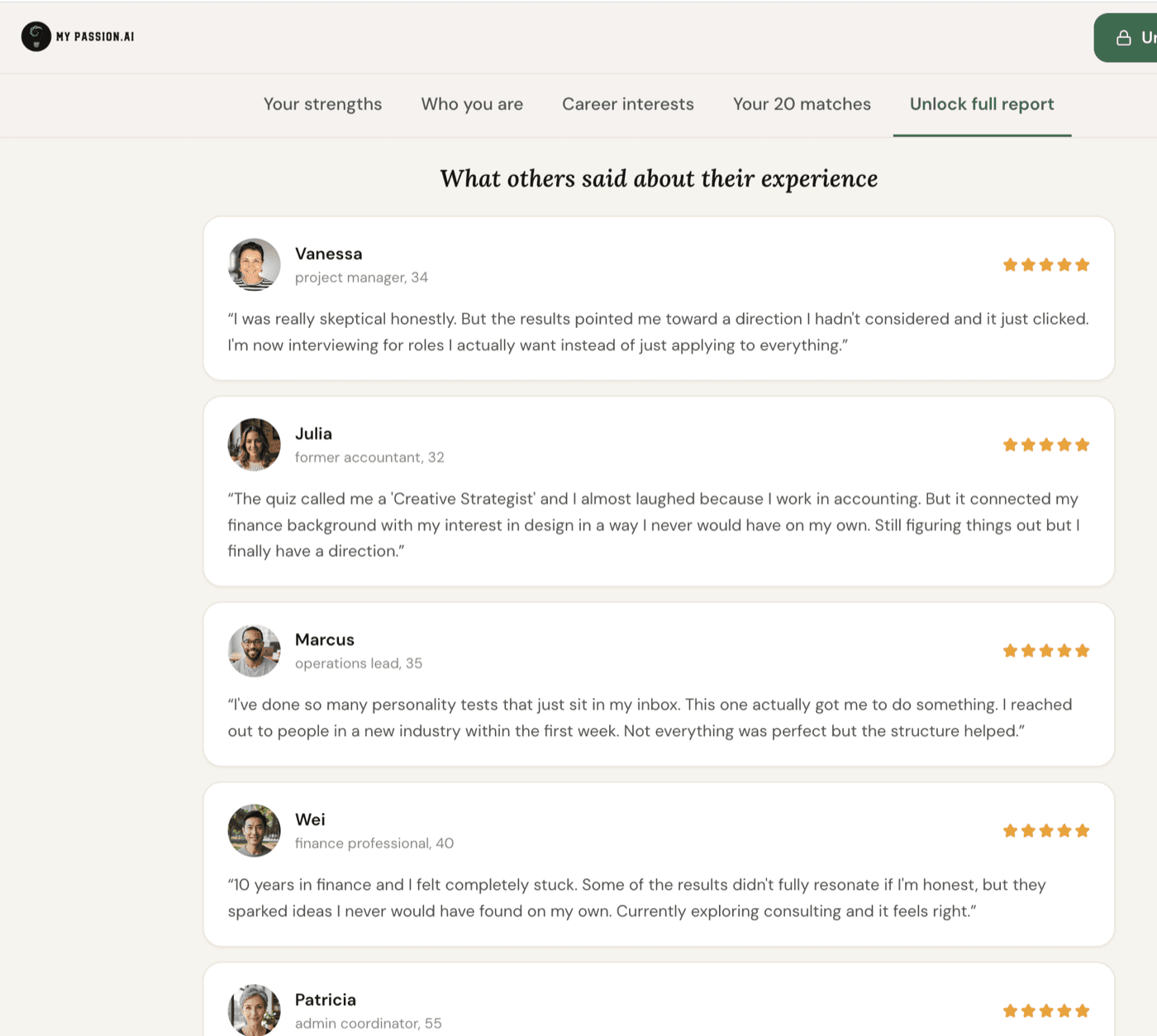
What the format claims is specific, and it is worth naming before anything else: each card presents a named person, with an age and a job, reporting in the first person what the product did for them- “the results pointed me toward a direction I hadn't considered,” “I reached out to people in a new industry within the first week.” That is a customer review. It is a claim about an event that happened to somebody.
The checkable facts sit against it. The photographs share a consistent studio look - the same even, directionless lighting across faces shot in what are meant to be different settings. Our reverse image search on September 22, 2026 could not trace a single one of the nine to any other web presence.
They appear to us to be AI-generated - and if they are, these are fabricated reviews, not just synthetic faces. We could not verify how the images were produced, so we stop at what the format asserts, which is the part that matters anyway: an AI-made face used as illustration is fine; an AI-made person presented as a customer describing her own result is a fabricated review, because the review is a claim that somebody experienced something. A synthetic face is not the objection - we build with AI ourselves. The screenshot above is there so you can run the same search we did.
The same question runs through their Instagram, which we opened the same afternoon. As of 4:50 PM Eastern on September 22, 2026, the account @mypassion.ai showed 40 posts, 32 followers and 0 following, with the bio “Take the free quiz and find your passion career.” The grid is mostly short videos of different people talking to camera, interleaved with archetype cards (“The Analyst 95% fit,” “The Guide 90% fit,” “The Maker 92% fit,” “The Strategist 93% fit”) and a milestone graphic reading “10,000-plus career quizzes taken in 2026.” Their website says 11,900-plus since January 2026; both are their own figures, published on the same day, and we cannot audit either.
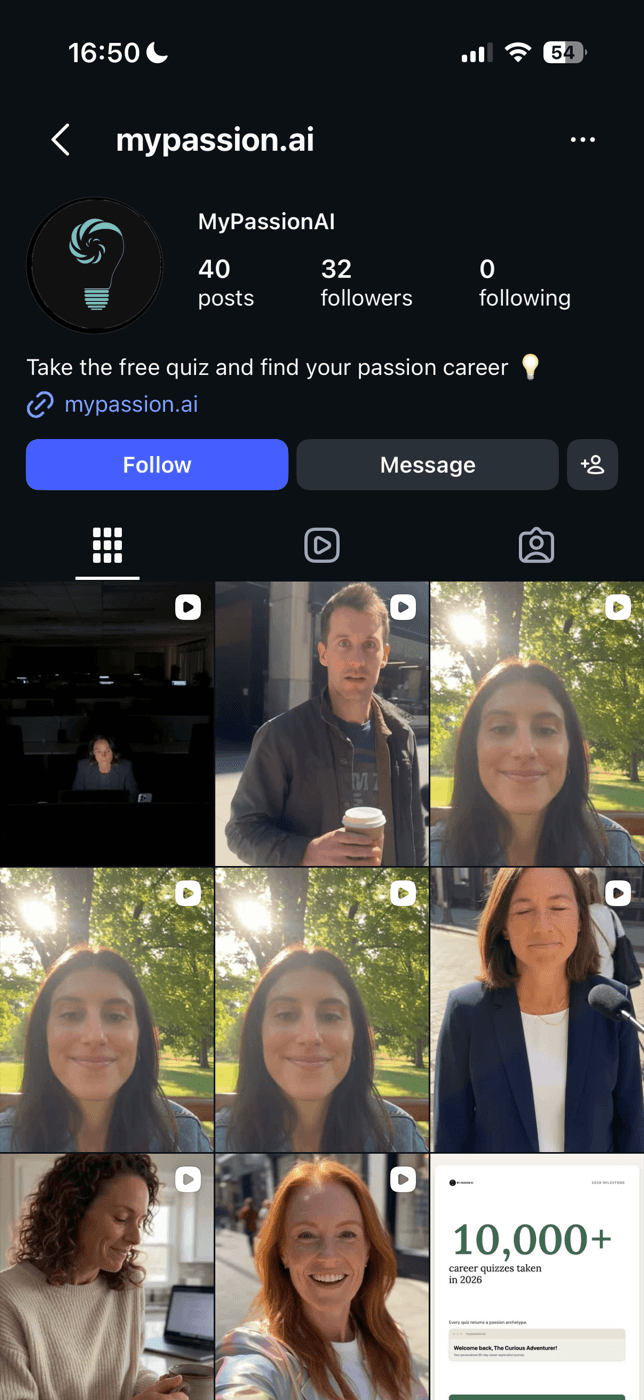
One thing in that grid is checkable without any judgment call: the same woman's thumbnail appears three times in a row, across what are presented as separate video posts.
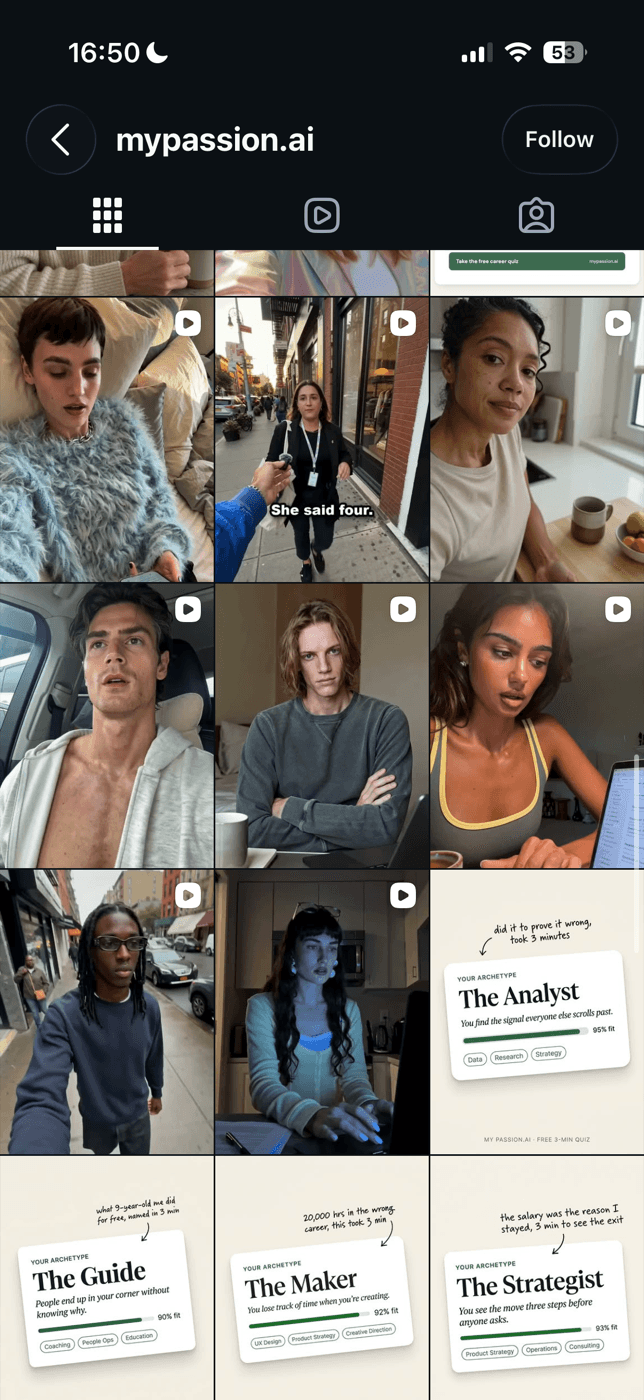
The reels themselves run the same format as the written reviews: a person to camera, speaking in the first person about their own career and what the product showed them - “Nineteen years in, everyone says start over. Nobody says what week one looks like…” That is a testimonial, not a brand advert.
One frame from those reels is worth pausing on, because it needs no judgment call at all. A man in a car holds a phone up to the camera showing what is meant to be the product. None of the text on that screen is a word. The header reads “MY PASIOIQ.AI” and every line under it is garbled pseudo-text - the shape of a question list with nothing legible in it.

We watched the videos, and they read to us the same way: the on-screen text is the kind of garbled filler an AI video tool produces, and the speech does not track the body. That puts them in the same class as the written reviews - not adverts featuring an avatar, but synthetic people vouching for a result they did not get.
We could not verify how those videos were produced, and an AI presenter in a brand video would be nobody's business but theirs. It is the first-person customer claim that raises the bar, and the facts a reader can check against it are all in the screenshots: the illegible product screen in the frame above, the 32 followers standing against the taker counts, the thumbnail repeated three times across what are presented as separate posts, and the fact that our reverse image search could trace no person in that grid or on the results page to another web presence.
Below the reviews sits “About the Founder - Marco Kohns” with a photograph, the line “I built this after leaving a six-figure Silicon Valley role. No existing tool really helped so I built one that does,” and a support address he invites you to write to directly. A named founder and a working support email is more accountability than most of this category offers. The footer closes on “Grounded in government salary data and 11,900-plus quiz takers” beside Instagram, TikTok and Facebook links.
The design difference, stated plainly
We build the closest thing to this product that exists, at the same two prices, so the comparison needs to be specific rather than flattering. MyPassion.ai reads your words and returns who you are; our career assessment reads your words and returns where to go.
Start with what is not different: we gate on email too. Our assessment asks for a first name and an email at the end, before the full results page opens, and sends you a copy. No account and no card - but an email, the same as theirs. The difference is not the gate. It is what is on the other side of it:
- Careers are named on our free side. Three specific paths, not counted, not blurred, not locked. Theirs names zero and prices the list at $29.
- Income is on the free side too, as ranges checked against what you told us you need to earn - which is a question their quiz never asked us.
- The paid tiers are optional. Ours ($29 (Brief) / $79 (Roadmap)) are optional depth on top of a result you have already read in full.
That is not a claim about accuracy. It is a claim about where each product draws the line between what you can read and what you must buy.
Who should pick which
Take ours if your question is what to actually do next, and whether it pays. That is a recommendation from the people who build it, stated plainly rather than buried: about 10 minutes, several answers in your own words, and a complete result - three named career paths with income ranges, your Work DNA, your resistance pattern - and nothing to buy to learn what your paths are called. Ours gates on email the same way theirs does: no account, no card, but a first name and an email at the end to open the full results page, with a copy sent to you.
Take MyPassion.ai if you want a written profile of yourself in four minutes and you are willing to spend $29 to see the career list attached to it. The free profile genuinely used what we typed, the price is one-time and published with a stated 14-day guarantee, and for someone who wants a readable self-portrait plus 20 matches for $29, that is a reasonable thing to buy. We have not seen the report, so we cannot tell you whether the 20 matches are any good.
Take neither - go to the free options - if you want occupational matching at no cost at all. O*NET is run by the U.S. Department of Labor, is free start to finish, asks for no email, and has no upsell in it.
MyPassion.ai vs. Make the Leap - the honest spec sheet
We build the competing tool at the same price points, so here it is as specs rather than adjectives. The MyPassion.ai column is what we saw on September 22, 2026; the rows we could not verify say so.
| MyPassion.ai | Make the Leap | |
|---|---|---|
| Price | $29 Premium Report or $79 Report + Kit, one-time, under a countdown claiming the $79 reverts to $179 | Free; Career deep-dives $29 (Brief) / $79 (Roadmap) |
| Free result | A substantial written profile that quotes your own answers - archetype, trait scores, Holland chart, working style - but no career named; the 20 matches are blurred and locked | The complete result: Work DNA, resistance pattern, 3 named paths with income ranges |
| Input | Mostly single-select radio lists (one answer only), plus some open-text boxes that the result visibly reads; nothing asked about current or required income | 30 questions, several in your own words - which it reads |
| Time in our run | 3m 59s on their own counter (their claims: “Under 10 Minutes,” “8 min typical”) | About 10 minutes |
| When an email is asked for | Before the written profile - the archetype and percentile claims are shown first, the profile after “Reveal Now” | Also before the full results - a first name and an email at the end open the page, and a copy is sent. No account, no card |
| Output we verified | The free results page only. Both paid tiers are unverified - we did not buy either | 3 named paths with income ranges + personalized analysis |
| Sourcing of its claims | Percentiles (16%, 73%, 79%), taker counts and “government salary data” all appear without a source, method or date | Figures on our pages carry the dataset and the date they were computed |
FAQ
Is MyPassion.ai free?
The quiz is free and so is a written results page - but an email is required before you can read it, and no career is named on the free side. We took it on September 22, 2026. The flow is: answer the questions, get told your archetype and a set of percentile claims, hand over a name and an email at a "Where should we send your Career Passion Report?" form, then read the profile. What arrives free is a genuinely personalized write-up - ours quoted our own typed answers back at us - plus trait scores, a Holland (RIASEC) interest chart and a working-style read. What does not arrive free is a single career: the 20 matches sit behind a $29 purchase, shown as three blurred rows marked "?? Fit" and a line reading "+ 17 more career matches inside the full report."
How much does MyPassion.ai cost?
Two one-time prices on the results page from our run: $29 for the Premium Report (20 career matches - 5 deep-dives plus 15 adjacent paths - each with a fit score, salary and why it fits, plus up to 3 match replacements, saved to your account) and $79 for "Report + Full Career Kit," shown struck through from $179 with a "Save $100" badge. The $79 tier lists a CV rewrite, a LinkedIn rewrite, 10 outreach messages, a 30-day workbook and an unlimited AI coach, totalled as "$621+ in value." Checkout is Stripe, one-time, with a 14-day money-back guarantee and "no recurring charges" stated. Above the plans sits a countdown: "Your quiz-taker price ends in 02:23:57 - Then the Report + Kit goes back to $179." We did not buy either tier, so what is inside them is unverified.
What do you get without paying?
More than most tools in this category hand over, and none of it is a career name. From our run: an archetype ("The Freedom Seeker," labelled "Archetype 2 of 20"), a written paragraph built from our own answers, three cards headed YOUR ENGINE / YOUR EDGE / WATCH THIS, five scored traits (Collaborative Problem-Solver 82, Growth-Oriented Learner 78, Initiative & Ownership) plus a "what tends to drain you" score, a six-bar Holland interest chart (Thinking 72, Helping 68, Creating 65, Building 62, Organizing 55, Persuading 38), a working-style read on four axes, and a "Your competitive edge" block quoting a line we had typed. Then the careers section, which names zero of them.
Is MyPassion.ai legit?
There is a real product that does a real thing: you type answers, and a written profile comes back that visibly used them. There is a published one-time price, a Stripe checkout, a stated 14-day money-back guarantee, a named founder with a support address, and no subscription. What we report from our own run is narrower and worth weighing: several claims on the page carry no source ("Only 16% of professionals show this unique skill pattern," "more unique than 73% of participants," "More focused than 79% of users"), the price sits under a countdown, and the nine customer reviews - named people with ages, jobs and first-person quotes about their results - share a consistent studio look, and our reverse image search could not trace one of them to any other web presence. We could not verify how those images were made. A synthetic face in an advert would be unremarkable; a synthetic person presented as a customer describing her own result is a different thing, because the review is a claim that something happened to somebody. Those are things to check before you pay.
Is MyPassion.ai accurate?
We cannot tell you, and the reason is specific. Accuracy here is a property of the 20 career matches, and the free tier names none of them - so the part you would judge for accuracy is exactly the part behind the $29. What we can judge is the input. Our run took 3 minutes 59 seconds on their own counter. Most questions were single-select radio lists where only one answer was possible, though some questions took open text and the result clearly read it. Our view of that trade: four minutes of mostly-fixed choices is too short to gather enough input for a genuinely personalized direction, and in many places you can pick only one option where two or three would be truer. Nothing in our run asked what we earn or what we need to earn, which matters if your question is whether a path pays.
How long does the MyPassion.ai quiz take?
Their landing page promises "Under 10 Minutes" and their own stat row says "8 min typical time spent on the quiz." Our run finished faster than both: the results-ready screen reported "3m 59s invested," and the whole session - quiz, email, results page - ran from about 4:36 to 4:44 PM Eastern. Mid-quiz there are interstitial screens that are not questions (a locked-teaser panel at 49% and a testimonial), and after the email a loading screen runs a checklist - "Assessing transferable skills and strengths," "Matching skills to new career directions," "Finalizing your transition roadmap" - under "Usually takes under a minute."
What are the best MyPassion.ai alternatives?
Depends on which part you did not like. If it is the paywall on the career names, the U.S. Department of Labor's O*NET Interest Profiler is free with no account and no upsell, and CareerExplorer shows its ranked matches free once you register - both taken first-hand on this site. If you want a validated personality instrument rather than a proprietary archetype, Truity shows real scores free. If you liked the reads-your-words idea and want the careers and the income check on the free side, that is what our own assessment does - three named paths with income ranges, free, before any purchase. We build it, so weigh that accordingly.
If you want the careers named, not counted
Our assessment asks 30 questions about your actual situation - including open text it reads as written - and returns three named career paths with income ranges checked against what you said you need to earn. The full result is free. Like theirs, it asks for a name and an email at the end to open it - no account, no card - and the difference is what opens: named paths, not a locked list.
Take the free assessmentRelated reading
- Best AI career assessment tools - the whole field, with the free/paid boundary marked and dated for each tool
- Best free career assessments - which ones are free all the way through, and which paywall the useful part
- JobTest.org review - the same category, taken first-hand, with no free result at all
- Apt (tryapt.ai) review - the other AI-native entrant, where the price is a subscription revealed late
- CareerExplorer review - the big free-with-account assessment, taken end to end

Written by Jon Miksis - entrepreneur, retreat facilitator, and founder of Make the Leap. Jon has facilitated 6 immersive retreat experiences, attended 18 retreats across four continents, and spent 5+ years researching why smart, capable people stay stuck. He's traveled to 73 countries and invested over $120,000 in personal development. Guides on this site are built from Make the Leap's assessment data and reviewed by Jon; the methodology and its limits are published here.