August 11, 2026 · Updated September 22, 2026 (first-hand edition) · 11 min read
CareerExplorer Review (2026): We Took the Whole Test - Here's What You Actually Get
We build a competing assessment, so read this knowing that - and knowing we'll tell you plainly when CareerExplorer is the better pick, because for some people it clearly is.
The short version
We took the whole test on September 22, 2026. Free, with an account - and your email, first name and birth date before the full results. The most thorough free career scan available; also the longest, and a scan, not a decision.
- What it is: a long scored questionnaire (Big 5 + Holland Codes, 140+ traits) that ranks you against 1,500+ careers and degrees.
- What's free: everything we saw - archetype, matches, degrees, trait report - once you register. No card was ever requested.
- Best for: students and early explorers who want the widest credible list of options at no cost and have the patience for it.
- Weakest for: experienced career changers who need a direction and income numbers - our results were a generic ten-career spread that never asked what we do now or what we can afford.
Is the CareerExplorer test free? (The question everyone asks)
Yes - and this answer has changed over the years, which is why the question gets asked so much. CareerExplorer's own site promises your “career and degree matches, insights, and even reports for free,” and our run bore that out: no card, no paywall, no locked section. Earlier versions kept detailed reports behind a premium tier (around $15/month when it ran), and that upsell has come and gone. What has stayed constant: you must register before the full results- email, first name and birth date, requested after you have finished answering (an archetype label appears earlier, unexplained). Free here means free-with-registration. (Zippia's career quiz makes the identical trade; our first-hand Zippia review walks through it.) If your hard rule is no account at all, the O*NET Interest Profiler remains the standard.
From our full run on September 22, 2026, cross-checked against careerexplorer.com the same day (their premium page still returns 404). Their model has changed before - treat the premium row as weather.
Our run: what the questions are actually like
The first section is a long run of single-task items under one prompt - “Would you like to...” - each rated from Hate it to Love it. The tasks are oddly specific. Our third question was “Counsel people with drug or alcohol addiction.” Our seventh was “Estimate the value of items for an insurance policy.” Soon after: “Help elderly people complete their daily activities.”
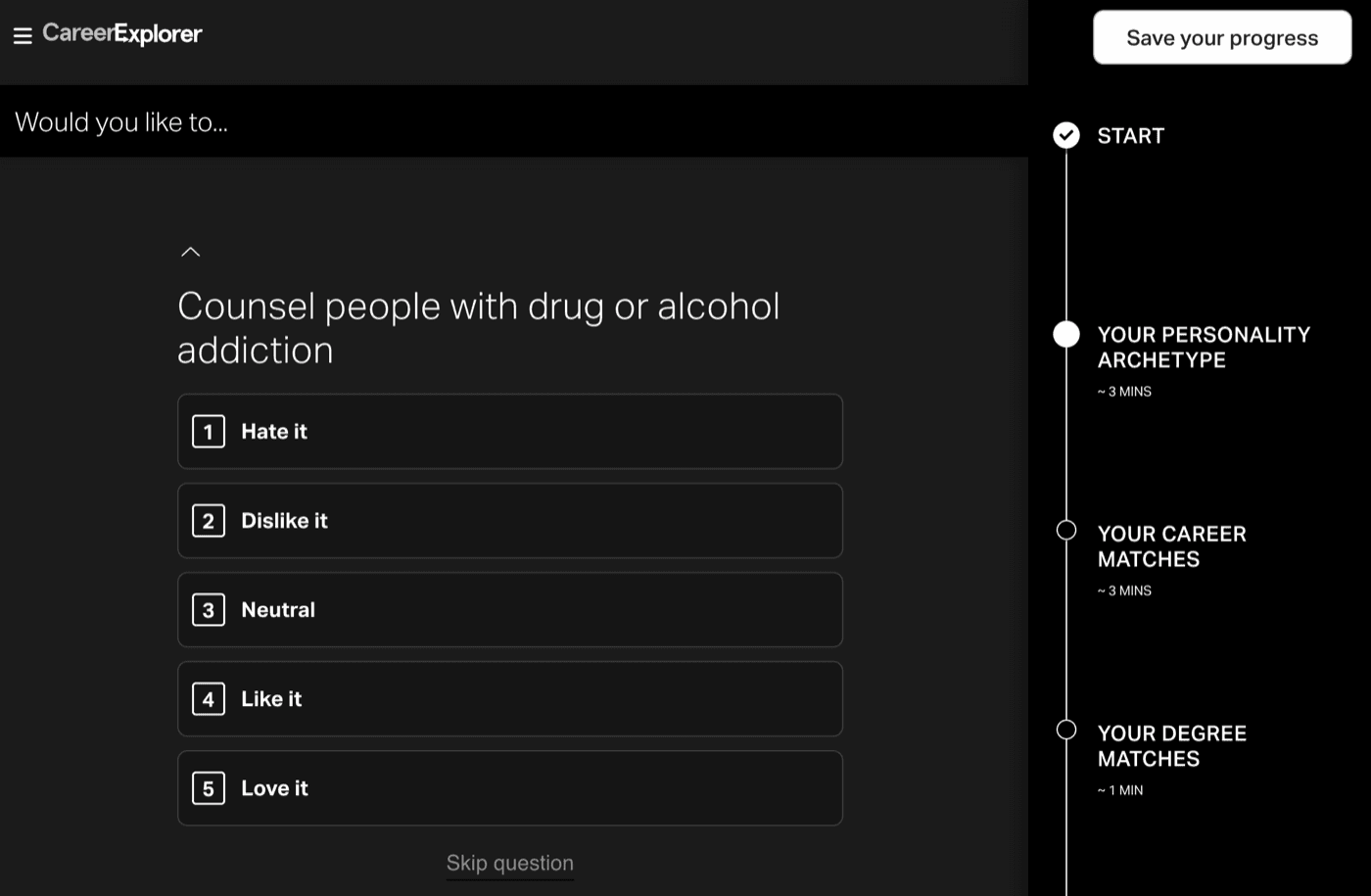
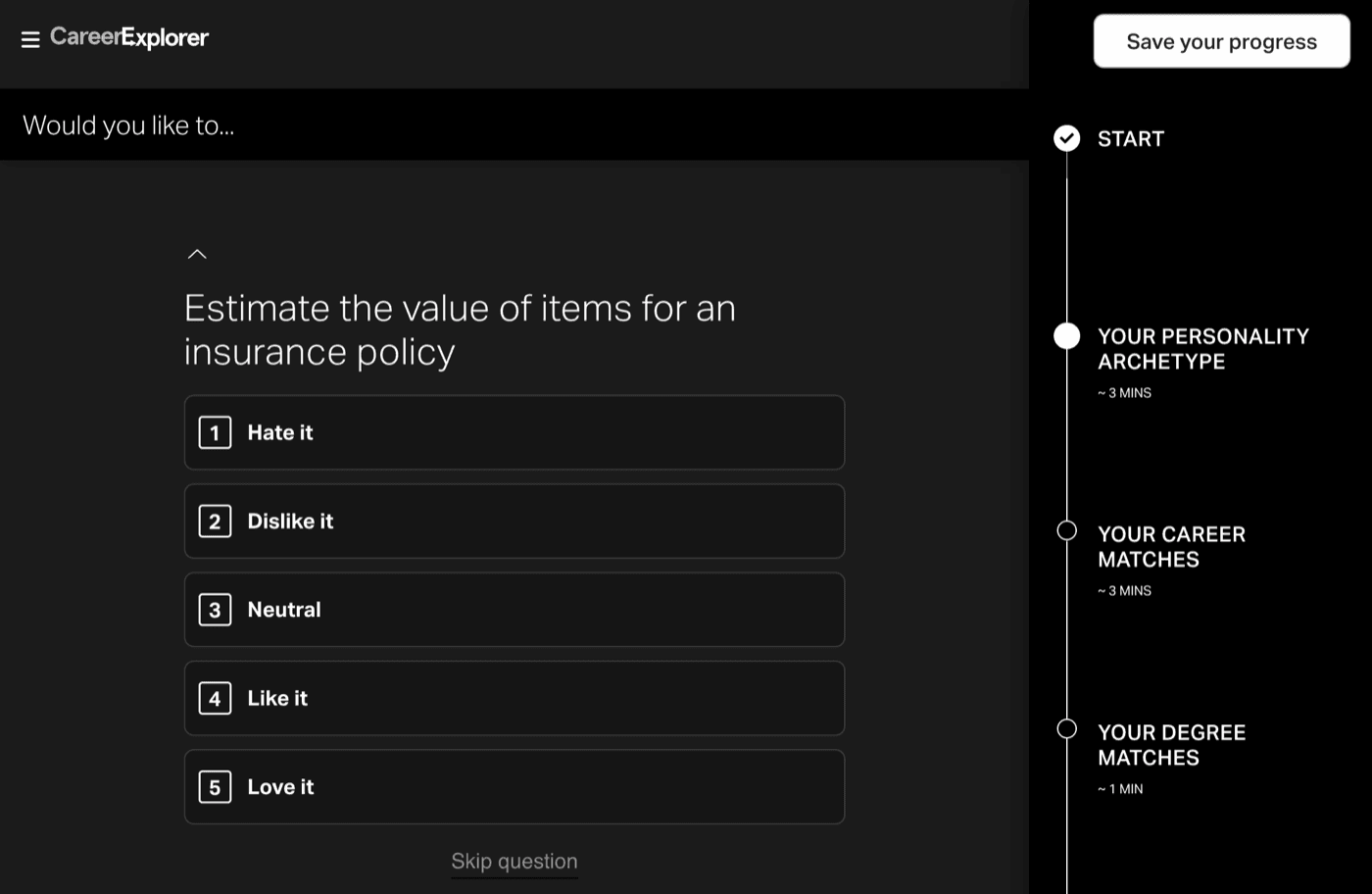
That is how a Holland-style interest inventory works - it samples concrete activities across the occupational map and infers your profile from the pattern - and it is a defensible method. It is also a strange experience if you are an adult who already knows what you do all day. Rating whether you would enjoy appraising items for an insurer tells the model something; it does not feel like it is learning anything about you, and the items do not build toward anything you can see. Nothing in the run asked what we do now, why we are looking, what we can afford, or what we have already tried.
At the end of that section it announced our archetype - “You are a Researcher,” badged Very Rare. It did not resonate, and the reason is structural rather than a matter of taste: the archetype lands before you have seen any evidence for it, and the label carries no explanation at that point.
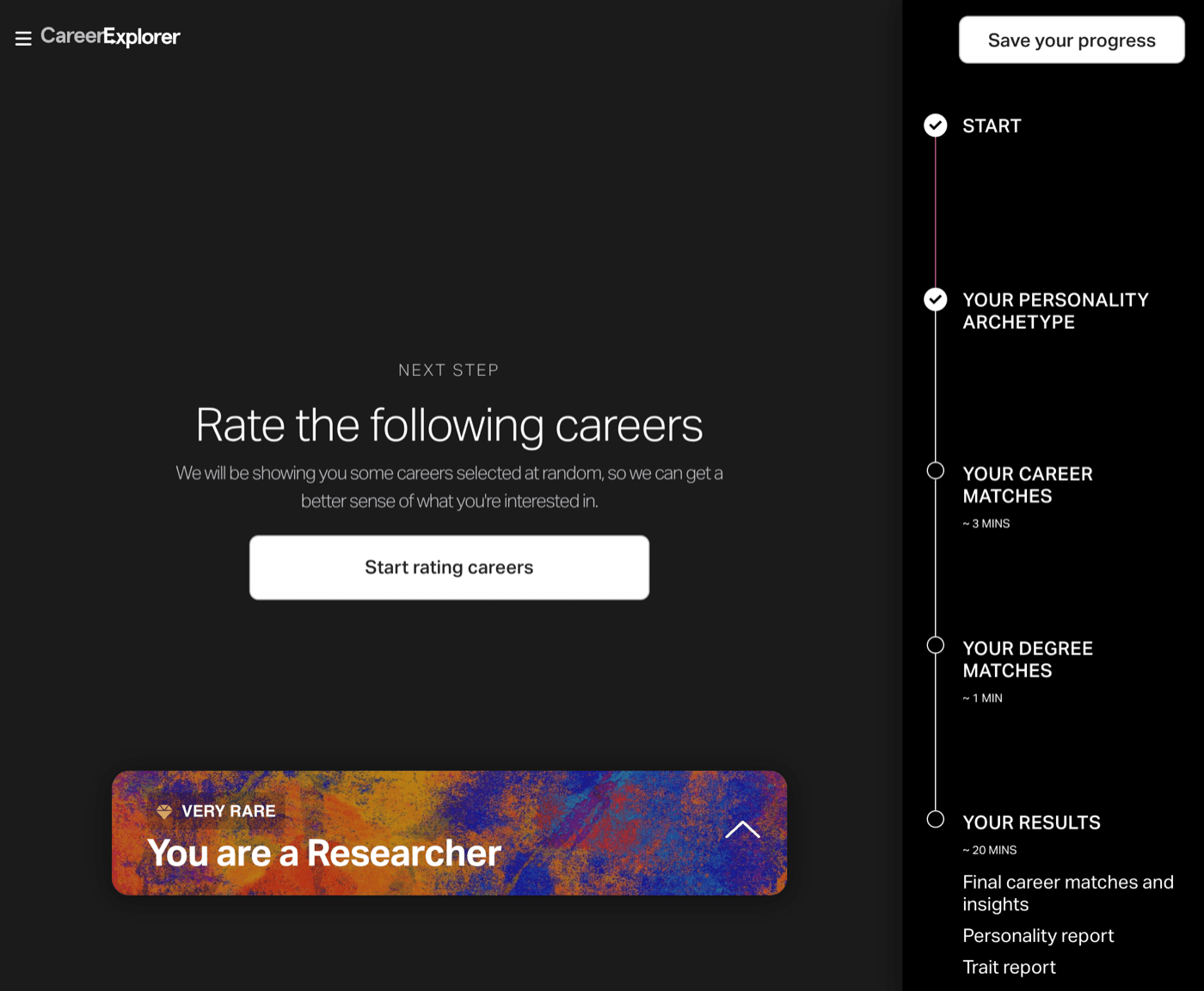
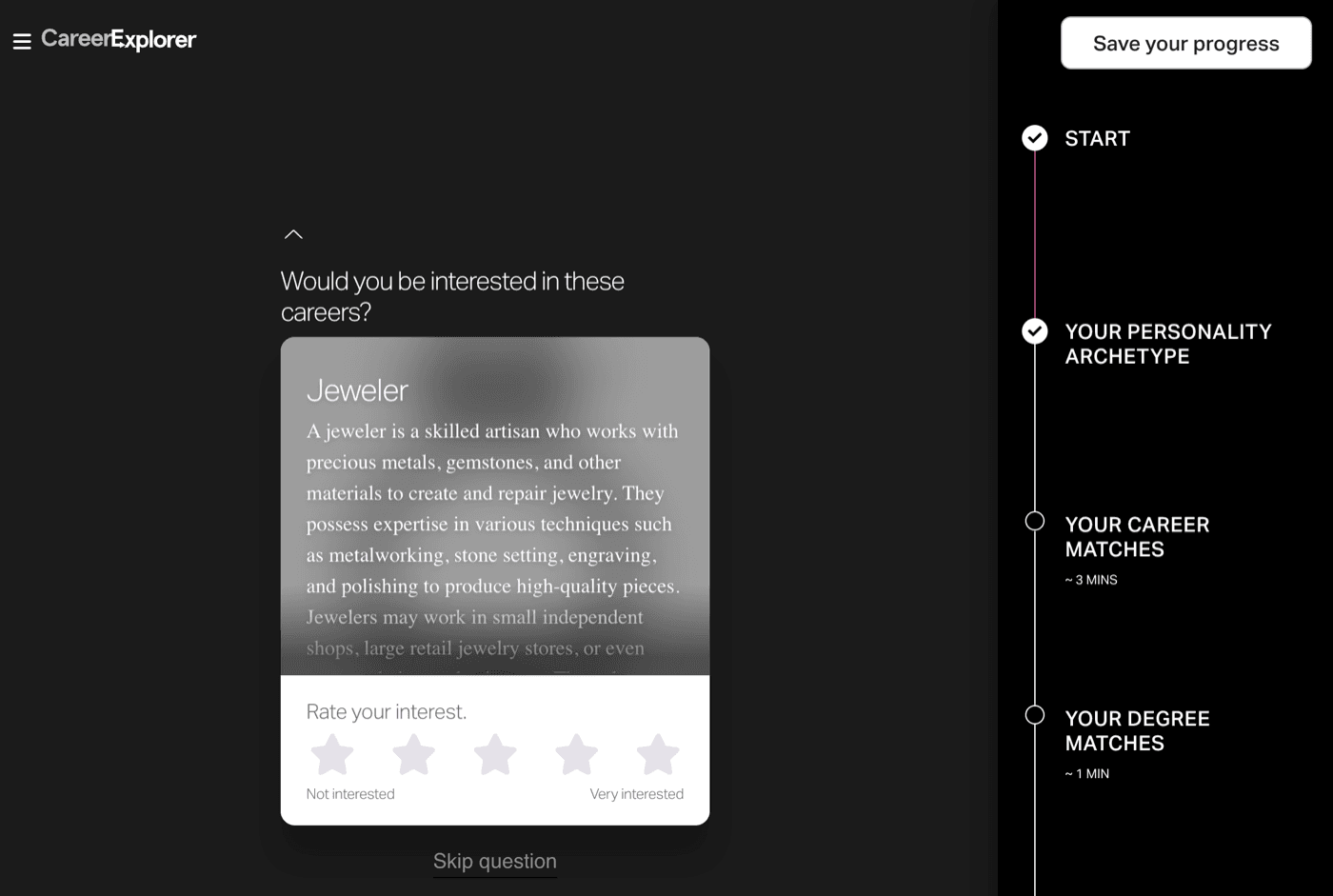
The second section says, in its own words, that it will show you careers “selected at random” to rate from one to five stars. Our first card was Jeweler. The third section does the same with degrees; our first card was Women's Studies. Random sampling is a legitimate way to calibrate a model, but from the chair it reads as the test guessing, and by this point the progress bar has been promising results for a while.
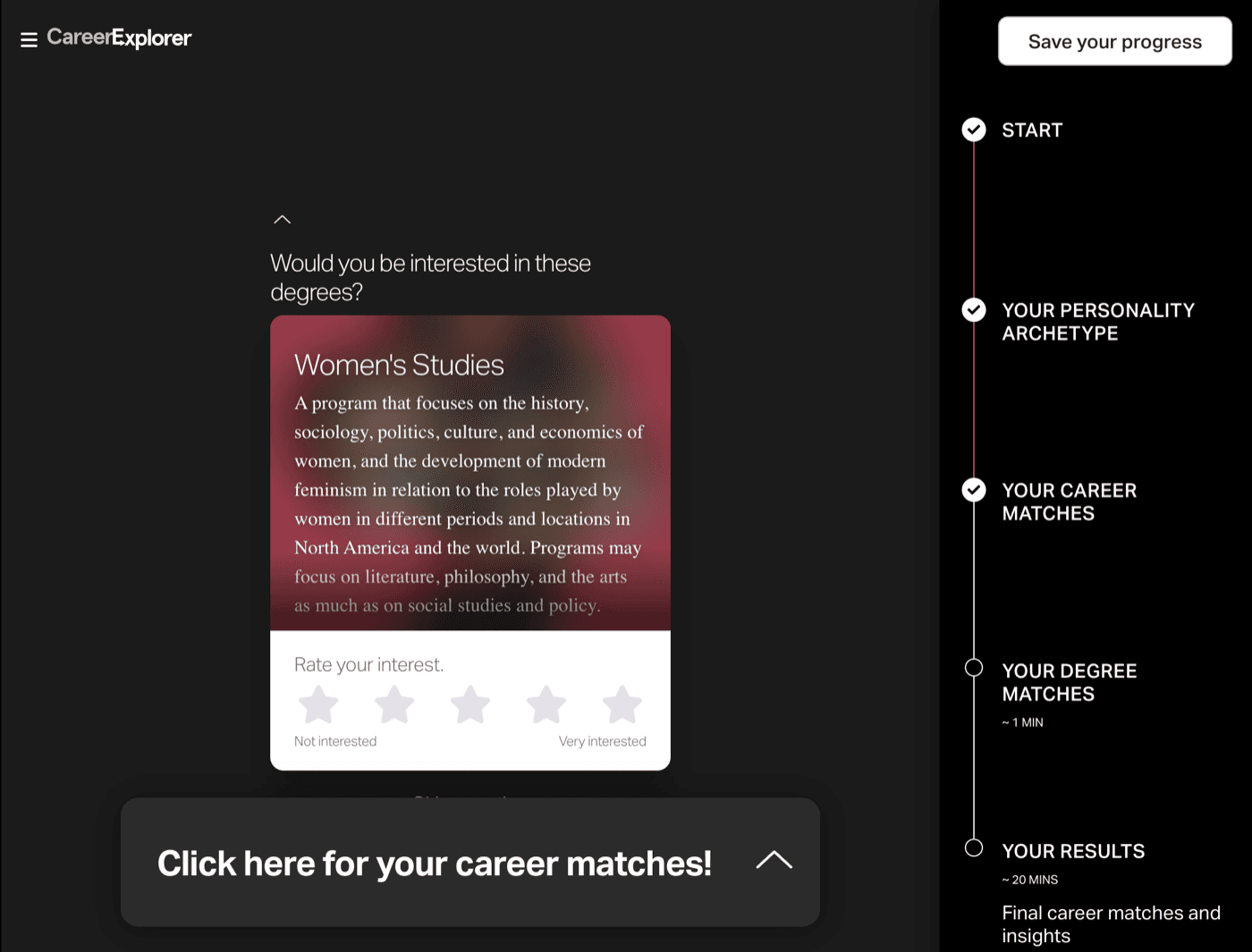
Then the registration step: email, first name and birth date, before the full results page (the archetype label is the only thing shown before it). On time, their own sidebar labels the stages at about three, three and one minutes plus a twenty-minute results stage; our screenshots span 12:55 to 1:07 PM with the first sections already underway before the first capture. It is not a ten-minute test.
Our results: what you get on the other side
The results appeared the instant we submitted the form - no processing, no wait. Whatever the scoring does, it does it over fixed-choice ratings, because those are the only inputs it ever collected; nothing about your situation was asked, so nothing about it can be in the answer. There is nothing wrong with that as a method; it just sets expectations for what the output can be.
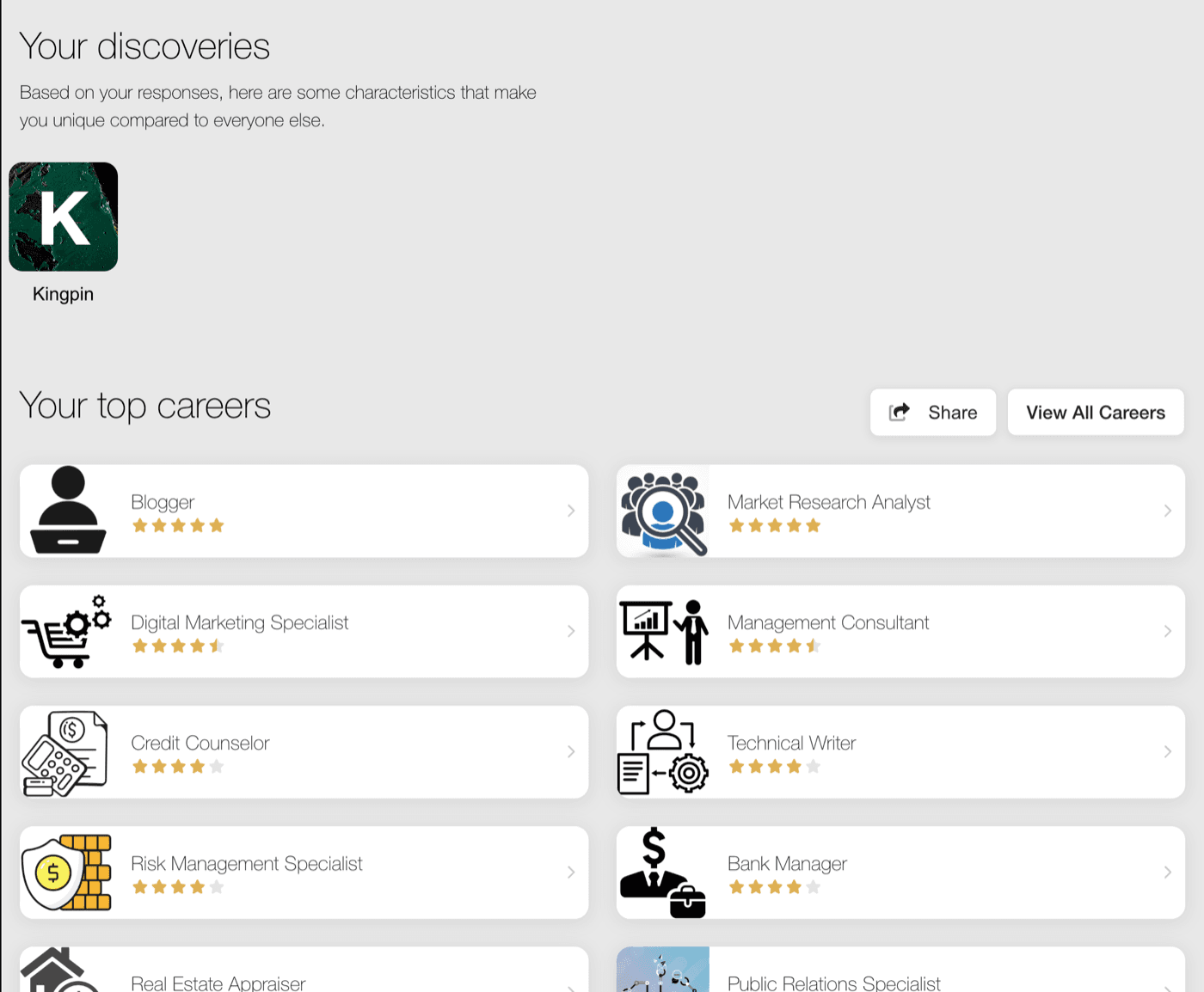
Ours opened with a “discoveries” tile - a single trait, Kingpin, presented as what makes us unique - followed by the top careers: Blogger and Market Research Analyst at five stars, then Digital Marketing Specialist, Management Consultant, Credit Counselor, Technical Writer, Risk Management Specialist, Bank Manager, Real Estate Appraiser and Public Relations Specialist. It is a wide spread. Blogger, bank manager and real estate appraiser are not one direction; they are three different lives, and the page gives you no way to tell which of them the model actually believes in beyond a half-star.
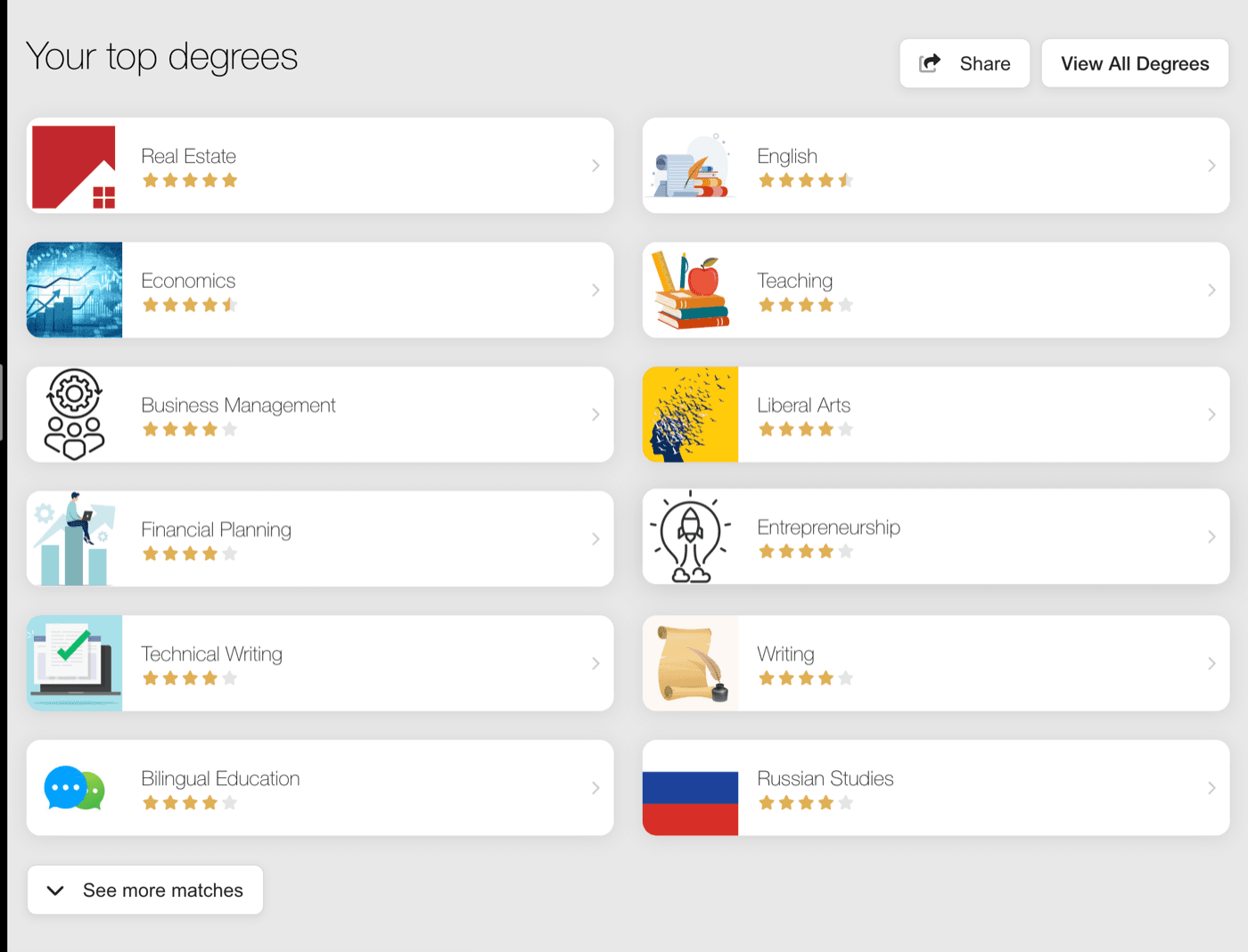
The degrees list was the same shape - Real Estate at five stars, then English, Economics, Teaching, Business Management, Liberal Arts, Financial Planning, Entrepreneurship, Technical Writing, Writing, Bilingual Education and Russian Studies. For a student choosing a major this is a genuinely useful long list. For someone twenty years into a career it is noise.
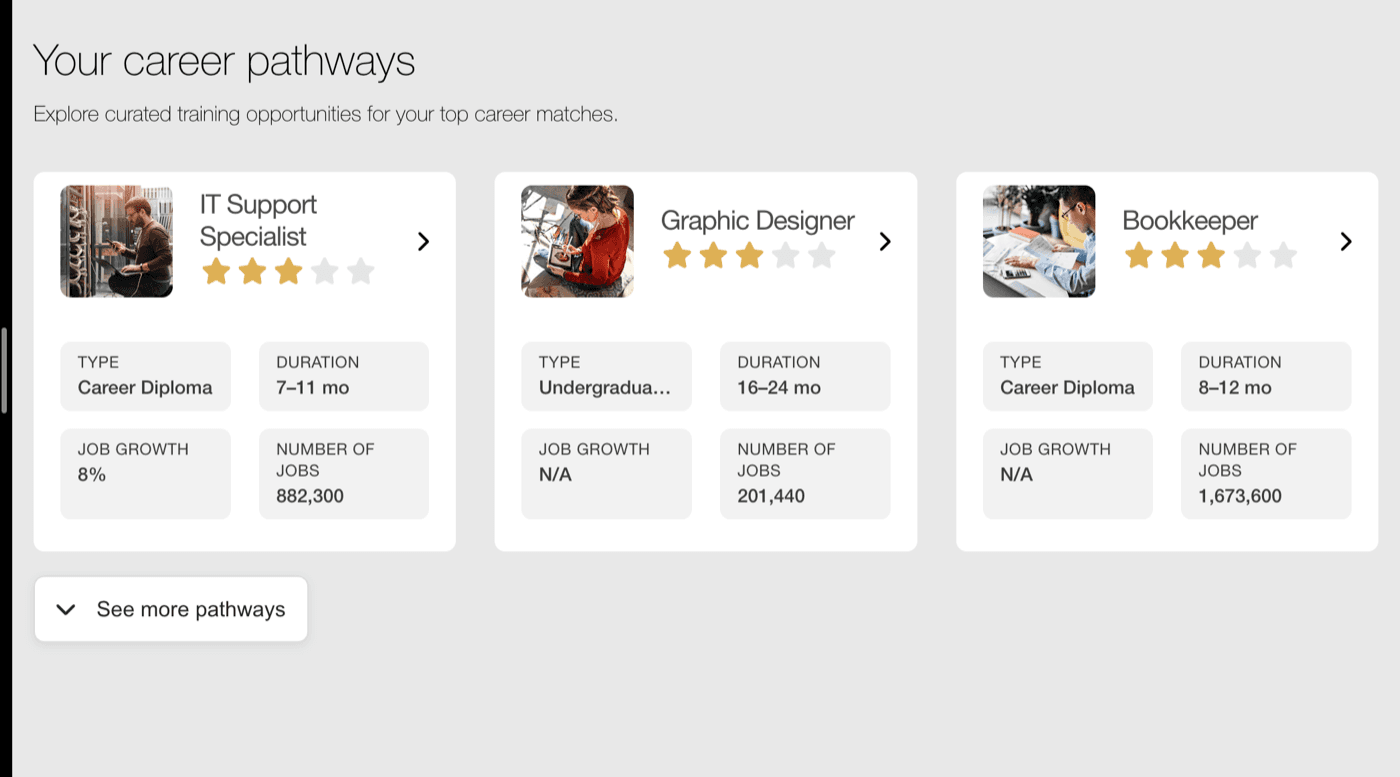
Below that sits “Your career pathways” - training programs for IT Support Specialist, Graphic Designer and Bookkeeper, with durations, job growth and job counts. Note that none of those three appeared in our top careers. This block is how a free test with a 1,500-career database pays for itself: it is a referral surface for education programs. That is fair, and the labour-market numbers on the cards are real and useful; just read it as an advert, not a recommendation.
Where it genuinely shines
Breadth and rigor at zero cost. The machinery is credible - Big 5 personality dimensions plus Holland Codes, scored across 140+ traits, matched against 1,500+ careers and degrees, with a model their team says is trained on hundreds of millions of responses. No other free test scores this many dimensions, the archetype and trait reports are richer than most paid ones, and the degree matches are something almost no career test offers at all. If you are early in a search and want the widest credible scan of the option space, this is the free tool that does it.
The honest limits
Three, and they matter more the further you are into your career. First, it scores a questionnaire; it never reads you. Every item is fixed-choice, so the result can only be a match against categories - it cannot weigh the sentence you would have written about why you actually want out, what income your life requires, or the idea you keep circling. Our run never asked. Second, a ranked list is not a decision. Ten star-rated careers from blogger to bank manager is an option space, and if you are the kind of person who has been stuck because the option space feels infinite, more options is the opposite of help. Third, the time and the registration wall are a real cost for someone who mostly needs a first signal - and the wall lands after you have done all the work.
CareerExplorer vs. Make the Leap - the honest spec sheet
We build the competing tool, so here is the comparison as specs, not adjectives - they are genuinely different instruments for different questions:
| CareerExplorer | Make the Leap | |
|---|---|---|
| Time | Long - plan on their quoted 30 minutes; multiple sections | About 10 minutes |
| Input | Rate single tasks, then random careers and degrees, Hate it to Love it / 1-5 stars | 30 questions, several in your own words - which it reads |
| Output | Archetype + star-rated careers and degrees from a database of 1,500+ careers | 3 named paths with income ranges + resistance pattern |
| Account | Email, first name and birth date before the full results (archetype shown earlier) | None to take it; email at the end to deliver results |
| Price | Free; sponsored training programs on the results page | Free; Career deep-dives $29 (Brief) / $79 (Roadmap) |
| Best for | The widest credible scan of the option space, including degrees | A specific direction, checked against your income reality |
Who should pick CareerExplorer
If APT is also on your shortlist, our APT AI vs CareerExplorer comparison weighs the two for experienced professionals choosing their next direction.
Students and early-career explorers, honestly, are the best fit - people whose real question is “what exists that would suit me?” and who benefit from breadth, and who can use a degree list. It is also the right pick if you want the most thorough scored assessment available without paying, and you have the patience for it. Take it alongside a written-answer tool rather than instead of one: the combination of a wide scan and a deep read beats either alone.
If you are an experienced adult whose question is “which specific direction, and can I afford it?” - our free career quiz is built for exactly that: about 10 minutes, reads your own words, and returns three named paths with income ranges rather than a ranked database. Both are free; they answer different questions. If you want a validated instrument with a one-time paid report instead, read our first-hand Truity review; for the subscription chat-mentor route, our first-hand APT AI review and the Apt alternatives comparison. For the full landscape, see our honest list of the best free career tests, the AI-native tools comparison, or how to interpret any career test result. If you'd rather see what the newer AI-driven approach looks like, our AI career test shows its full result for a name and an email at the end, no account and no card.
Want your results without the registration wall?
Our assessment is free end-to-end - 30 questions, three specific paths with salary ranges, full results before any payment.
Take the free assessmentFrequently asked questions
Is the CareerExplorer test free?
Yes - we took the whole thing on September 22, 2026 and were never asked for a card. The catch is registration: it shows you an archetype label part-way through, but before the full results page it asks for an email, a first name and a birth date. So you pay with your details, not money. A premium tier (roughly $15/month at points) has come and gone historically and we did not encounter one in our run, so the exact upsell you see may vary.
How long does the CareerExplorer assessment take?
Longer than its own '~3 min' section labels suggest. Our screenshots run from 12:55 to 1:07 PM with the first sections already underway before the first capture, and the sidebar labels the results stage alone at about 20 minutes. Plan on the 30 minutes their site quotes. It is the longest mainstream free career test, and it feels it.
Is CareerExplorer accurate?
For what it measures, it is one of the more rigorous free options: Big 5 plus Holland Codes, scored across 140+ traits, trained on a very large response base. In our run the results were plausible but generic - ten careers spanning blogger, bank manager and real estate appraiser - and they appeared the instant we submitted the registration form. Every input is fixed-choice, so it never reads anything you would write in your own words: your constraints, your history, the thing you keep circling.
Is CareerExplorer legit?
Yes - as career-matching platforms go it is one of the more credible. It is built on two validated frameworks (Big 5 and Holland Codes), operated by Sokanu, has been running for years, and its free tier delivered what it promised in our September 2026 run. Legitimate does not mean situational, though: it scores a fixed questionnaire, so treat its ranked matches as a credible option space, not a personal verdict.
CareerExplorer vs 16Personalities - which should I take?
Different jobs. 16Personalities is faster (~12 minutes) and better if what you want is self-understanding - a type and a rich profile of how you're wired. CareerExplorer is longer but actually career-focused: its output is ranked career matches, not a personality label. If your question is 'what am I like?', take 16Personalities. If it is 'what careers fit me?', CareerExplorer is the stronger free pick of the two.
What are the best CareerExplorer alternatives?
Depends on the gap you're filling. For a no-account, government-backed baseline: the O*NET Interest Profiler. For a validated personality instrument with a paid deep report: Truity - see our first-hand Truity review. For a faster assessment that reads your own written answers and returns three named paths with income ranges - built for working adults deciding on a change rather than students exploring - Make the Leap's free assessment is our own tool, and the full result is free. Most people get the best picture from taking two different kinds and comparing.

Written by Jon Miksis - entrepreneur, retreat facilitator, and founder of Make the Leap. Jon has facilitated 6 immersive retreat experiences, attended 18 retreats across four continents, and spent 5+ years researching why smart, capable people stay stuck. He's traveled to 73 countries and invested over $120,000 in personal development. Guides on this site are built from Make the Leap's assessment data and reviewed by Jon; the methodology and its limits are published here.