September 22, 2026 · Updated September 22, 2026 (first-hand edition) · 10 min read
JobTest.org Review (2026): We Took the Test. Here's What's Waiting at the End.
We build a competing career assessment - read this knowing that. This page replaces an earlier edition written from their public pages alone: we have now answered every question ourselves.
The short version
We took the whole test on September 22, 2026 and reached the end with nothing to read. There is no free result - not a partial one, not a teaser of one career.
- What you pay: a subscription, not a report - $29.99/month billed monthly, $19.99/month billed quarterly, and an annual plan displayed at $9.99/month (that row was cut off in our capture, so the annual figure is unconfirmed). No price appears anywhere before you have answered everything.
- What you see first: a countdown - “You will lose access to your report in: 14:54” - on a page where you have not yet seen a report.
- The numbers: nine different user counts across their site and test, from 100,000 to “over a million.”
- What is genuinely good: a handful of unusually specific questions we have not seen in other career assessments, and a real human coaching arm behind the product.
- Still unverified: the report. We did not subscribe, so we make no claim about what the paid product contains or whether it is any good.
- The contrast we build: our own assessment shows the complete personalized result - Work DNA type, resistance pattern, three named paths with income ranges - with no card at any point and paid depth optional on top.
First, the part that is genuinely good
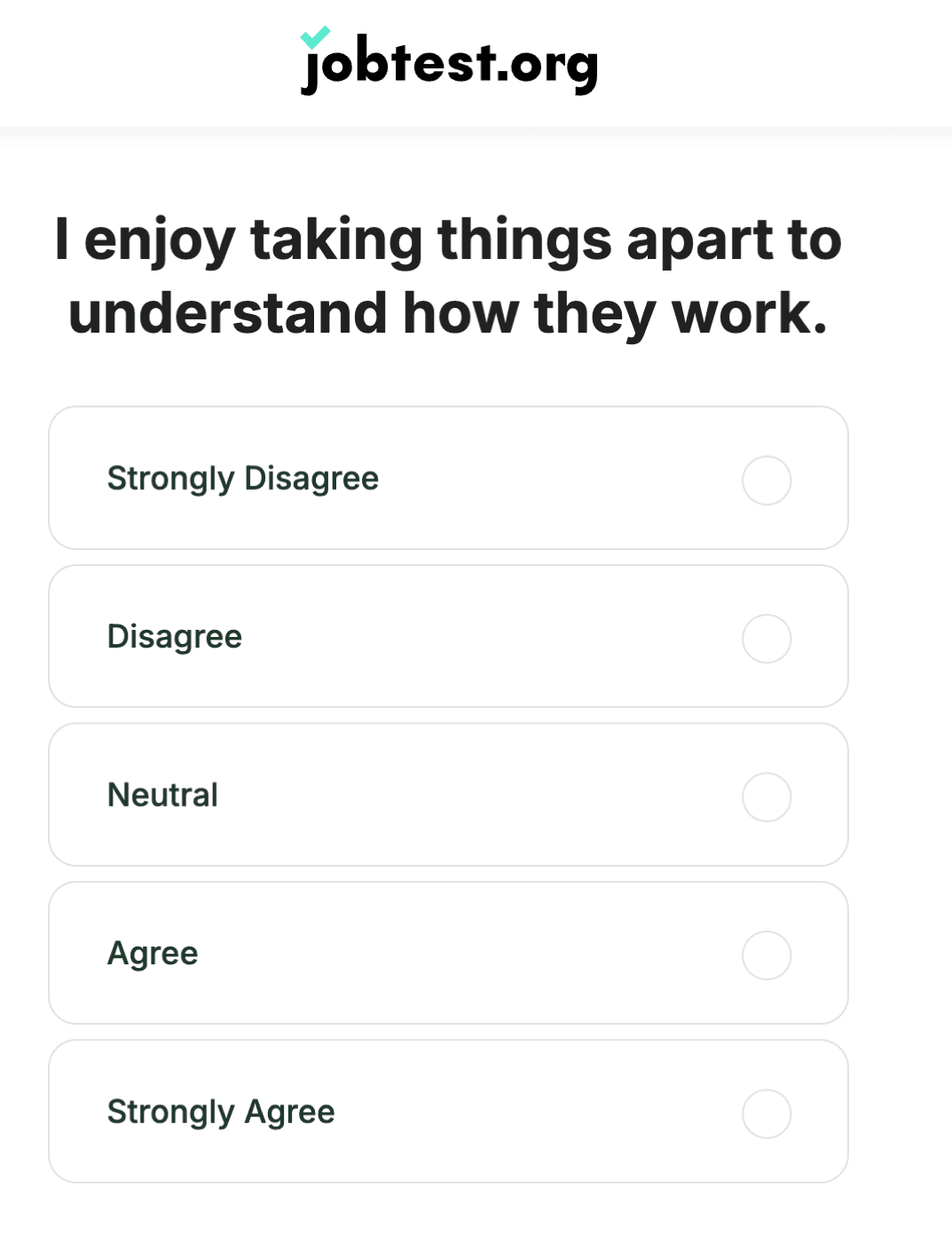
Some of JobTest's questions are better than the category standard. Not the personality boilerplate - the specific ones. “I enjoy taking things apart to understand how they work” is a real signal about how somebody engages with a problem, and it is not a question we have seen in other career assessments.
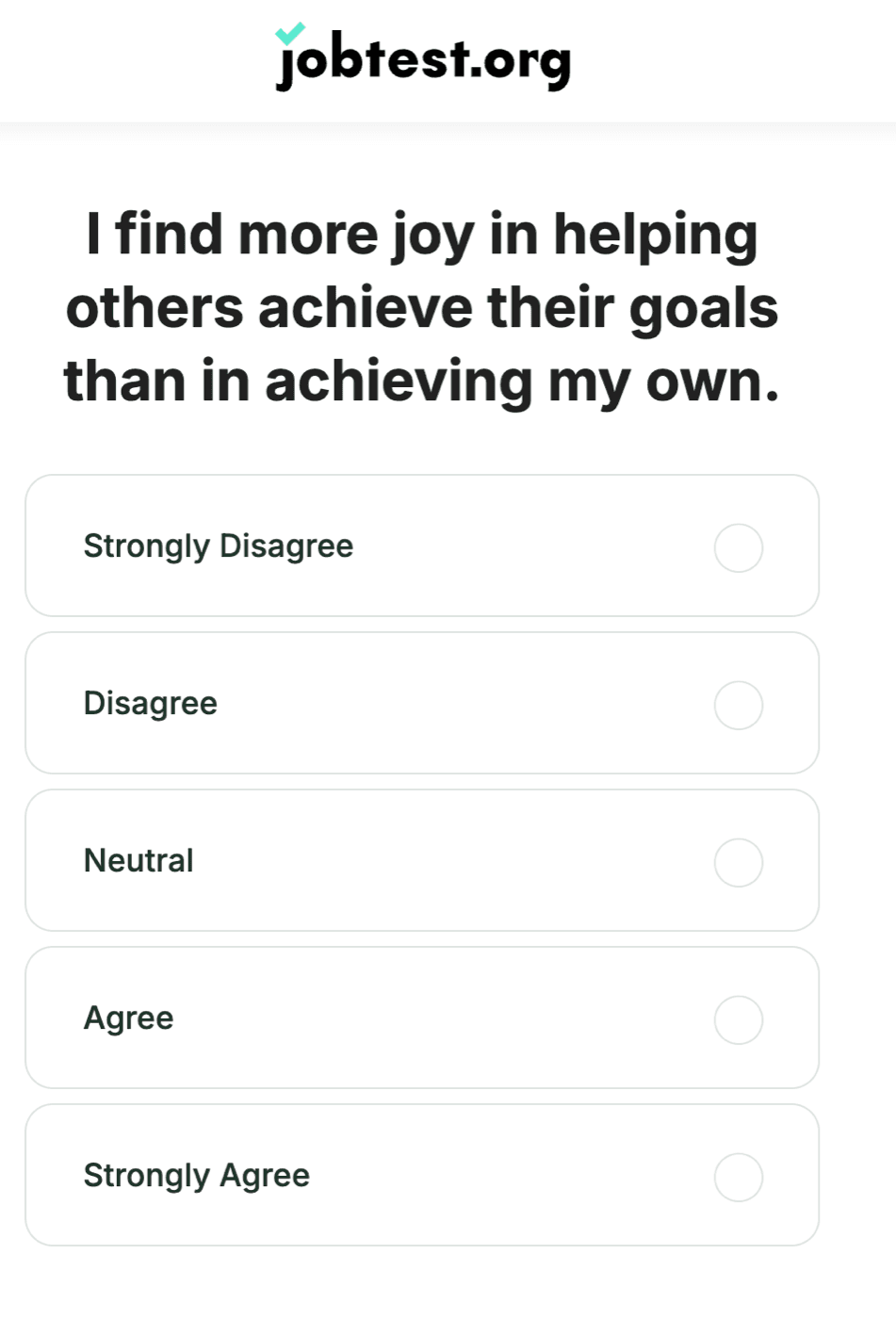
A question about whose goals give you more satisfaction does the same work - oddly specific, and useful because of it. These are the best items in the set.
The business behind it is also clear-headed in a way most of this category is not. It is an assessment that feeds a human career-coaching offer, and human coaching is a genuine answer to a genuine need - one we do not sell. We have written at length about when a coach beats a tool; if that is the part you want, the coaching arm is the reason to look at them.
What the questions are actually like
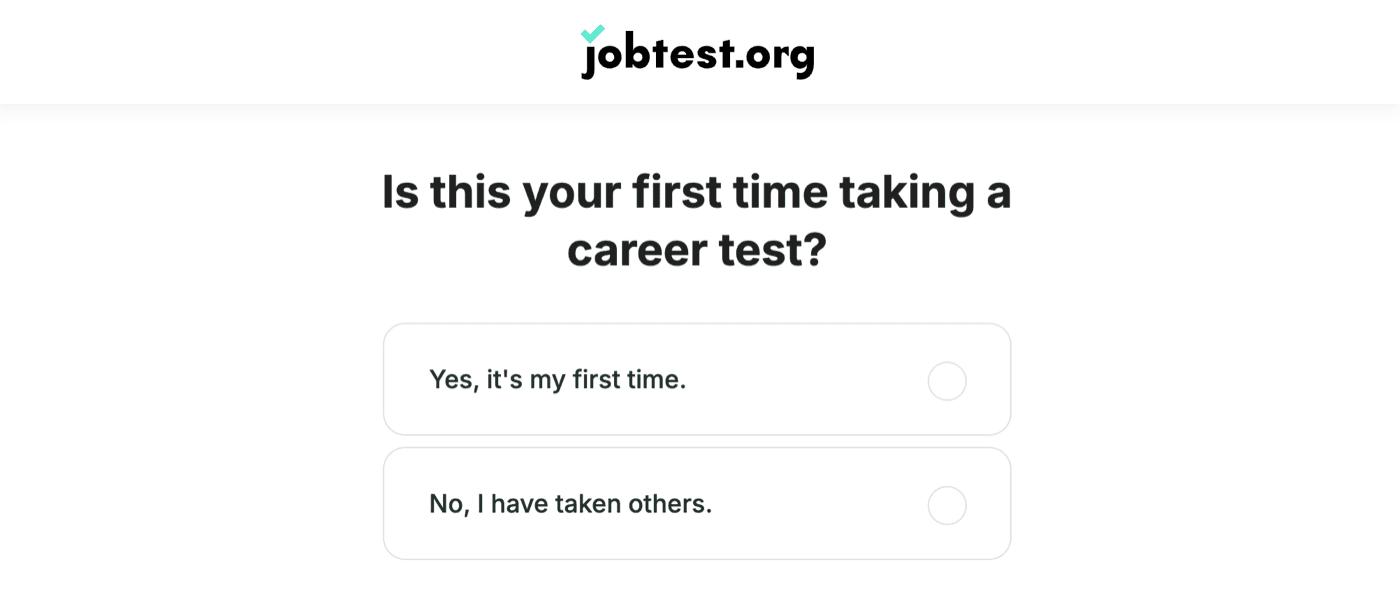
The opening is standard - how you found them, whether this is your first career test. Then it widens, and not all of it is aimed at a career.
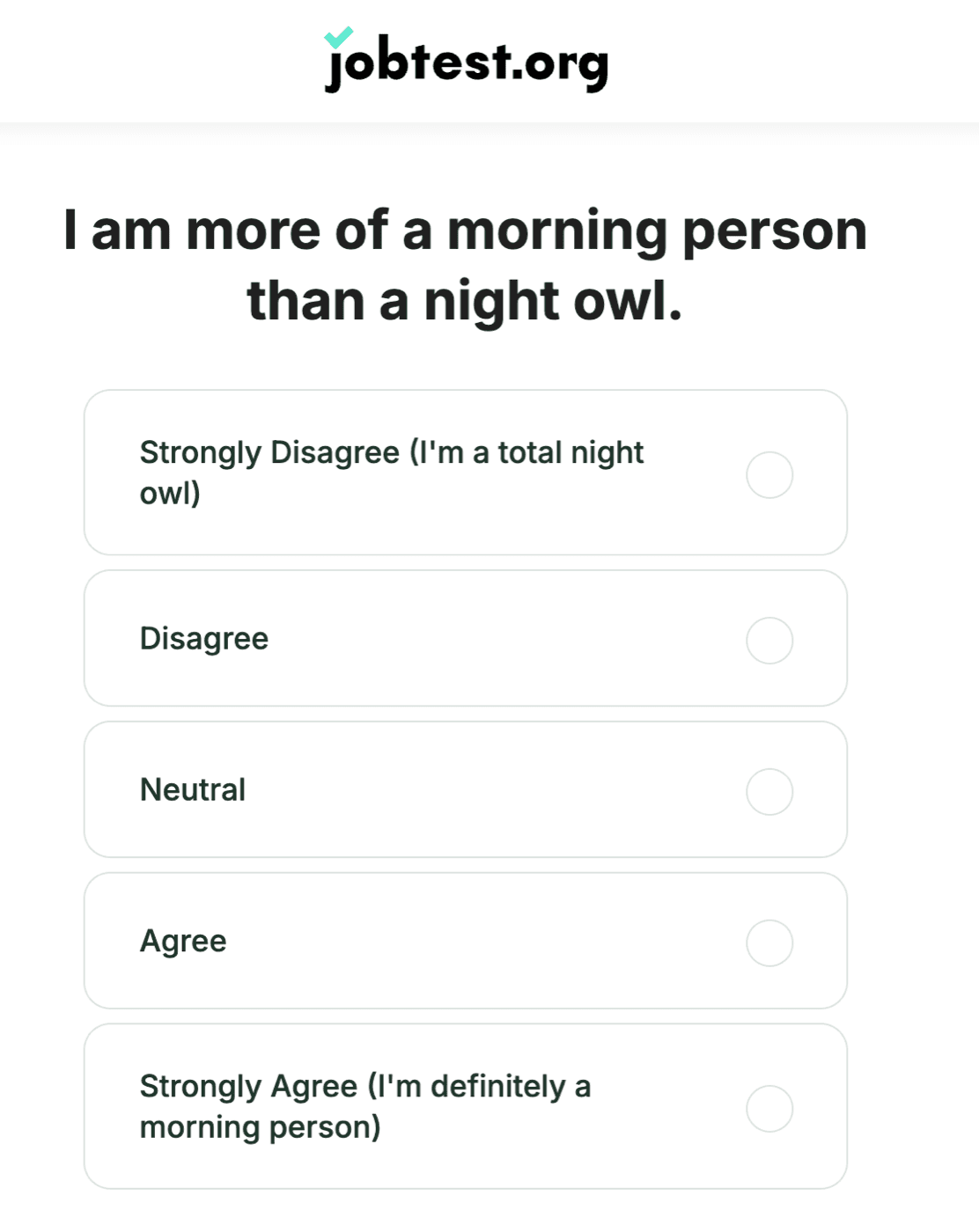
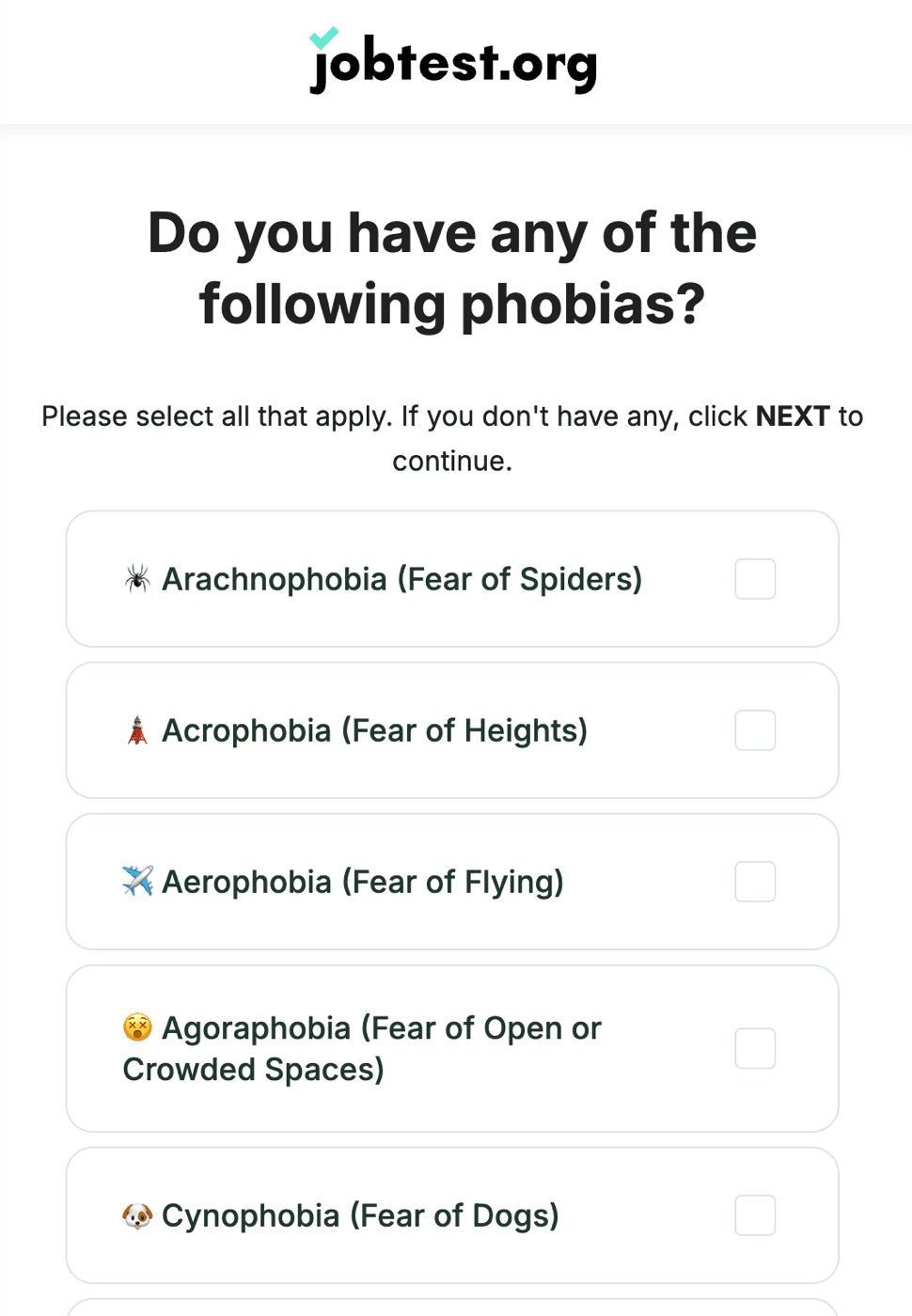
A stretch of it is generic. Morning person or night owl is the clearest example - a real trait, but it is not clear what it is doing in a career assessment, and a checklist of phobias raises the same question. Neither is wrong to ask; both are a long way from the thing you came to find out.
One item asks you to choose between two images - a surreal landscape and a set of puzzle pieces. We would take a landscape over a puzzle most days and still did not want to pick this one: the image is unappealing, which is a strange thing to have standing between a person and their answer. When the picture is the instrument, the art is doing the measuring.

The whole set runs long and repetitive - the same ground asked again in slightly different words, often enough that it starts to feel like too much. Some of that is deliberate; reliable instruments do re-ask items to check consistency. It still costs the person answering, and nothing in the flow tells them why it is happening.
The end of the test: a long load, then an offer

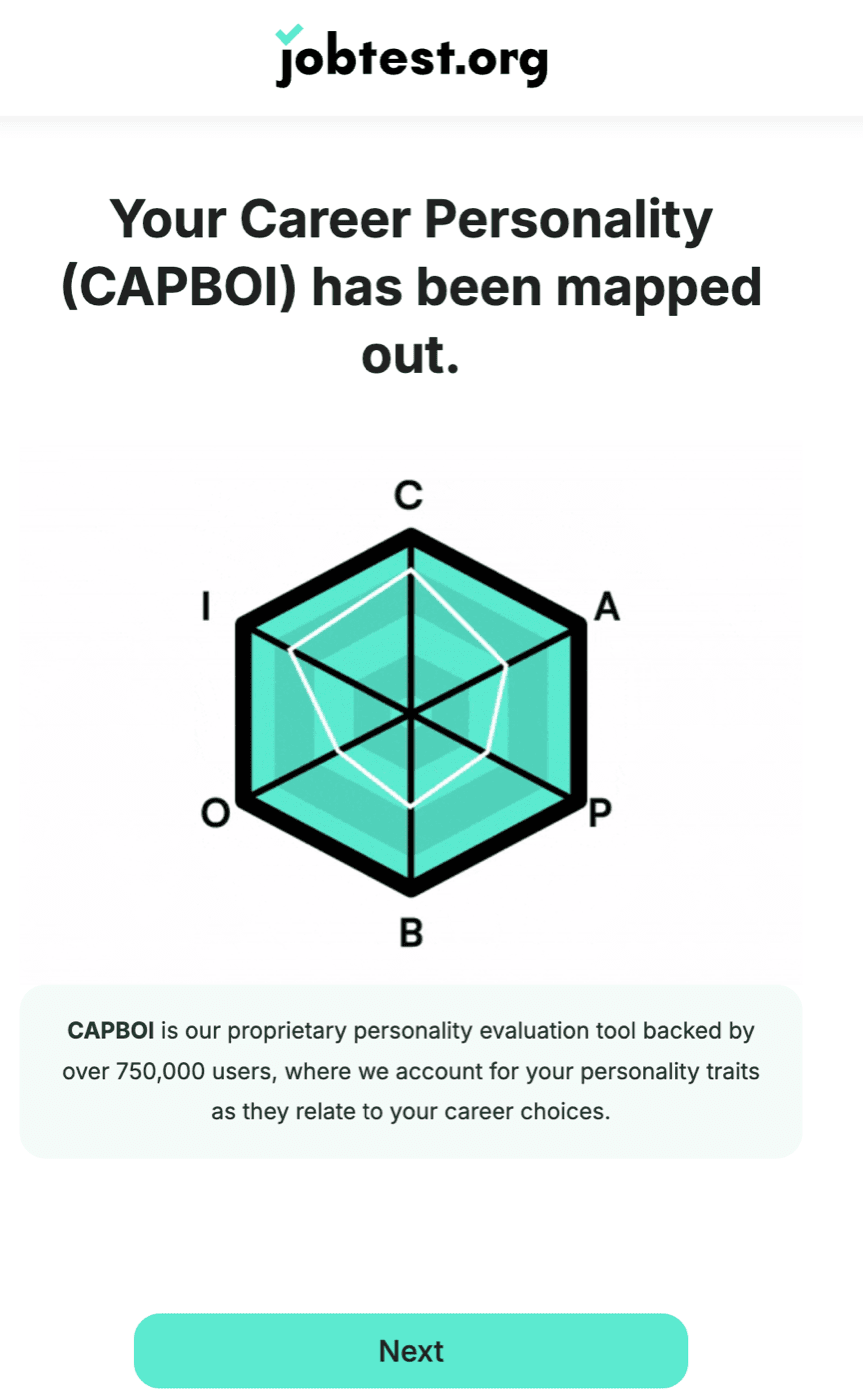
After the behavioural section, a results screen: a hexagon of six letters - CAPBOI - with no key, no scores, and no explanation of what any letter stands for, under the line “backed by over 750,000 users.” Another user count, different again from the ones on the public pages, which leaves the obvious question: which number is it?
Then a loading screen, which ran for roughly three to four minutes - our estimate at the time, not a stopwatch reading. Two checkable facts sit side by side here: the wait was minutes long, and what loaded at the end of it contained no result. (CareerExplorer's results page, in our run the same day, appeared instantly.) We cannot see what the server was doing, so we do not call the delay artificial - only that four minutes is a long time to wait for a sales page.
What appeared was not a result. It was a sales page, headed “Goodbye Uncertainty. Hello Clarity. 20 minutes today will change your next 20 years.” Below it: a “100% money back guarantee” badge, “850,000 people found direction - your turn is now” (another count, different again), a line reading “Designed by career experts... Our 30+ experts” above a row of university logos - UCLA, Johns Hopkins, Stanford, Chicago, Northwestern, Harvard, Duke, MIT, Penn, Yale, Cornell, Princeton - with no stated relationship between those universities and JobTest anywhere on the page.

And a number. “$625,000 - We believe your earning potential can be $625K and more. That's a 150% increase from your current salary, and you have the qualification and skillset to get there.” No reasoning was shown for it: not which paths produce it, not over what horizon, not which of our answers it was derived from. It is the single most consequential claim on the page and it arrives with nothing attached.
Running along the bottom, a sticky bar: “You will lose access to your report in: 14:54” with an Unlock My Report button and a live countdown. A report we had not seen, on a page that had shown us no part of it. The checkable fact is exactly that: the timer counts down access to something that was never displayed, on a roughly fifteen-minute clock. We think that is an indefensible way to sell - a report that “disappears” before the buyer has read a line of it.
The rest of the page is coach cards with star ratings and clients-served figures, “Get 4 hours of live career coaching a month - for less than $1/day,” a claim that “99% received a job interview within 3 months,” and a wall of reviews timestamped “Just now,” “12 hours ago,” “1 day ago.”
Intent is not something we can observe, so here is the sequence instead: every question answered, three minutes of loading, zero output, a countdown, and a subscription. It felt to us like a bait and switch, and the screenshots above are the reason we say so.
The design difference that end screen makes vivid
We build the other kind of product, and this is the clearest place to say what the difference actually is. Our career assessment shows the complete personalized results page before you are asked for a payment: your Work DNA type, your resistance pattern, three named career paths with income ranges, and the written synthesis behind them. No account, no card - a first name and an email at the end open the page and send you a copy. The paid tiers ($29 (Brief) / $79 (Roadmap)) are optional depth on top of a result you have already read in full. One product shows you everything it found and then offers more; the other showed us nothing and started a timer. We build it, which is why we are telling you - and why the full result is readable without paying rather than described.
The price, finally - and it is a subscription
This is the thing their public pages never said. It is not a report you buy once. It is a recurring plan, presented as three tiers with identical contents:
From the offer page at the end of our own run, September 22, 2026. Every tier listed the same contents. We did not subscribe, so nothing beyond this screen is verified.
Every tier lists the same nine things - Top 10 Career Paths, Detailed Personality Types & Insights, Tailored Career Strategy, Unlimited Quiz Retakes, Resume & LinkedIn Optimization, Personalized Job Board, Job Opening Alerts, Weekly Live Career Coaching, and 2 Hours of Coaching per Month - under “Unlimited access with a flexible subscription - cancel anytime.” The footer names the company: Realign, Inc. (Jobtest.org).
Set that against what their public site says. There is still no price on any public page we inspected: we requested jobtest.org/pricing and the server returned the homepage. Their FAQ answers “How much does a career test cost?” with “Though it is entirely possible to find a free career test, the majority of paid tests range between $19.95 and $200.00. At JobTest.org, we provide various pricing plans so that you can decide which career test report and support is best for you.” That is a range for the market, and it describes a test you buy. The product at the end of the funnel is a monthly subscription. A visitor deciding whether to spend twenty minutes has no way to learn that before spending them.
Two different refund promises on one product
Their FAQ, in full: “If your report fails to identify any career paths based on the answers you provided to the test, we will offer a full refund of the cost of the test.” Read the condition: the trigger is the report identifying no career paths at all. A report naming ten careers you would never do has, on that wording, done what it promised.
The end-of-test page says something else: “100% Money-Back Guarantee: If our report doesn't deliver what it promises, we will refund your money. Please double check our Refund Policy,” beside a “30-day money back” badge. That reads as a satisfaction guarantee. The two sentences set different bars, and the one a buyer sees at the moment of payment is the looser one. We did not subscribe, so we cannot tell you which promise is honoured in practice; we can only tell you there are two.
Nine different user counts, none of them defined
This was the first thing we noticed, before the test even started: different social-proof numbers on different pages, with no way to tell whether they have 100,000 users, 300,000, 850,000 or a million. Here is the full count, with where each one appears.
All nine observed on September 22, 2026, during and around our own run. Counts their site writes with a trailing plus sign are rendered here as “-plus.”

What is observable is the list above: nine different figures, on different pages, mixing at least three things - reports created, coaching clients, and users - with no date and no definition attached to any of them. Several are lower bounds (“over 300,000,” “over a million”), and a lower bound can be literally true of the same population at the same time as a larger one. So we are not saying any single figure is false; we have no way to check any of them. What a visitor cannot do is tell which number is current, or what any of them counts - and read cold, nine unexplained figures do not build confidence. They cost it.
This is also why we publish no star rating of our own anywhere on this site. The career-test page displays a self-reported 4.8 out of 5 and “3,568 customers in the last 30 days”; the offer page displays “265 people purchased in the last 24 hours” and reviews stamped “Just now.” A number nobody outside the company can audit is decoration, not evidence - ours would be too.
What we still cannot tell you
Being specific about the hole is more useful than papering over it. Unverified by us: what the report contains, how personalized it is, whether the Top 10 Career Paths are any good, what the $625,000 figure was computed from, whether the coaching is worth the plan, whether the countdown does anything at 0:00, and whether either refund promise is honoured. All of that needs a subscription, and we did not take one. If that changes, this page gets rewritten with a date attached.
What we would tell you to do instead - and the one carve-out
If what you want is a career assessment result, take ours instead. That is a recommendation from the people who build it, stated plainly rather than buried: it is about 10 minutes, it reads several answers in your own words, and it shows you the whole result - Work DNA, resistance pattern, three named paths with income ranges - with nothing to buy. If it is not useful you have lost ten minutes and no money, which is not the trade JobTest's end screen offers.
The honest carve-out, and it is a real one: you want a human coach. The coaching arm is real, it is the centre of the business, and it is a service we do not sell - if a monthly plan with live sessions is the shape of help you want, this is a legitimate place to look, and the assessment is the front door to it. The same goes if what you actually want is an ongoing job-search subscription - a job board, alerts, resume and LinkedIn work, unlimited retakes - and you are comfortable buying that sight-unseen. Those features are the bulk of what the plans list.
For everyone else: you will not get an assessment result without a recurring plan, you will not learn the price until you have answered everything, and you will make that decision under a countdown with no output in front of you to judge. There is no reason to buy blind when a complete result is free to read.
JobTest.org vs. Make the Leap - the honest spec sheet
We build the competing tool, so here it is as specs rather than adjectives. The JobTest column is what we saw on September 22, 2026; the rows we could not verify say so.
| JobTest.org | Make the Leap | |
|---|---|---|
| Price | Subscription: $29.99/mo monthly, $19.99/mo quarterly; annual displayed lower at $9.99/mo, unconfirmed. Not published on any public page | Free; Career deep-dives $29 (Brief) / $79 (Roadmap) |
| Free result | None. An unexplained six-letter code and an earning-potential figure; no career paths | The complete result: Work DNA, resistance pattern, 3 named paths with income ranges |
| Input | Multiple-choice personality and preference items, some repeated in different words; one image-preference item | 30 questions, several in your own words - which it reads |
| When you learn the price | After every question, on a page with a countdown | Before you start; the assessment and its result are free |
| Output we verified | The paid report is unverified - we did not subscribe | 3 named paths with income ranges + personalized analysis |
| Human coaching | Yes - live sessions included in the plans | No live coaching; we do not sell it |
FAQ
Is JobTest.org free?
The test is free to take. The results are not. We took the full test on September 22, 2026 and reached the end without paying anything - and what we got was an offer page, not a result. No career paths, no personality profile beyond an unexplained six-letter hexagon, no report content of any kind. Every tier of the subscription has to be bought before you see a single match. So: free to answer, paid to find out.
How much does JobTest.org cost?
It is a subscription, not a one-time report - which is the thing their public pages never told us. At the end of our run on September 22, 2026 the options were $29.99/month billed monthly, $19.99/month billed quarterly (marked MOST POPULAR), and an annual plan shown at $9.99 (the monthly-equivalent figure; that row was cut off in our saved copy, so treat the annual total as unconfirmed). Every tier listed the same contents. Their public pages still publish no price at all - our request for their /pricing URL returned the homepage - and their FAQ answers the cost question with a market range, "the majority of paid tests range between $19.95 and $200.00," which describes the category rather than what they charge you.
What do you get without paying?
In our run: nothing. After the last question the page loaded for about three minutes and then showed a sales page. The only piece of output on it was a six-letter hexagon labelled CAPBOI, presented without a key or an explanation, and a line claiming our earning potential was $625,000 - with no reasoning shown for the figure. Everything a career test is for - the paths, the personality read, the strategy - was listed as a feature of the plans, not displayed.
Is JobTest.org legit?
There is a real company behind it - the end screen names Realign, Inc. (Jobtest.org) - with a real product, a paid human coaching arm, and a refund policy. What we can say from our own run is narrower and still worth knowing: you answer every question before you learn the price, the price is a recurring subscription rather than a report, a countdown starts on the offer page, and the user counts on their own pages range from 100,000 to over a million. Those are reasons to decide with your eyes open.
What is JobTest.org's refund policy?
There are two different promises, and they do not say the same thing. Their FAQ: "If your report fails to identify any career paths based on the answers you provided to the test, we will offer a full refund of the cost of the test." The end-of-test offer page: "If our report doesn't deliver what it promises, we will refund your money. Please double check our Refund Policy," under a "30-day money back" badge and a "100% money back guarantee" headline. The first is conditioned on the report naming no career paths at all; the second sounds like a satisfaction guarantee. We did not buy, so we cannot tell you which one is applied in practice - only that a buyer is reading two different guarantees on one product.
How long does the JobTest.org career test take?
Their claim is "under 20 minutes," and the end screen promises "20 minutes today will change your next 20 years." Our run was in that neighbourhood for the questions themselves, plus roughly three minutes of loading at the end before the offer page appeared. We did not stopwatch it, so we are not publishing a figure of our own. The question set is longer than it needs to be in one specific way: it asks the same things in slightly different words more than once.
Why do JobTest.org's user numbers not match?
Because they are different numbers on different pages, and on September 22, 2026 we counted nine of them across the site and the test: 100,000 and 300,000 on the coaching page, 300,000 and "half a million" on the homepage, 600,000 reports and 300,000 professionals on the career-test page, 750,000 on the in-test results screen, 850,000 on the end-of-test offer, and "over a million" in the homepage hero. They mix at least three things - reports created, coaching clients, users - and none carries a date or a definition. Several are lower bounds ("over 300,000", "over a million"), which can be true of one population at once, so we are not calling any single figure false. What a visitor cannot do is tell which number is current or what any of them counts.
What are the best JobTest.org alternatives?
Depends on which part you did not like. If it is paying before you see anything, Truity shows real scores free and sells a one-time report, and the U.S. Department of Labor's O*NET Interest Profiler is free with no account at all - both have first-hand coverage on this site. If it is the subscription, CareerExplorer's full results are free once you register. If you are mid-career and what you need is named directions with income ranges built from your own words rather than multiple-choice buckets, that is what our own assessment does, free in full - we build it, so weigh that accordingly.
If you want the result before the price
Our assessment asks 30 questions about your actual situation - including open text it reads as written - and returns three named career paths with income ranges checked against what you said you need. The full result is free, with no plan to choose and no countdown.
Take the free assessmentRelated reading
- Best AI career assessment tools - the whole field, with the free/paid boundary marked and dated for each tool
- Truity career test review - a validated instrument that shows real free scores before asking for anything
- CareerExplorer review - the big free-with-account assessment, taken end to end
- Zippia career quiz review - free results behind an account wall, taken first-hand
- APT AI career test review - the other subscription-behind-an-assessment product, taken first-hand
- Do you need a career coach? - when the human option is the right purchase, written by people who sell the other one

Written by Jon Miksis - entrepreneur, retreat facilitator, and founder of Make the Leap. Jon has facilitated 6 immersive retreat experiences, attended 18 retreats across four continents, and spent 5+ years researching why smart, capable people stay stuck. He's traveled to 73 countries and invested over $120,000 in personal development. Guides on this site are built from Make the Leap's assessment data and reviewed by Jon; the methodology and its limits are published here.