August 30, 2026 · 11 min read · First-hand + data
What Does a Blogger Actually Do? Nine Years In, With the Numbers
Most answers to this question are written by people who have never run a blog. This one is written by someone who has run one for nine years, and who has spent seven of them coaching other bloggers across travel, food, personal finance, health and fitness, technology and lifestyle. Where it makes a claim about money, the number comes from 24,370 career assessments, not a guess.
A blogger researches, writes, publishes, distributes and monetizes content on a website they usually own. In practice, professional blogging is much more than writing: a working blogger splits their time between producing content, search optimization, growing an audience, negotiating partnerships, reading analytics, and keeping the site running. Most people who do it full-time earn from advertising, affiliate commissions, brand partnerships, or their own products rather than from the writing itself.
The short version
- The job is four jobs. Writing, search, business development, and site operations, and drafting is usually the smallest of them.
- The pay is real but late. Creator-titled paths in our data start at a median $15K-$30K, and blog income lags the work by a year or more because it is asset income, not wages.
- The same skills pay 2.4–3.3× more elsewhere. Creator-titled paths start at a median $15K-$30K. Salaried writing careers using the identical skill set start at $45K-$62K (content writing) up to $65K-$85K (technical writing): that is the midpoint range.
- Nearly 1 in 11 career changers want this: 8.96% of 24,370 name blogging or content creation unprompted, and they are mostly teachers, assistants, and nurses.
- Almost everyone should start it on the side. Not as a hedge, because the unpaid runway is the thing that ends most attempts.
| Blogger career | The reality |
|---|---|
| Degree required | No, there is no credential or gatekeeper |
| Typical setup | Independent or freelance; some corporate/in-house roles |
| Income models | Ads, affiliate, brand partnerships, own products or services |
| Modeled starting range | $15K-$30K (median across 940 matched paths) |
| Adjacent writing careers | $45K-$62K–$65K-$85K to start: same core skill, salaried |
| Best for | Self-directed builders who can work without feedback for months |
| Biggest obstacle | The unpaid runway before income compounds |
| AI exposure | High for commodity how-to content; far lower for first-hand and original work |
What a blogger actually does
The standard answer is a list: create content, manage the blog, engage the audience, do SEO, promote, monetize. It's accurate the way “a restaurant serves food” is accurate. What it misses is the proportions, and the proportions are the entire job.
Writing is the smallest part. In a representative week, drafting is usually a minority of my hours. The rest splits across four things nobody warns you about:
1. Search work, which never ends
Deciding what to write is a research job before it is a writing job: what people actually typed, what already answers it, and whether you can answer it better. Then there's the unglamorous half: going back to posts written two years ago that have started slipping, and rewriting them. A mature blog spends serious time defending work it already did. Nobody puts that in the job description.
2. Business development
Most blog income does not come from writing; it comes from deals. Pitching brands, negotiating rates, delivering to contract, invoicing, chasing invoices, managing affiliate relationships, tracking what converts. If you dislike selling, this is the part that decides whether the blog becomes a business or stays a hobby with an audience. In seven years of coaching bloggers, this is the single most common place talented writers stall.
3. Operations
Site speed, broken links, hosting, image optimization, email deliverability, the plugin that breaks the layout on mobile. It's a small tech load in absolute terms, far smaller than beginners fear, but it's permanent, and it always arrives on the day you planned to write.
4. Deciding, repeatedly, without feedback
The hardest part is not any task. It is that for a long stretch, nothing you do produces a visible result. You publish into silence and choose to publish again. That is the actual skill the job selects for, and it is why so many people who are excellent writers never build a blog: the work is not hard, the unrewarded work is hard.
What blogging pays, and what our data can and can't tell you
Blogger salary figures are unusually unreliable, and it is worth understanding why before trusting any of them, including ours. Career databases typically list blogging as an hourly wage (one widely-cited page shows about $12/hr with growth marked “N/A”). That figure is not absurd: annualized, it lands inside the range our own data shows for creator work. The problem is what an hourly figure cannot express.
First: blog income is not hourly. It is asset income. You are building something that earns while you sleep, and it lags the work that created it by a year or more. Expressing it as a wage makes early blogging look like a bad job rather than what it is: an unpaid build phase followed by income that is no longer proportional to hours at all. Both halves of that are invisible in “$12/hr”.
Second, and this is the number nobody publishes: across 73,062 career paths our engine generated for 24,370 real people, the paths titled as blogging or content creation carry a median starting range of $15K-$30K (940 such paths). The writing careers that use the same underlying skills start at a median $45K-$62K.
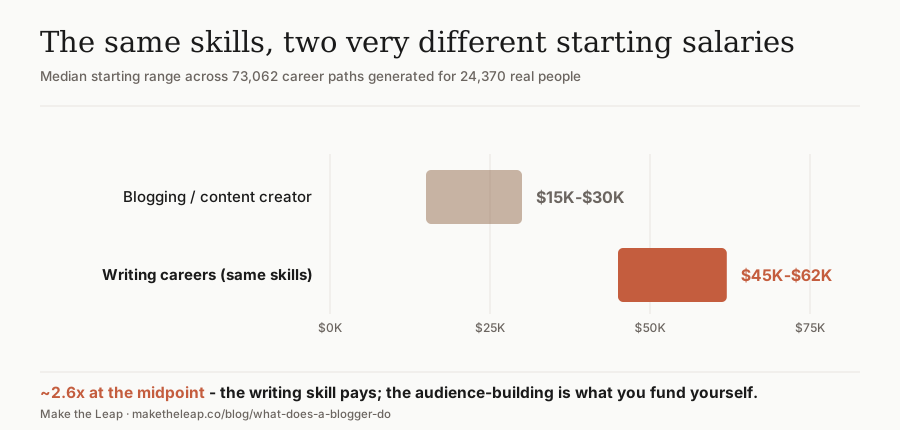
We call this the blogger pay gap: comparing midpoints, roughly 2.4× against content writing and 3.3× against technical writing, for the same core competence. (We show the range rather than a single figure because the answer depends on which salaried writing career you compare to, and picking the widest gap would flatter the point.) That is not an argument against blogging: I've made my living from it for years and would choose it again. It is an argument for knowing what you're choosing: the writing skill has a market price, and blogging is the one option on the ladder where you pay the first year or two out of your own pocket in exchange for owning the asset at the end.
Where the writing money actually is
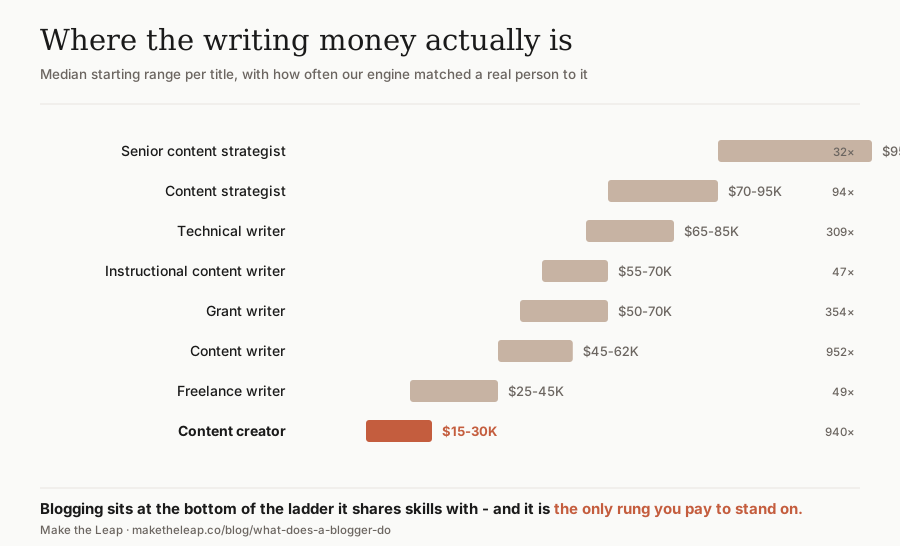
If you are drawn to this work, these are the careers our engine matched real people to, ranked by what they start at. Every row is a title real users were shown, with how often it came up:
| Career | Typical start | Times matched |
|---|---|---|
| Senior content strategist | $95K-$130K | 41× |
| Content strategist | $70K-$95K | 498× |
| Technical writer | $65K-$85K | 309× |
| Instructional content writer | $55K-$70K | 54× |
| Grant writer | $50K-$70K | 354× |
| Content writer | $45K-$62K | 952× |
| Copywriter | $45K-$62K | 220× |
| Freelance writer | $25K-$45K | 175× |
| Content creator | $15K-$30K | 940× |
Two things worth noticing. Grant writing and technical writing dominate the match counts (354 and 309 times respectively) because they convert writing skill into salaried work without requiring an audience. And the route most people never consider is the strongest one I've seen in seven years of coaching: take the paid writing role and build the blog. The skills compound in both directions, and the rent is never riding on this month's traffic.
The types of blogger that actually matter
Career pages sort bloggers by topic: fashion, food, fitness, parenting, travel. Having coached bloggers across most of those niches, I can tell you the topic is close to irrelevant to how the career goes. What decides it is the business model, and there are really only four:
| Model | Income comes from | What it demands of you |
|---|---|---|
| Ad / traffic | Display ads against pageviews | Volume and search durability. Most exposed to algorithm and AI-answer shifts. |
| Affiliate | Commission on what readers buy | Trust and buying-intent topics. Fewer readers needed; more judgment required. |
| Partnerships | Brands paying for access to your audience | Selling. The blog is the portfolio; the income is a client business. |
| Own product / service | Courses, memberships, consulting | The highest ceiling, and the only one where you control pricing. |
A food blogger and a personal-finance blogger on the same model face nearly the same career. Two travel bloggers on different models face completely different ones. If you are trying to work out whether this fits you, that is the question to answer, not which niche you like.
Who actually wants this, and what they do now
Across 24,370 assessments, 8.96% (95% CI [8.61, 9.33]) name blogging, writing, or content creation in their own words when asked what they'd do if money and credentials weren't the constraint: 2,184 people, nearly 1 in 11. Here is what those people do today:
| Current job | Count |
|---|---|
| Teacher | 37 |
| Administrative assistant | 17 |
| Executive assistant | 16 |
| Operations manager | 12 |
| Project manager | 11 |
| Registered nurse | 11 |
Teachers lead, by a distance. Then administrative and executive assistants, operations and project managers, nurses. What that list has in common is not writing training: it's that every one of those jobs uses writing and explaining constantly while crediting neither. The pull toward blogging is often less about wanting to write and more about wanting the writing to finally count as the work rather than the overhead.
Is blogging being replaced by AI?
Partly, and unevenly, which is the answer that matters, because the average hides it. AI answers absorb commodity informational content most completely: the how-to post, the definition, the listicle assembled from other people's work. If that describes a blog, the traffic model is genuinely threatened, and pretending otherwise helps nobody.
What survives is what a model cannot synthesize from the open web: first-hand experience, original data, a recommendation from someone with something at stake, a community, or a product. This article is a small example: the numbers in it exist nowhere else, and the day-to-day description comes from having done the job. That is the entire durability test, and it applies to every blog: if your post could have been written by someone who has never done the thing, assume it is replaceable. The same logic decides which careers hold up more broadly, which we mapped in the four moats of AI-durable work.
The practical read from coaching bloggers through this shift: the ones losing traffic were publishing what everyone else published. The ones holding steady had something proprietary: their own testing, their own photos, their own numbers, or a relationship with readers that a search result does not replace.
How to become a blogger
There is no credential, so the sequence matters more than the qualifications. What I would tell someone starting today, having watched a lot of people start:
- Pick a problem and an audience, not a topic. “Travel” is a topic. “People taking a first solo trip over 50” is an audience with a problem, and it tells you what to write.
- Publish 10–20 genuinely useful pieces before judging anything. Below that you have no data, only feelings. This is where most people quit.
- Learn one distribution channel properly. Search, one social platform, or email: pick one. Spreading across four badly beats none of them.
- Choose an income model early (ads, affiliate, partnerships, or your own product), because it changes what you should be writing from day one.
- Keep your income until the numbers say otherwise. Not caution, arithmetic. The unpaid runway is what ends most attempts, and a salary is the cheapest way to survive it.
Notice what is absent: choosing a platform, picking a theme, buying a course. Those are the decisions beginners spend months on and they are close to irrelevant. The work is publishing, distributing, and outlasting the silence.
Should you actually do it?
After nine years doing it and seven coaching it, the honest filter is short.
Do it if you can tolerate a long stretch of unrewarded output, you are willing to sell, and you want an asset you own rather than a wage. The people who succeed are almost never the best writers in the room: they are the ones still publishing in month fourteen.
Don't make it your only plan if you need income inside a year, you dislike the business half, or you are leaving a job mainly to escape it. Blogging punishes urgency. Two-thirds of career changers in our data say they'd start something on the side rather than take a pay cut, and for this career they are right: the side-first route is the one that survives.
And if what you actually want is for writing to be the job rather than the hobby, look hard at that ladder above before committing to the bottom rung. A grant writer at $50K-$65K and a technical writer at $60K-$80K are using the skill you already have, and either one funds a blog beautifully.
FAQ
What does a blogger actually do all day?
Writing is the smallest part of it. In nine years running a blog that has reached over 10 million people, a representative week looks roughly like: research and writing, then search work (keyword research, structuring pages so they can be found, updating old posts that are slipping), then the business layer, pitching and managing brand or affiliate partnerships, invoicing, analytics, then the technical layer of site speed, broken links, and email. Most weeks the actual drafting is a minority of the hours. Anyone describing blogging as 'writing about what you love' is describing the first year, before the thing becomes a business with operations attached.
How much do bloggers actually make?
Honestly: far less than the internet implies, and much later. Across 73,062 career paths our engine generated for 24,370 real people, the paths titled as blogging or content creation carry a median starting range of $15,000-$30,000, and that is a starting range, not a salary, because blog income is asset income that lags the work by 12-24 months. The number people quote at you is almost always someone's best year, not their third. It is also worth knowing that the same writing skill pays a median $50,000-$68,000 in adjacent employed roles, which is the comparison nobody makes.
Is blogging still worth it in 2026?
As a business, it is harder than it was and it is not passive. Search traffic is more contested, AI answers absorb informational queries, and the audience-building phase is unpaid work you fund yourself. As a skill-builder it is arguably more valuable than ever: running a blog teaches writing, SEO, analytics, audience psychology, partnership negotiation and shipping on a schedule: a bundle that maps directly onto content strategist and technical writer roles paying $60K-$130K. The honest framing is that blogging is an excellent thing to do, and a difficult thing to do as your only income early on.
What skills does a blogger need?
Four, in rough order of how often they decide the outcome. Writing that survives being skimmed. Search literacy: understanding what someone actually typed and why. Enough analytics to tell which work is compounding and which is decorative. And the business skill nobody lists: negotiating and delivering partnerships, because that is where most blogging income comes from. The technical requirements are far smaller than beginners fear; the sustained-output requirement is far larger.
Do you need a degree to be a blogger?
No. There is no credential, license, or gatekeeper, which is genuinely one of the field's best features and one reason it draws people out of credential-heavy work. In our data the people who name blogging or content creation as their dream are most often teachers, administrative and executive assistants, operations and project managers, and nurses. What they have in common is not writing training; it is that their current job burns the skill without ever crediting it.
How long does it take a blog to make money?
In our experience coaching bloggers across lifestyle, personal finance, health and fitness, food, technology and travel, the pattern is consistent across niches: months of unpaid output before anything compounds, first meaningful income somewhere in the second year, and the step-change only after a body of work exists that keeps earning while you sleep. The people who fail almost never fail at writing. They fail at surviving the gap between starting and earning, which is exactly why nearly every credible version of this career starts on the side of an existing income.
Is blogging a good career, or better as a side project?
For most people entering it, side-first is the honest answer, and it is what career changers themselves choose: two-thirds say they would start something on the side rather than take a pay cut. Keep the income, build the asset alongside it, and let the numbers decide the switch. What we would resist is the framing that these are opposites: the strongest outcome we see is people who blog seriously while working in an adjacent paid writing role, so the skill compounds in both directions and the rent is never riding on this month's traffic.
Where does writing actually fit in your career?
Our free assessment reads your actual experience, constraints and income floor and returns three named paths with real starting ranges: the same engine every number in this article came from. If writing belongs in your next move, it will say so, and it will tell you what it pays.
Take the free assessment
Written by Jon Miksis - entrepreneur, retreat facilitator, and founder of Make the Leap. Jon has facilitated 6 immersive retreat experiences, attended 18 retreats across four continents, and spent 5+ years researching why smart, capable people stay stuck. He's traveled to 73 countries and invested over $120,000 in personal development. Guides on this site are built from Make the Leap's assessment data and reviewed by Jon; the methodology and its limits are published here.