April 23, 2026 · Updated August 27, 2026 · 11 min read
Signs It’s Time to Quit Your Job or Change Careers
You’ve read every listicle. You already know. Six signs it’s time to quit your job or change careers — grounded in what 24,061 people actually reported at this exact point — and the real reason having every sign still isn’t enough to get you to move.
You’ve been googling this for a while now. Not every day. But enough that the autocomplete knows what you’re typing before you finish. Signs it’s time to quit your job. How to know when to leave. When to change careers.
You’ve read the listicles. You’ve counted how many of the fifteen signs apply to you. Some months it’s four. Some months it’s eleven. Surely eleven is enough. And still, on Monday, you’re at your desk.
The signs are there. They’ve been there for a while. You already know them — the Sunday tightness, the LinkedIn tab that’s always open, the colleague’s resignation that hit harder than it should have. You’ve been cataloging them quietly for months. Somewhere in a Notes app on your phone there’s probably a half-written list you don’t want to look at.
What follows are the signs it’s time to quit your job and make a career leap — the ones that mean the career itself has stopped fitting, not a passing frustration. The ones that say stop performing a version of yourself that no longer belongs to you.
Read them. See how many land. And at the end, something honest: why having every sign on the list still might not be enough to get you to move.
What this looks like across 24,061 people
Most articles on this topic are one person’s opinion about your life. This one has a denominator. Every figure here comes from 24,061 people who took our career assessment between February to August 2026 — all of them at the exact moment you’re in now, weighing whether to go.
- 3.9%describe their work as energising. That is the whole of it — 39.5% say burned out, 20.6% say going through the motions.
- 82.8%enjoy half their work or less. The median person enjoys 40% of what they do all day.
- 17.3%say the people closest to them would be relieved if they left.
- 34.1%have no idea what they’d do instead — which is the whole problem with “just quit.”
1. Wins Have Stopped Feeling Like Wins
You closed the deal. You shipped the project. The promotion came through, or the raise, or the client said the thing you’d worked eighteen months to hear them say. And you watched yourself not feel what you were supposed to feel. Wait — was that it?
You used to care about these. There was a version of you, not that long ago, who would have called someone on the way home. Now you close the laptop and pour a drink and wonder when the good news stopped landing.
A senior director I was coaching got a bonus last January that was larger than his first three years of salary combined. He mentioned it in passing in our session, the way you’d mention picking up dry cleaning. When I asked him what he’d done to celebrate, he said: “I moved it into the account before I’d finished reading the email. I didn’t tell my wife for two days. I didn’t know how to bring it up.”
A career that still fits produces hits. Small ones, mostly — the flash of pride after a hard meeting, the quiet satisfaction of solving something ugly. When those stop, it’s rarely because the work got worse. It’s because you outgrew the container it comes in.
A good day at the job now feels hollow. That’s the work telling you it no longer fits.
This is not a rare condition. Of the 24,061 people in our data, only 3.9% described their current work as energising. Not “fine.” Energising. The single most common answer, given by 39.5%, was burned out.
2. You Can’t Picture a Future in This Career
Try it. Close the laptop for a second and picture yourself doing this same work in fifteen years. Same industry. Same kind of meetings. Same kind of wins. So this is the rest of it.
Watch what happens. For most people reading this, the image won’t form. You try to render it and your mind goes somewhere else — to a trip you took, a conversation you had, anything but the meeting you’re in ten years from now.
The blank is the signal. Your system is refusing to rehearse a future it doesn’t believe in. It isn’t that you’ve weighed the next fifteen years and decided against them. You’ve tried to look, and something inside you has quietly declined to produce the image.
People in the right career can picture a decade of it without flinching. If you can’t, that’s information.
If the blank where the future should be worries you, it is worth knowing how normal it is: 34.1% say they have no idea what they’d do instead, and another 31.3% have only a vague sense. Two thirds of people at this exact point cannot name the thing they’d rather be doing. The absence of a plan is not evidence that you should stay.
3. Your Body Got There Before Your Mind
Notice what happens before you open the laptop on Monday. The shallow breathing. The jaw that’s already set. The specific way your shoulders rise halfway to your ears when a certain name pops up in your calendar. You haven’t had the thought yet. The body is already responding.
Friday at six, your shoulders drop. Sunday at four, they start climbing back up. This isn’t stress. Stress responds to workload. What you’re describing tracks the work itself — the content of it, the meaning of it, the fit. Your nervous system has been running a quiet verdict for months, and the verdict is the same every time.
This has a name. It’s called interoception — the brain’s ability to read signals from inside the body — and researchers at Harvard have described it as the system that gives you a preview of how you’ll feel before you’ve consciously decided anything. Your body clocked the misalignment before your mind would let you see it. The question is whether you’ll trust the reading.
What the body is registering usually shows up in the numbers as a ratio rather than a crisis: 82.8% of people at this point enjoy half their working day or less, and the median person enjoys 40% of what they do. That is not a bad week. It is most of a working life spent on the wrong side of the ledger.
4. Monday You and Weekend You Are Different People
Catch a glimpse of yourself on a Zoom call sometime. Not a deliberate look — just the split-second you spot your own tile. Watch the expression on that face. Listen to the voice coming out of it when you speak next. Who is that?
There’s a version of you that shows up on Monday morning and does this job. It has a slightly different voice, a slightly different posture, a slightly different set of things it says yes to. Sunday at four, you start packing away the person you’ve been all weekend — the one your friends know, the one your kids recognize — so the Monday version can come back out.
At first the switch is clean. You do the work, then you come home and you’re yourself again. After enough years, the Monday version starts leaking into the evenings. The voice you use at work shows up at dinner. The self you perform at the desk starts replacing the self underneath.
When the commute is identity, not geography, something has gone wrong.
5. You Know Whose Life You’d Rather Have
There’s a specific LinkedIn profile you keep finding yourself back on. Someone who left your field three years ago and does something that looks, from the outside, like the life you thought you were building when you started this one. You don’t read it with interest. You read it with something closer to a wince. That could have been me. That should have been me.
Pay attention to this. Envy has a reputation as a character flaw, which is why most people look away from it. But in this specific situation, it’s information. Your system has been quietly pointing at something for months — the podcasts you now listen to that have nothing to do with your job, the friend whose pivot you can’t stop thinking about, the stranger at the coffee shop whose life looks like what yours was supposed to.
None of that attention is random. It’s telling you where you actually want to go. Your envy is a compass. Read where it’s pointing.
One thing worth holding onto before Sign 6: 27.2% of the people in this dataset have already changed careers successfully at least once. The person whose life you’d rather have is very often someone who was sitting exactly where you are, with the same incomplete information.
6. You’ve Stopped Talking About It
There was a period, maybe a year or two ago, when you talked about work. You vented to your partner about the Tuesday meeting. You told your closest friend about the manager who made your stomach drop. You wrote the half-angry note in your journal on the train home.
That stopped.
Not because it got better. Because somewhere along the way, saying it out loud started to feel like something you couldn’t afford. If you let the sentence finish — I don’t think I can do this anymore — you’d have to do something about it. So the sentence doesn’t finish. At dinner parties now, “what do you do?” gets the one-line answer and a change of subject. The venting has gone quiet. The journal entries have thinned out.
Silence around the job can mean you’ve made peace with it. It can also mean the opposite — that the gap between what you’d say and what you’re willing to hear yourself say has grown too wide to cross in conversation. Only one of those is peace.
The quiet is information too.
And here is the part that tends to land hardest. When we ask how the people closest to them would react if they left, 17.3% say those people would be relieved. Another 9.6% have not told anyone at all. Nearly one in five is carrying something the people around them can already see — and would be glad to see end. The silence is rarely as convincing from the outside as it feels from the inside.
It Isn’t the Hours
Almost every article on this subject assumes the problem is workload. Work less, boundary better, protect your evenings. When we asked 24,061 people what actually drains them, that is not what came back.
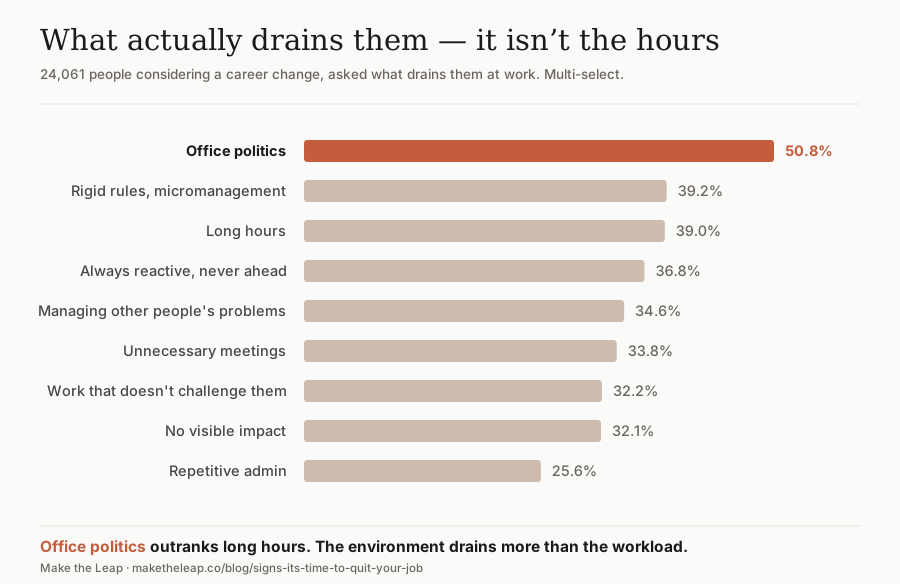
Office politics (50.8%) outranks long hours (39.0%). The environment drains more than the workload does. And 32.2% — nearly a third — are drained by work that doesn’t challenge them, which is the opposite complaint from burnout and almost as common.
This matters for the decision in front of you. If the hours were the problem, a lighter job in the same field would fix it. If the problem is the political weather, the absence of impact, or being bored by work you can already do — those travel with the career, not the calendar. That is the difference between needing a new job and needing a new direction.
Six Signs and You’re Still Here
You might have nodded through all six. And in six months, if nothing else changes, you’ll still be in the same chair reading the same kind of article.
The intro promised you something honest: why having every sign might still not get you to move. This is it.
The signs were never the bottleneck. You had them already. What stops you is quieter, older, and harder to name — something that fires every time you get close to acting on what you already know.
I spent three years in consulting with every sign I’m describing. I had the plan. I had the savings. Every Monday I drove to the same office. The pattern was making the decision. Not the knowledge I already had.
The data says the same thing in colder language. 24.1% of people at this point have already made an attempt that stalled — tried and it didn’t work, started and stopped, got partway. So the bottleneck is not knowledge, and it is not willingness either. Both have already been spent. Something survives the attempt.
Two other numbers sharpen it. 34.1% have no idea what they’d do instead, and 38.4% have no financial runway at all — not one month. That combination is why “just quit” is bad advice for most people reading this, and why the useful move is almost never the dramatic one.
Three of these patterns specifically trap the reader who knows they should quit. Security tells you what you’ve built is more fragile than it is. Timing dresses avoidance up as wisdom — after the bonus, after the reorg, after one more good quarter. Comfort keeps you still by keeping you from being miserable enough to move. I mean, I can’t complain. That isn’t a yes.
If one of those just landed a little too hard, that’s the one. The full guide to all nine is where this stops being theory — and why knowing what to do isn’t enough is the companion read on the gap between knowing and acting.
What You Actually Came Here For
You already knew. Somewhere between Sign 1 and Sign 6, whatever number of them landed, the thing you were looking for stopped being on the list.
You were looking for permission.
That’s the thing no article can hand you. And it’s the thing that’s been keeping you in the chair for months, maybe years, even though the signs have been there the whole time. Every one of them. Loud enough. Clear enough. Ready to be read.
The pattern is the gatekeeper. Until you can see yours — by name, in your own words — permission keeps arriving as a question you can’t quite answer.
Career Leap is built for this exact moment. It maps your real strengths, values, and constraints to three specific career directions — with income ranges, difficulty ratings, and a 30-day plan to get to the first one. It takes about ten minutes. Your own words, reflected back in a way that’s hard to unsee.
If you’re not sure the career is what needs to move yet — if the signs in this piece didn’t all land, or if something beneath the career is what’s actually stuck — the Make the Leap assessment surfaces your primary resistance pattern first. Start there if that’s the more honest place to start.
You already know what’s next. You came here looking for a sign. You brought one with you.
Frequently Asked Questions
How do you know when it’s time to quit your job?
The clearest signal is when the signs track the work itself, not the circumstances around it. A bad manager, a chaotic quarter, or a heavy workload can make any job feel wrong temporarily — those fixes arrive through a move or a recovery period. But when the misalignment follows you regardless of where you sit, who you report to, or how well things are going, the job has stopped fitting. Six specific signs of that kind are named in this piece. If four or more land, it’s time to stop waiting for the sign to get clearer. It already has.
How do I know if I should quit my job or change careers?
Picture yourself doing the same work — same industry, same daily substance — at a different company, with a different manager and team. If something in you unclenches, the job is the problem and a move will fix it. If the picture feels the same — same tightness, same flatness — the career itself is the misalignment, and no new employer will resolve it. The distinction is important because the wrong fix is expensive. A survey of 2,500 workers by The Muse found that 72% experienced surprise or regret in their new role, most often because they’d misread what they were leaving for.
Is it burnout or time to quit my job?
Burnout rests. A career that no longer fits doesn’t. If you take a two-week vacation, or even a three-month sabbatical, and come back to the same tightness, same dread, same quiet refusal in your body — the problem was never fatigue. It was fit. Burnout responds to recovery. A career-level misalignment doesn’t, because the thing wearing you down is the work itself, not the volume of it.
Should I quit my job before I have another one lined up?
Usually no. The resistance pattern calls this “being bold.” It’s more often a bridge you didn’t need to burn. Runway buys you one thing your pattern hates most: options. Most meaningful career changes happen alongside the current job — a course taken on weekends, a few freelance projects, five conversations with people doing the work you want to do next — not from a standing start with no income. The people who change careers well rarely feel ready. They also rarely start broke.
What if I regret quitting and making a career change?
Some people do. Usually not because they left, but because they left without seeing the pattern running underneath the decision. A quit driven by a specific toxic boss lands you in a similar dynamic at the next company. A career change made to escape burnout lands you in another high-intensity role because intensity has become your default. Seeing the pattern before you move is what separates the people who change careers once and settle from the people who keep changing and stay stuck. Career Leap was built for exactly this — to map your real strengths and constraints to specific directions before the pattern makes the decision for you.
What percentage of people are unhappy at work?
Across 24,061 people who took our career assessment between February to August 2026 — all of them actively considering a change — only 3.9% described their work as energising. 39.5% said burned out, 20.6% said going through the motions. On a separate measure, 82.8% enjoy half their working day or less, and the median person enjoys 40% of what they do. One honest limit: this is a self-selected group. People who seek out a career assessment are not a cross-section of all workers, so read these as a description of people already weighing a move, not a national unhappiness rate.
Is it normal to not know what to do next?
It is the majority position. Of 24,061 people at the point of considering a career change, 34.1% said they had no idea what they’d do instead, and another 31.3% had only a vague sense. Roughly two thirds cannot name the alternative. Not having a plan is therefore not evidence that you should stay — it is the ordinary starting condition. It is also why quitting outright fails so many people: 38.4% have no financial runway at all.
What is the number one thing that drains people at work?
Office politics, named by 50.8% of 24,061 people considering a career change — ahead of long hours at 39.0%. Rigid rules and micromanagement, being always reactive, and managing other people’s problems all rank high too. Notably, 32.2% are drained by work that doesn’t challenge them, which is the opposite complaint from overwork and nearly as common. If hours were the problem, a lighter job in the same field would fix it; political weather, absent impact and boredom travel with the career, not the calendar. Multi-select question, so shares do not sum to 100%.

Written by Jon Miksis - entrepreneur, retreat facilitator, and founder of Make the Leap. Jon has facilitated 6 immersive retreat experiences, attended 18 retreats across four continents, and spent 5+ years researching why smart, capable people stay stuck. He's traveled to 73 countries and invested over $120,000 in personal development. Guides on this site are built from Make the Leap's assessment data and reviewed by Jon; the methodology and its limits are published here.