February 17, 2026 · 14 min read
Why You're Stuck (And Can't Figure Out Why): 9 Hidden Patterns That Keep Smart People From Making a Change
Feeling stuck but can't explain why? You're not lazy or broken - you're running one of 9 resistance patterns. Here's how to identify yours and finally move forward.

You know what you need to do. You've known for months, maybe years. You've read the books, listened to the podcasts, journaled about it at 2am. And yet here you are. Still in the job. Still in the city. Still in the relationship. Still circling the same question you had eighteen months ago.
Maybe you're feeling stuck in your career and can't figure out why. Maybe you're afraid of change even though you know the change is overdue. Maybe you've googled “how to get unstuck” more times than you'd admit. Whatever brought you here - the answer isn't more motivation. It's seeing the pattern.
You're not lazy. You're not broken. You're not even afraid - at least, not in the way you think. You're running a resistance pattern. And it's so deeply embedded in how you see the world that you can't see it. Like asking a fish about water.
Research on resistance to change has been well-documented in psychology - what's less understood is how these patterns operate differently in high-performers who have the intelligence and resources to change but still don't. (I wrote about this from a different angle after traveling to 73 countries and seeing how other cultures handle change - read that here.)
After studying thousands of people at the edge of transformation, we've identified nine distinct resistance patterns. Everyone runs at least one — and almost nobody runs only one. Across 23,961 career assessments, the average person is named 3.6 of these patterns, and 79.7% carry three or more. Only 7.1% have a single one. Each tells a very specific lie that sounds exactly like the truth.
Which Pattern Is Actually in the Way
Before the nine, it is worth knowing which ones actually show up. These are not evenly distributed, and the ranking is not the one most people would guess.
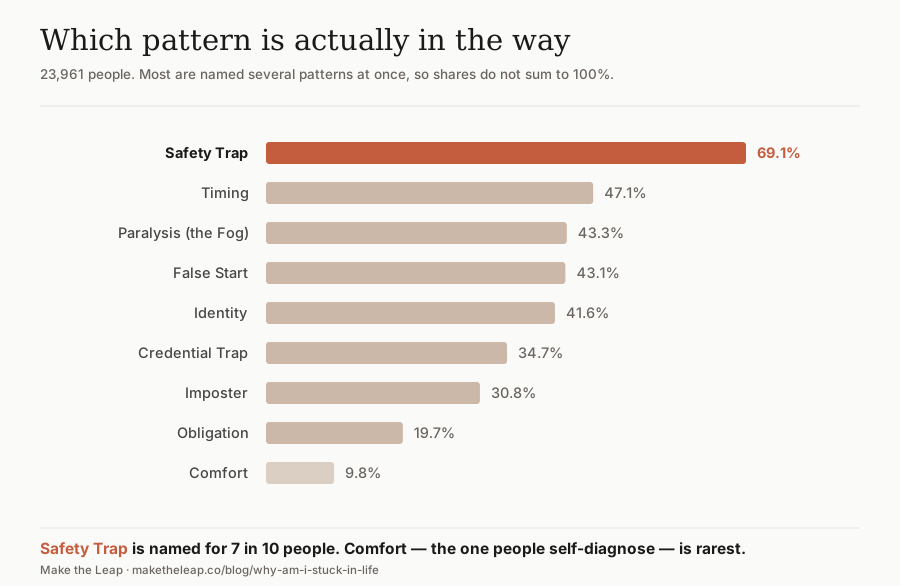
The Safety Trap is named for 69.1% of people — seven in ten. It is not close. Whatever you think is keeping you where you are, the most likely answer is that you have something worth protecting and no trustworthy way to weigh what protecting it costs.
And look at the bottom of that chart. Comfort is the rarest at 9.8% — roughly one person in ten. It is also the one people reach for first when they diagnose themselves. I’m just too comfortable. Almost always, that is a more flattering story than the real one, which is usually fear wearing a calmer outfit.
1. The Timing Pattern: “I'll Do It When the Time Is Right”
47.1% of 23,961 people are named this one.
“I'll do it when...” When the kids are older. When I have more savings. When the market settles. When I feel ready. The Timing Pattern is the most socially acceptable form of resistance because it sounds like wisdom. It sounds like patience. It sounds like being responsible.
But here's the lie: there is no ready. There is no perfect window. The conditions you're waiting for are a moving target because the pattern isn't actually about timing - it's about the terror of irreversibility. You're not waiting for the right moment. You're waiting for a guarantee that doesn't exist.
The tell: you've pushed back your timeline at least twice. Each new deadline felt just as reasonable as the last one.
We measured how long this waiting actually lasts. Across 22,252 career assessments, the most common answer to “how long have you been thinking about a change?” is one to two years (35.5%). 19.3% - one in five - have been thinking about it for five years or more, and 11.6% say they've wanted a change for as long as they can remember. We call that group the always cohort, and the full numbers are in the Career Change Deliberation Study. The Timing Pattern's favorite word is “when.” For one person in nine, “when” has been running their whole adult life.
I ran this pattern for three years before leaving consulting. Every quarter I had a new reason to wait. The reasons were always logical. They were never the real reason.
I've worked with a founder who had his business plan finished for two years. Updated it quarterly. Never launched. When we dug into it during a retreat, the plan wasn't the problem - it was his fear that launching meant he could no longer call it “promising.” The Make the Leap assessment would have shown him in ten minutes what took us two days to surface: his resistance wasn't about timing. It was about protecting an identity he'd built around potential.
2. The Safety Trap Pattern: “I Can't Risk What I've Built”
69.1% of 23,961 people are named this one.
“I can't risk what I have.” You've built something. Maybe it's a salary, a reputation, a lifestyle, a network. The Safety Trap Pattern convinces you that what you have is fragile, that any change could shatter it, and that starting over is too dangerous.
The lie: your current security is real. In most cases, the stability you're clinging to is far less stable than you think. Industries shift. Relationships built on inauthenticity erode. The body you're ignoring sends louder signals. The Safety Trap Pattern doesn't protect you from risk - it locks you into the specific risk of staying exactly where you are while the world changes around you.
The tell: you can articulate everything you'd lose, down to the dollar amount. But when asked what you'd gain, you go vague.
A woman I coached left a $180,000 consulting job that was slowly destroying her health. Within eight months she was earning more as an independent consultant, working half the hours. The security she thought she was protecting was actually costing her more than she realized. This is exactly the kind of pattern Career Leap is built for - it maps your real skills and constraints to directions you haven't considered, so leaving doesn't feel like jumping blind.
3. The Obligation Pattern: “Other People Need Me to Stay”
19.7% of 23,961 people are named this one.
“Other people need me to stay.” Your parents expect a certain career. Your partner is comfortable. Your team relies on you. Your kids need stability. The Obligation Pattern wraps your resistance in virtue - you're not stuck, you're selfless.
The lie: they need you to stay the same. In reality, the people who love you can feel your restlessness. Your kids are learning from your example. Your partner fell in love with the person you were becoming, not the one who stopped. The Obligation Pattern uses love as a cage, but real love doesn't require you to shrink.
The tell: you feel resentment toward the people you say you're staying for. And then guilt about the resentment.
This is one of the most common patterns I see at retreats. Someone breaks down on day two and admits they've been living for everyone else's expectations for a decade. The guilt is always the last thing to go.
4. The False Start Pattern: “What If I Try and It Doesn't Work?”
43.1% of 23,961 people are named this one.
“What if I try and it doesn't work?” This one hits the high performers hardest. You've built an identity around being good at things, around getting it right. The False Start Pattern tells you that a public attempt that fails would be worse than a private dream you never chase.
The lie: failure is permanent and identity-defining. But failure is data. Every founder, artist, and leader you admire has a graveyard of failed attempts they rarely talk about. The False Start Pattern isn't protecting your reputation - it's protecting a self-image that was never as solid as you thought.
The tell: you prepare obsessively but never launch. You have fourteen drafts of the plan. The plan for the plan.
One of the sharpest people I've met at a retreat had a notebook full of business ideas - each one researched, validated, and abandoned before launch. He didn't lack ability. He lacked permission to be bad at something new. His entire identity was built on competence, and a public failure felt like an identity collapse.
5. The Imposter Pattern: “Who Am I to Want More?”
30.8% of 23,961 people are named this one.
“Who am I to want more?” You should be grateful. Other people have it worse. You don't deserve to want something different when you already have so much. The Imposter Pattern is the quietest and often the deepest. It doesn't argue with your plan - it argues with your right to have one.
The lie: desire is entitlement. Wanting a different life doesn't mean you're ungrateful for this one. The ache you feel isn't greed - it's signal. It's the gap between where you are and where you're supposed to be. The Imposter Pattern turns that signal into shame.
The tell: you dismiss your own desires as ridiculous or selfish before anyone else gets the chance to.
I've watched people who built million-dollar businesses sit in a room and say they don't deserve to want more. Imposter is the pattern that doesn't care about your resume.
6. The Comfort Pattern: “Things Aren't Bad Enough to Change”
9.8% of 23,961 people are named this one.
You're not miserable. That's the problem. You're fine. Your job is fine. Your relationship is fine. Your life is fine. Nothing is on fire. Nothing demands immediate action. And so you stay.
The Comfort Pattern is the hardest to identify because it doesn't feel like resistance. It feels like contentment. But there's a difference between being at peace and being numb, and the Comfort Pattern lives in that gap. You're not choosing to stay because this life is right. You're staying because leaving requires a level of discomfort that nothing in your current life is forcing you to face.
The lie: if it's not broken, don't fix it. But “not broken” isn't the same as alive. The slow erosion - the glass of wine that becomes three, the weekends that blur together, the moments with your kids you're physically present for but emotionally absent from - that's not stability. That's decay in a comfortable chair.
The tell: someone asks if you're happy and you say “I mean, I can't complain.” That's not a yes.
At one retreat in Sweden, a man told me his life was “fine” for twenty minutes before he started crying. Fine is the most dangerous word in personal development.
The Make the Leap assessment is particularly effective for this pattern because it uses your own words to show you the gap between “fine” and alive. Most people running the Comfort Pattern don't think they need help - until they see their answers reflected back to them in a way they can't dismiss.
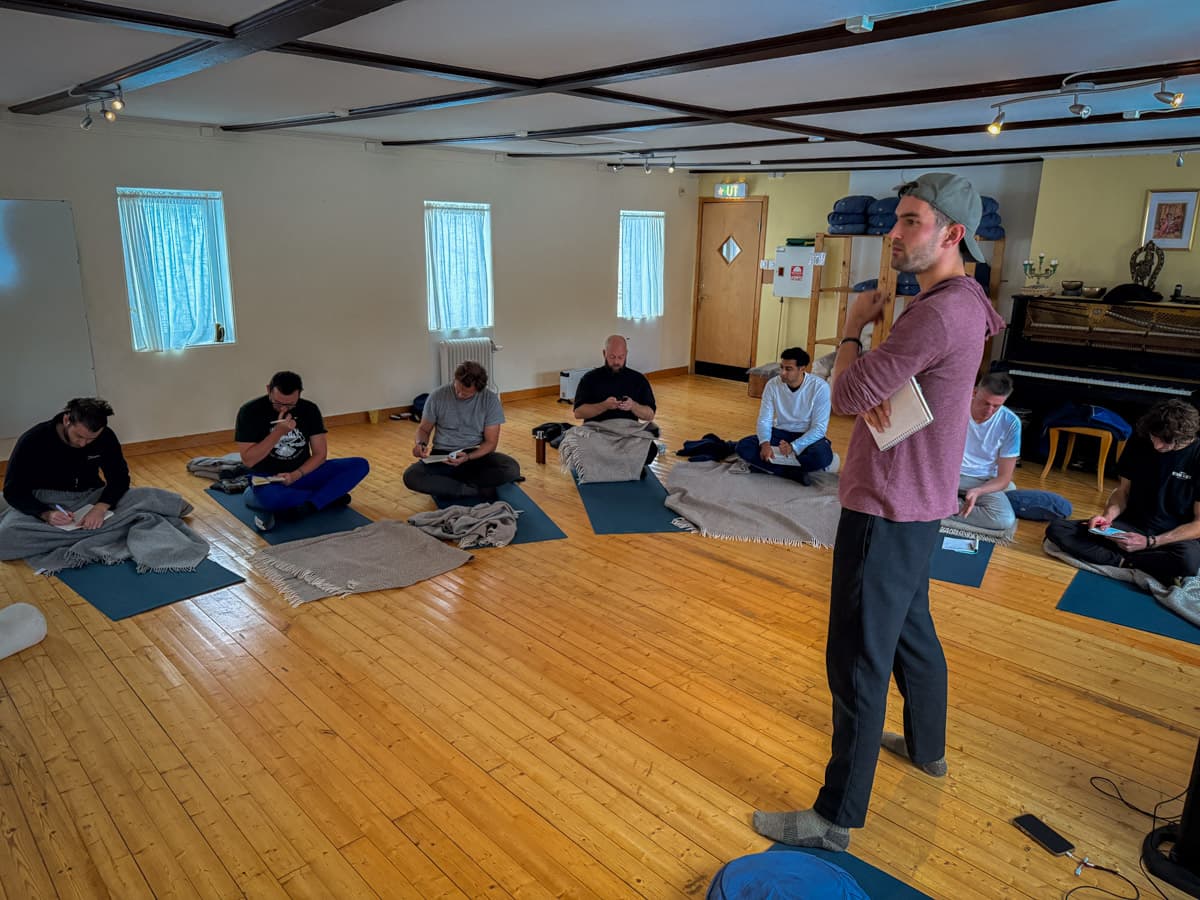
Working through resistance patterns at a men's retreat in Sweden
7. The Fog: “I Don't Even Know What I Want”
43.3% of 23,961 people are named this one.
You're not avoiding the decision. You genuinely can't see it. Everything feels equally possible and equally impossible. You could do anything - which means you do nothing. The Fog is resistance disguised as confusion.
The lie: you need more clarity before you can act. But clarity doesn't come from thinking harder. It comes from moving. The Fog keeps you researching, weighing options, taking personality tests, reading one more book - anything that feels like progress without requiring commitment.
The tell: you can list fifteen things you might want to do. But you can't commit to one for more than a week before the doubt creeps back in.
I've watched people spend years in the Fog, convinced their problem is that they haven't found the right answer yet. The problem was never the answer. It was their unwillingness to be wrong. Read the full breakdown of the Fog.
8. The Credential Trap: “I Need One More Certification”
34.7% of 23,961 people are named this one.
One more degree. One more certification. One more course. You're not procrastinating - you're preparing. Except you've been preparing for years and you're no closer to starting.
The Credential Trap is the Fog's ambitious cousin. Where the Fog freezes, the Credential Trap moves - just in the wrong direction. Every new qualification feels like progress. But it's actually a sophisticated delay tactic dressed up as self-improvement.
The lie: you're not qualified enough yet. But qualifications are what you show people who don't know you. The people who'd actually hire or buy from you care about what you can do, not what's on your wall.
The tell: you have more certifications than clients. If this pattern sounds familiar, here's the deep dive.
9. The Identity Pattern: “This Is Just Who I Am”
41.6% of 23,961 people are named this one.
I'm just not a relationship person. I'm just a workaholic. I'm just independent. I'm just not creative. The Identity Pattern is the moment resistance stops being something you do and becomes something you are. You've told the story so many times it has replaced the truth.
The Identity Pattern is particularly stubborn because it doesn't feel like a pattern at all. It feels like self-knowledge. But there's a difference between knowing yourself and having decided yourself, and the Identity Pattern lives in that gap. At some point you confused a coping mechanism with a character trait, and now the cage looks like a mirror.
The lie: people don't change. But you've already changed dozens of times. You're not the same person you were at 15, or 22, or last year. The identity you're protecting isn't fixed - it's a snapshot you've chosen to frame. And it's costing you everything that doesn't fit inside the frame.
The tell: someone suggests you might be different than you think and you feel physically defensive. Not curious. Defensive.
I met a man in Iceland who introduced himself as “not a creative person” and then spent the week writing the most moving journal entries I've ever read. The identity he was protecting had nothing to do with who he actually was. It had everything to do with who he'd been told to be at 14.
When the Patterns Stack
This is the norm, not the exception, and the data is emphatic about it: 79.7% of people are named three or more patterns, and the average is 3.6. Only 7.1% run a single one. If you read the nine above and recognised yourself four times, that was not you being indecisive. That is the ordinary result.
There's one more thing worth naming: what happens when multiple patterns stack on top of each other. When Timing meets Safety Trap meets Imposter, you don't just feel stuck - you feel frozen. You can't even identify what's holding you back anymore. Not because you can't decide, but because every option feels equally impossible. If this is you, you don't need more information. You need someone to help you see the water.
One stacking pattern I see constantly: Busyness. It's not its own resistance pattern - it's how other patterns hide. You start three side projects so you never have to sit with the Fog. You optimize your morning routine so you can ignore the Comfort Pattern. You build a packed calendar so nobody (including you) can suggest you're stuck. Movement is progress, right? Not when velocity has no direction. I built three businesses partly because I loved building - and partly because building meant I never had to stop and ask what I was building for.
If you're wondering why you can see your pattern but still can't act on it, read Why You Can't Take Action (Even When You Know Exactly What To Do) - it explains the gap between knowing and doing that most people never address.
And if you want to see how the tools in this space compare before you take anything, we mapped them against each other in the best life assessments and life-purpose quizzes - including our own data on what people are actually stuck on, which turns out not to be work about half the time.
The 9 Resistance Patterns at a Glance
- 1Timing - “I'll do it when the time is right”
- 2The Safety Trap - “I can't risk what I've built”
- 3Obligation - “Other people need me to stay”
- 4The False Start - “What if I try and it doesn't work?”
- 5Imposter - “Who am I to want more?”
- 6Comfort - “Things aren't bad enough to change”
- 7The Fog - “I don't even know what I want”
- 8The Credential Trap - “I need one more certification”
- 9Identity - “This is just who I am”
Frequently Asked Questions
What is a resistance pattern?
A resistance pattern is the specific, usually invisible way you avoid making a change you know you need to make. Unlike personality types, resistance patterns describe behavior - the mechanics of how you stay stuck, not who you are.
Why do smart people stay stuck?
Intelligence often makes resistance worse, not better. Smart people are better at rationalizing their patterns - they build more convincing arguments for why now isn't the right time, why the risk is too high, or why they should wait. The pattern sounds like logic.
How long do people stay stuck before making a change?
Longer than almost anyone admits. Across 22,252 career assessments, 94.9% of people deliberated for months or years before acting - most commonly one to two years - and 11.6% said they'd wanted a change for as long as they can remember.
How do I find out my resistance pattern?
The Make the Leap assessment identifies your primary resistance pattern in about 10 minutes. It uses your own words to surface the specific way you've been avoiding change - and gives you a concrete first step.
Can you have more than one resistance pattern?
Yes, and it is overwhelmingly the norm. Across 23,961 career assessments the average person is named 3.6 of the nine patterns, 79.7% are named three or more, and only 7.1% run a single one. When several stack it can feel like total paralysis — you can't even name what's wrong any more. Recognising yourself in four of the nine is not indecision; it is the ordinary result.
Which resistance pattern is the most common?
The Safety Trap, named for 69.1% of 23,961 people — roughly seven in ten, and far ahead of everything else. Then Timing (47.1%), Paralysis or “the Fog” (43.3%), False Start (43.1%), Identity (41.6%), the Credential Trap (34.7%), Imposter (30.8%) and Obligation (19.7%). Comfort is the rarest at 9.8%, which is notable because it is the pattern people most often reach for when diagnosing themselves. Shares do not sum to 100% because most people are named more than one.
What Now?
Naming your pattern is the first step, but it's only the first step. The pattern doesn't dissolve just because you can see it - it shifts, adapts, finds new arguments. What changes things is understanding how your specific pattern operates in your specific life, with your specific fears and your specific dreams.
That's what the Make the Leap assessment is built for. In 10 minutes, it identifies your primary resistance pattern, shows you how it's been operating below the surface, and gives you a personalized path forward.
Not generic advice. Not a motivational quote. A mirror - and a map.
If your resistance pattern is showing up in your career - if you're stuck in the wrong job, avoiding a pivot, or circling a change you can't make - take the Career Leap assessment. It's a 30-question deep dive that maps your skills, values, and constraints to specific career paths with a 30-day plan to get there.

Written by Jon Miksis - entrepreneur, retreat facilitator, and founder of Make the Leap. Jon has facilitated 6 immersive retreat experiences, attended 18 retreats across four continents, and spent 5+ years researching why smart, capable people stay stuck. He's traveled to 73 countries and invested over $120,000 in personal development. Guides on this site are built from Make the Leap's assessment data and reviewed by Jon; the methodology and its limits are published here.