October 28, 2026 · 12 min read
AI Career Coach vs. Human Career Coach (2026): Cost, Limits & What Works
You do not need the most elaborate coaching package to make every career decision. You need help with the part you cannot resolve alone. That might be comparing two paths against your income needs, practicing a promotion conversation, or facing a pattern you keep explaining away.
AI is useful for accessible, repeatable thinking and preparation. A good human coach adds a relationship, observation and judgment you can test over time. The useful comparison is what each will do with your situation, not which can produce the longest plan.
Disclosure: we build Make the Leap, including an AI career coach. This comparison uses public provider pages and our product implementation checked October 28, 2026. We did not purchase the human services below or run a head-to-head outcomes study.
Need a clearer starting point before choosing support? Our 30-question assessment brings together your experience, priorities and constraints.
Explore my next career directionThree named paths free with your name and email. No card. Paid reports are optional.
Which support should you choose?
- You know the problem and need preparation
- Start with DIY AI and a written brief. Use it to organize evidence, compare options or rehearse a conversation. Check factual claims before acting.
- You cannot turn your experience into a direction
- An assessment-backed tool can provide a structured starting point. Inspect an example before paying: named paths alone are less useful than reasons, constraints and a testable next step.
- You keep circling a difficult decision or need live challenge
- Interview a human coach with relevant experience. Ask how they would examine the decision and what evidence you would produce together. A useful session may complement AI preparation.
Why the income constraint belongs in the brief
In our frozen study of 13,383 completed career assessments, 71.4% (6,327 of 8,856) in the group reporting 15+ years of experience named financial risk as a blocker to career change. In that same experience group, 65.3% (5,787 of 8,856) said they would start something on the side first. A useful coaching conversation should establish what you can risk before recommending a leap.
Source: existing published assessment snapshot, 2026-07-01 to 2026-09-30, Eastern Time. This is a self-selected career-change cohort, counted per assessment; retakers can appear more than once. Experience is not age. These are stated constraints and willingness, not coaching results or subsequent career moves. Study questions and methodology.
Compare the work, not just the cost
Generic AI chat and a structured AI coach are different starting points. Both still depend on the information available to them. Human coaches also vary in preparation, experience and the amount of support their fee buys.
| Need | Generic AI chat | Make the Leap AI coach | Human career coach |
|---|---|---|---|
| Cost | Free and paid plans; limits vary by product. | Limited free preview; 30 days included in the $79 Roadmap. | Session or package fees; named examples below. |
| Context | You supply your background. Memory and project features depend on settings and product. | Selected assessment context, paths, available report highlights and conversation summaries. | Intake, discussion and notes; ask how they prepare and maintain continuity. |
| Challenge and blind spots | Can critique a plan if asked; may accept a mistaken premise or miss an omission. | Can compare your question with stated patterns and constraints; can still misread you. | Can question inconsistencies and respond to tone or hesitation. Quality and fit matter. |
| Constraints | Needs your income floor, time, location and responsibilities stated clearly. | Starts with relevant assessment inputs; update it when circumstances change. | Can explore competing priorities with you; should make assumptions explicit. |
| Accountability | Helps review progress when you return; reminders depend on the tool. | Discuss next steps and setbacks when you use the coach. This is not a promise of automatic check-in messages. | Scheduled meetings and agreed follow-up can create a commitment to another person. |
One career decision, three ways to work on it
Illustrative editorial walkthrough: Maya is a fictional hospital operations professional with 15 years of experience. She needs a $95,000 annual income floor and more predictable hours. She is comparing an employed process-improvement role with independent consulting. The approaches below are our explanation of how to investigate that decision, not transcripts or outputs from a live AI-versus-human test.
1. DIY AI: turn the question into an evidence plan
Supply the same experience, income floor and hours constraint. Ask for a comparison of employee process-improvement work and consulting, separating known facts from assumptions.
Useful work: a list of missing inputs: advertised pay, normal meeting hours, travel, required credentials, and how consulting income would cover expenses and gaps between projects.
Evidence still needed: current employer postings and conversations with people doing both kinds of work. A plausible AI salary range or an invented client pipeline cannot establish that either option meets Maya's floor.
2. Assessment-backed AI: inspect why a path was suggested
Start from the relevant assessment context and suggested paths. Ask which parts of Maya's operations background carry over, which constraints shaped the suggestion, and what would disqualify it.
Useful work: a concrete first investigation, such as the job-posting exercise in the demo below, then a discussion of what the evidence changes.
Evidence still needed: whether the actual roles meet pay and hours needs. An assessment recommendation is a starting hypothesis, not an offer, verified pay quote or proof of demand for consulting.
3. Human coach: examine the difficult trade-off
Bring the same brief and the findings from postings. A useful session could examine whether Maya wants consulting itself or primarily wants relief from unpredictable hours, and challenge what she is assuming about independence.
Useful work to agree in advance: a decision rule, the assumptions to test and one manageable experiment. Ask how the coach's experience relates to hospital operations or independent client work.
Evidence still needed: real employer expectations and potential client conversations. A coach's confidence cannot substitute for either.
Compare the quality of the questions and the next investigation, rather than how reassuring the answer sounds. Maya can keep her current job while testing both routes; the example does not establish that either route will provide her required income or hours.
What a concrete first step looks like in our Roadmap
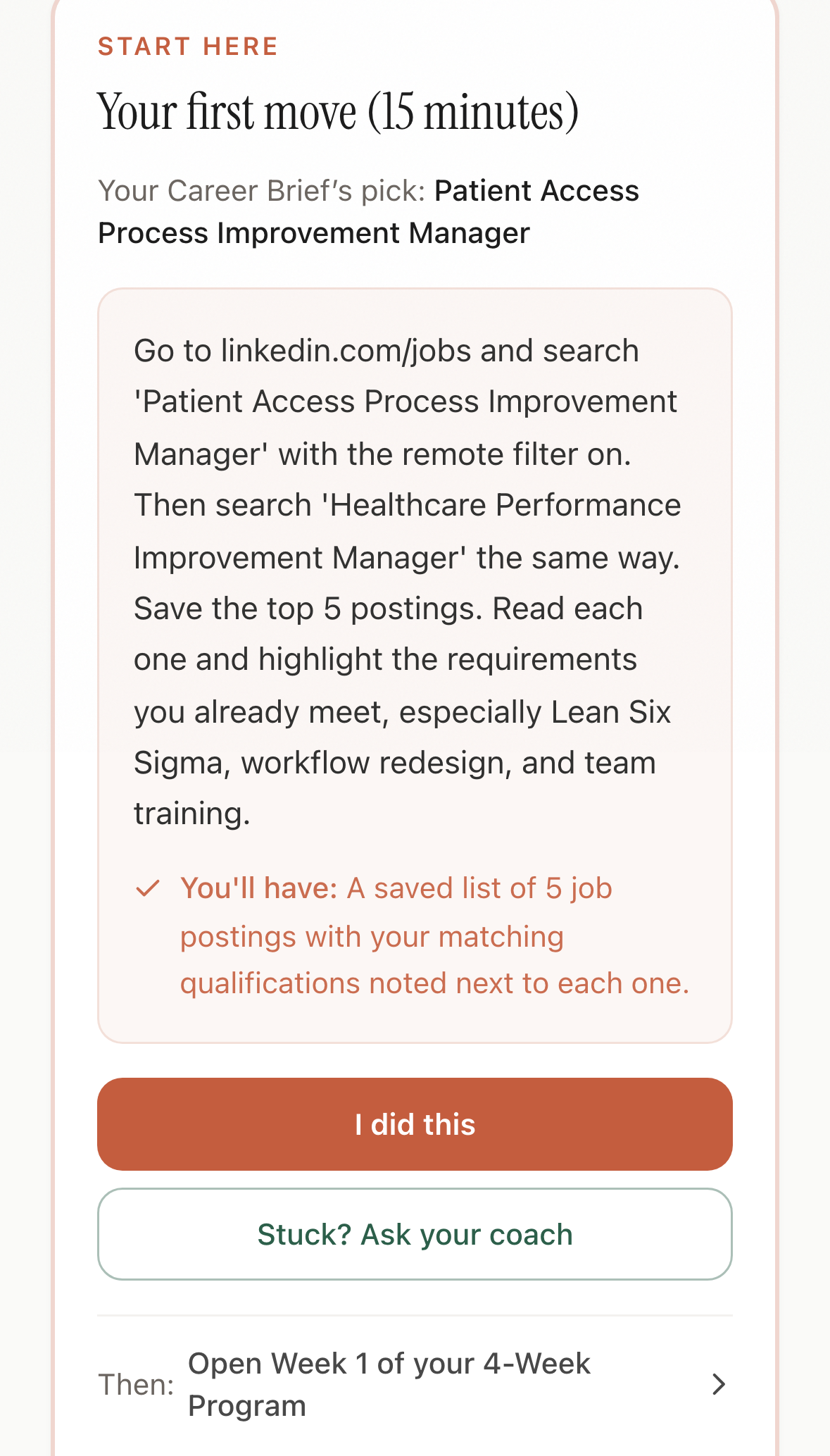
Our public Maya demo turns one possible direction into a small evidence-gathering task: search two process-improvement job titles, save five postings and highlight matching requirements. The screenshot shows a program step and an Ask coach button; it does not show the coach answering or a career outcome.
Open the fictional Maya Roadmap screenshot
- For each saved posting, record the published pay range, location, hours expectations and requirements. Mark anything the posting does not disclose as unknown.
- Highlight requirements Maya can support with examples from her hospital work; list the gaps separately. A matching keyword is not evidence of experience.
- Keep employee salary separate from consulting revenue. For consulting, investigate client demand, unpaid sales time, expenses and benefits before comparing it with the $95,000 employee income floor.
- Bring the findings back to whichever support you chose. Ask which option still fits and which single unanswered question could change the decision.
Human coaching prices: three concrete examples
A session price without its duration and follow-up tells you little. On the public pages checked October 28, 2026, the following services were advertised in US dollars:
- Life Work Balance lists a general career session at $150 for 45 minutes. Its single-session offer excludes additional follow-up support.
- The same provider lists $550 for four weekly 45-minute sessions with email coaching during the month. That is three hours of calls plus the stated between-session support.
- PRF Coaching lists $200 per month for one session, typically 60 minutes, including email and text support.
These examples show different ways to buy help. They do not establish a market average or which coach will work for you. Confirm the total fee, cancellation terms, availability, session length and actual follow-up before booking. A one-off conversation and an ongoing coaching relationship should not be compared as though they deliver the same thing.
What generic AI chat can do well
Bring a clear brief: what you do now, the decision you face, the income you need, what you cannot change and what you have already tried. Ask it to separate facts from assumptions, identify the missing evidence and compare options. Keep a short summary you can correct and reuse.
You can also rehearse a conversation or ask for the strongest objection to a plan. A useful answer should expose a trade-off: for example, whether an attractive role requires a pay cut you cannot absorb. Agreement alone is not evidence that the plan works. Check important claims about employers, credentials and compensation with their original sources.
Context limits are conditional. Some products can retain selected information or work from saved documents; a fresh or temporary conversation may have much less. Check what the tool actually has available. Our AI prompts for career change guide provides five workflows you can use without buying our product.
A background brief you can reuse with AI or a human
Copy these headings into a note. Use your own facts, label estimates and omit confidential employer or client information.
- Decision and deadline
- What am I choosing between, and when must I decide? What happens if I wait?
- Experience I can demonstrate
- My current responsibilities, relevant results and examples of work I want more or less of.
- Constraints
- Minimum acceptable compensation, benefits, weekly hours, location, caring responsibilities and available runway. Separate essentials from preferences.
- Options and evidence
- What I have already tried; postings, conversations or projects that support each option; what remains unknown.
- The help I want
- Challenge my assumptions, identify the most important missing evidence, and help choose one next investigation. Do not fill unknowns with reassuring guesses.
Where a human coach can earn the fee
Consider a human when the obstacle is difficult feedback, a repeated failure to act, or an organizational situation you cannot interpret alone. A coach who knows your field may help you test a promotion story against how decisions actually get made. Ask for relevant experience; a coaching credential alone does not establish knowledge of your employer or industry.
Before committing, ask how they would work on your specific decision, what they need from you, and what a useful first month would produce. Ask how they challenge a client and what happens between sessions. A strong fit is someone who can explain the work and its limits, not promise the outcome.
You can combine the two. Prepare your evidence and questions with AI, use a human session for the difficult judgment, then use AI to turn the agreed next step into a draft or rehearsal. Keep ownership of the decision and avoid uploading confidential workplace material.
Questions to ask before paying a human coach
- How would you work on my specific decision, and what would we produce in the first session?
- What relevant experience do you have with my target roles or industry? Where would we need an outside specialist?
- How do you challenge a plan you disagree with? How will we distinguish my assumptions from evidence?
- What preparation and between-session contact are included? How will we review whether the work is helping?
- What is the total commitment, cancellation policy and confidentiality arrangement, including use of recordings or AI tools?
An informative answer names a process and its limits. A promise that you will get the role, or a sales conversation that avoids your constraints, gives you little basis for judging the service.
What Make the Leap actually adds
Our AI career coach starts from selected information from your assessment: your Work DNA and resistance patterns, skills insight, income and runway inputs, and suggested career paths. Available clarifying answers, path feedback, report highlights and earlier conversation summaries can also inform the response. You do not have to construct that starting brief from scratch.
That is a context advantage, not proof that every answer will be better. It cannot see a conversation you did not describe, independently know your manager's motives or guarantee that a suggested path meets your income floor. Correct it when it misses something and test suggestions against real work and current opportunities.
The free 30-question assessment returns three named career paths after you provide your name and email. The optional $29 Career Brief develops the path comparisons. The $79 Career Roadmap includes the Brief, a practical program and 30 days of AI coaching. These are different offers; the Brief is not the Roadmap coaching package. Check the coach page for ongoing access terms.
If your decision is a new direction, start with Career Leap. If you want to advance in a field you still want to be in, Leap Up focuses on your current role, target role and the gap between them.
Frequently asked questions
Can an AI career coach replace a human coach?
For organizing your situation, comparing options and rehearsing a conversation, AI may provide enough help. A human coach can be more useful when you need a continuing relationship, difficult feedback or help interpreting organizational dynamics. Neither can guarantee a job, promotion or salary. Choose around the decision and support you need.
How much does human career coaching cost?
Prices depend on the provider, session length and support included. Public pages checked October 28, 2026 list Life Work Balance at $150 for one 45-minute career session or $550 for four sessions plus email support. PRF Coaching lists $200 per month for one typically 60-minute session plus email and text support. These are named examples, not a market average or endorsements.
Does an AI coach remember my career situation?
It depends on the product, settings and available conversation context. Generic chat can use a background brief and may have memory or project features. Make the Leap's career coach starts with selected assessment context and career paths, plus available report highlights and conversation summaries. Correct missing or outdated details; neither system is a perfect record of your life.
Is Make the Leap's AI career coach free?
The 30-question career assessment and three named career paths are free with your name and email; no card is needed. There is a limited coach preview on the results page. The optional $79 Career Roadmap includes 30 days of AI coaching. The $29 Career Brief is a separate report option, not the same coaching package. See the coach page for current ongoing access terms.
Start with the decision you need to make. Choose support once you know where you are stuck.
Take the free career assessment
Written by Jon Miksis - entrepreneur, retreat facilitator, and founder of Make the Leap. Jon has facilitated 6 immersive retreat experiences, attended 18 retreats across four continents, and spent 5+ years researching why smart, capable people stay stuck. He's traveled to 73 countries and invested over $120,000 in personal development. Public provider pricing and our product implementation checked October 28, 2026. This is an editorial comparison, not a paid-service test or comparative outcomes study. Make the Leap is our product.